Titanium Cutting Board: Benefits, Pros, Cons & Buying Guide (2026)
Last updated: July 29, 2026
Quick Answer: A titanium cutting board is a food-grade kitchen surface made from pure or high-grade titanium metal. It is non-porous, antibacterial, non-reactive with food, and far more durable than plastic or wood alternatives. The Katori Titanium Cutting Board is one of the most-discussed models in 2026, priced between $89 and $179, and is best suited for health-conscious home cooks and professional chefs who want a long-term, hygienic prep surface.
Key Takeaways
- A titanium cutting board uses food-grade titanium to create a non-porous, bacteria-resistant prep surface that outlasts wood and plastic boards.
- Titanium is biocompatible (used in surgical implants), making it one of the safest materials for food contact.
- Unlike glass or ceramic boards, titanium is gentler on knife edges than most people expect, though it is harder than wood.
- The Katori Titanium Cutting Board costs between $89 and $179 and is positioned as a “buy once, use forever” kitchen investment.
- Real user feedback rates the Katori board at approximately 4.7 out of 5 stars, with the main complaints being the upfront price and a metallic chopping sound.
- Titanium boards outperform plastic on hygiene and durability, and outperform wood on maintenance and food safety.
- The biggest mistake buyers make is using steel wool or abrasive scrubbers, which can scratch the surface finish.
- Only buy from official or authorized sources to avoid counterfeit boards that use inferior metal alloys.
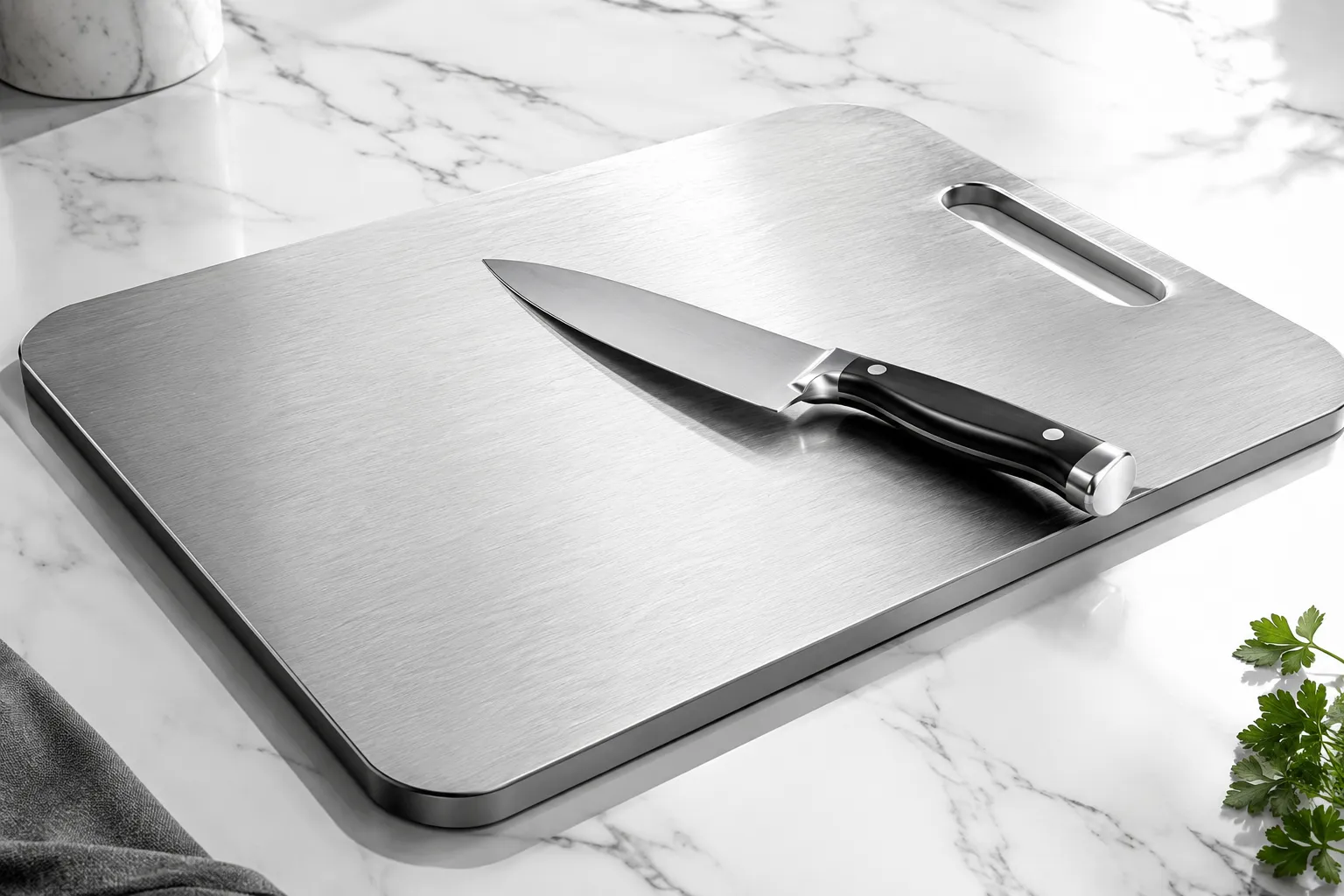
What Is a Titanium Cutting Board and How Does It Work
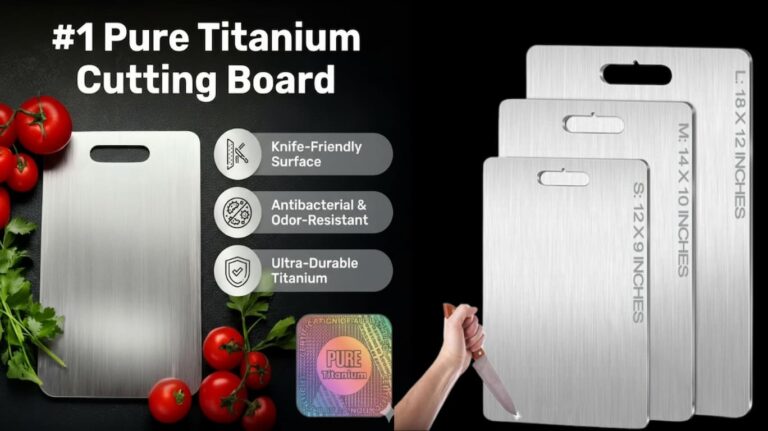
A titanium cutting board is a flat kitchen prep surface manufactured from food-grade titanium, typically Grade 1 (commercially pure) or Grade 2 titanium. The metal is formed into a thin, rigid slab, usually around 2 mm thick, with a matte brushed finish that reduces glare and provides light grip for food.
The board works by offering a non-porous surface. Unlike wood, which has natural grain channels, or plastic, which develops micro-grooves from knife cuts, titanium does not absorb liquids or harbor bacteria in surface crevices. When you cut on it, the blade contacts a smooth, inert metal surface that resists staining, odor absorption, and microbial growth.
How the material properties translate to kitchen use:
- Non-porous surface: No channels for bacteria, mold, or food particles to settle into.
- Inert chemistry: Titanium does not react with acidic foods like citrus, tomatoes, or vinegar.
- Thermal stability: The board does not warp from heat or cold, so you can briefly rest a hot pan on it.
- Biocompatibility: The same grade of titanium used in surgical implants and dental hardware means zero metal leaching into food.
The Katori Titanium Cutting Board specifically advertises a 100% pure titanium surface with rounded safety edges and an optional non-slip silicone backing. For a detailed breakdown of user experiences with this specific model, see the Katori Titanium Cutting Board reviews and complaints compiled from verified buyers.
Titanium vs. Wooden Cutting Boards: Which Is Better
For most home cooks, titanium wins on hygiene and long-term maintenance, but wood wins on aesthetics and knife feel. The right choice depends on your priorities.
Wooden boards, especially end-grain hardwood like maple or walnut, have natural antimicrobial properties from tannins, and they are gentler on knife edges because the wood fibers compress slightly under the blade. However, wood requires regular oiling, cannot go in the dishwasher, and develops deep grooves over time that trap bacteria.
Titanium boards require almost no maintenance, are fully dishwasher-safe, and never develop the kind of deep grooves that become bacterial breeding grounds. The tradeoff is that titanium is harder than wood, so knives may experience slightly more edge wear over time compared to a well-maintained end-grain wooden board.
Side-by-side comparison:
| Factor | Titanium | Wood (Hardwood) |
|---|---|---|
| Bacteria resistance | Excellent (non-porous) | Good (natural tannins, but grooves develop) |
| Knife edge wear | Moderate | Low (end-grain) |
| Maintenance required | Minimal | High (oiling, hand-washing) |
| Dishwasher-safe | Yes | No |
| Odor absorption | None | Moderate |
| Lifespan | Decades | 5-15 years with care |
| Warping risk | None | Moderate to high |
Choose titanium if you prioritize hygiene, cook raw meat frequently, or want a zero-maintenance board. Choose wood if you prefer a traditional feel, want the softest possible surface for your knives, and are willing to maintain the board regularly.
Are Titanium Cutting Boards Safe for Food
Yes, titanium cutting boards are among the safest food prep surfaces available. Titanium is classified as biocompatible, meaning it does not react with human tissue or food compounds, and it is the same material used in surgical implants, bone screws, and dental fixtures.
From a food safety standpoint, three properties matter most:
- Non-reactive: Titanium does not leach metals into food, even when cutting acidic ingredients like citrus, tomatoes, or fermented foods. This is a meaningful advantage over some lower-grade stainless steel boards, which can impart a metallic taste to food over time.
- Non-porous: The surface has no microscopic channels where bacteria like Salmonella or E. coli can hide after washing.
- Chemical resistance: Standard kitchen cleaners, vinegar solutions, and even diluted bleach do not degrade the surface.
One consideration worth noting: titanium boards are not certified by the FDA as a food contact material in the same way that plastics receive NSF ratings, because titanium is not commonly regulated as a food surface material (it is so inert that it rarely raises concerns). When buying, look for boards that specify Grade 1 or Grade 2 titanium, which are the commercially pure grades with the highest biocompatibility.
Can you cut raw meat on a titanium cutting board? Yes, and this is actually one of its strongest use cases. The non-porous surface means raw meat juices do not soak in, and the board can be sanitized with boiling water, alcohol, or a standard dishwasher cycle without degrading the material.
Titanium Cutting Board Price: How Much Do They Cost
Titanium cutting boards range from approximately $89 to $179 for consumer-grade models, with professional or oversized slabs reaching $200 or more. The Katori Titanium Cutting Board sits in the mid-premium range at $89 to $149 depending on size and bundle.
That price point is significantly higher than plastic boards ($10-$40) and competitive hardwood boards ($50-$120). However, the cost-per-use calculation shifts dramatically over time. A titanium board that lasts 20 or more years at $149 works out to roughly $7.50 per year, which is cheaper than replacing a plastic board every two to three years.
Price breakdown by category:
- Budget plastic boards: $10-$40 (replace every 2-4 years)
- Quality hardwood boards: $50-$120 (replace every 5-15 years with proper care)
- Titanium cutting boards (standard): $89-$149
- Titanium cutting boards (large/professional): $150-$250+
Pro tip: The Katori brand occasionally runs “Buy 2 Get 1 Free” promotions through their official website. If you are buying for a household with multiple prep stations or as a gift, these bundles significantly improve the value proposition.
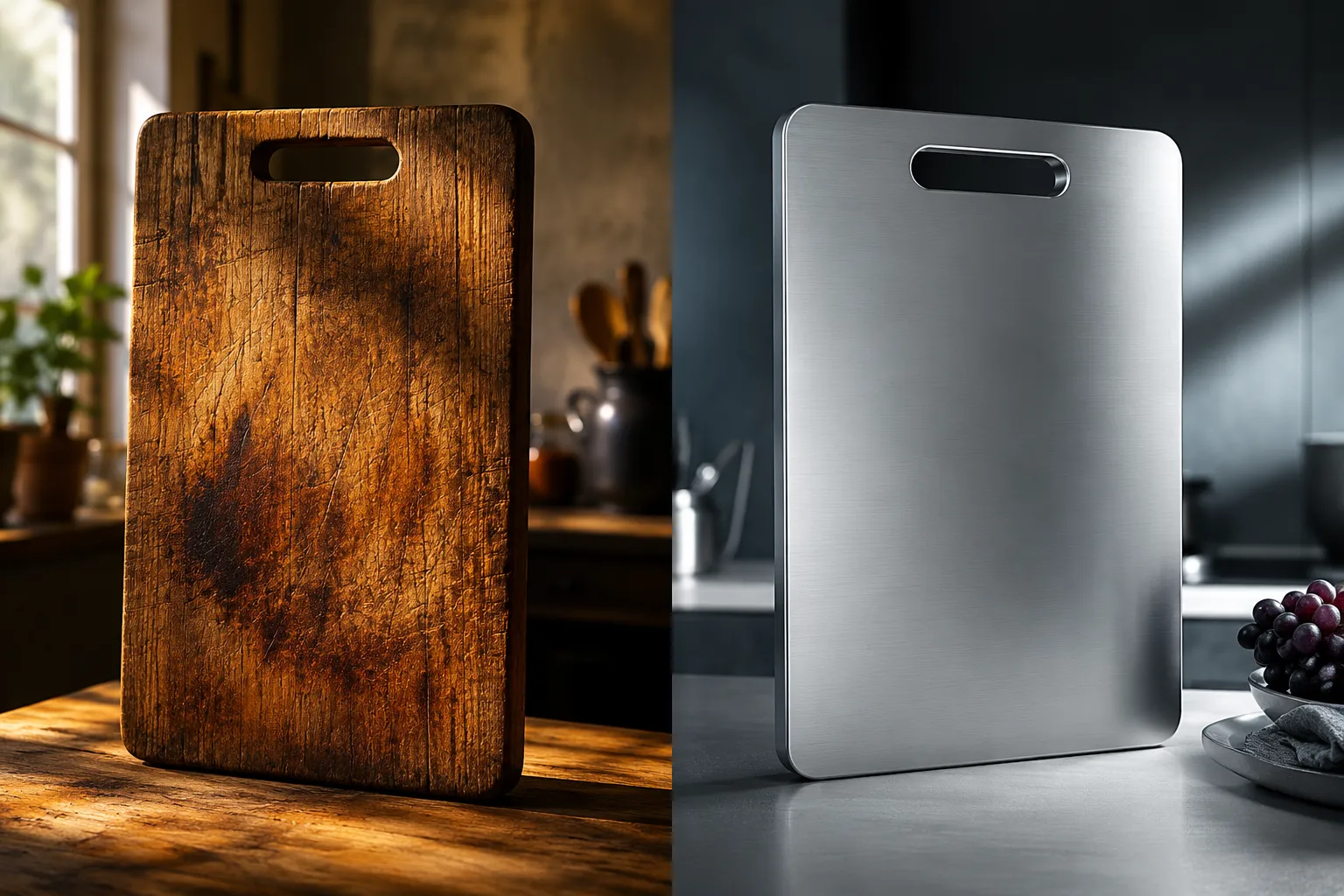
Titanium Cutting Board Pros and Cons
The titanium cutting board is a strong performer in most kitchen scenarios, but it is not perfect for everyone. Here is an honest breakdown.
Pros:
- Non-porous surface prevents bacteria, mold, and odor absorption
- Dishwasher-safe with no warping, cracking, or swelling
- Non-reactive with acidic, salty, or fermented foods
- Rustproof and corrosion-resistant
- Extremely durable, no cracking or deep grooves over time
- Lightweight relative to its strength (roughly 40% lighter than equivalent steel)
- Can handle brief contact with hot cookware
- Long-term cost-effective despite high upfront price
Cons:
- Premium upfront price ($89-$179) is a barrier for budget buyers
- Harder surface than wood means slightly more knife edge wear over time
- Produces a noticeable metallic sound when chopping, which some users find jarring
- Can be slippery on smooth countertops without a non-slip mat underneath
- Limited aesthetic variety compared to wood or bamboo boards
- Primarily sold through official channels, limiting in-store availability
Common mistake: Many buyers skip the non-slip silicone mat, then complain the board slides during use. This is an easy fix, a $5-$10 silicone mat or damp kitchen towel placed underneath solves the problem entirely.
Do Titanium Cutting Boards Dull Knives
Titanium cutting boards are harder than wood and bamboo, but they are not as damaging to knife edges as glass or ceramic boards. The short answer is: a titanium board will cause more edge wear than a soft end-grain wood board, but significantly less than glass, and comparable to or better than most plastic boards over time.
Here is why this matters: knife edge wear is primarily caused by the hardness differential between the blade and the cutting surface. Glass and ceramic boards (Mohs hardness 5.5-7) are harder than most knife steel, which is why they are notorious for dulling blades rapidly. Titanium (Mohs hardness approximately 6) sits in a similar range to glass, which raises a legitimate concern.
However, in real-world kitchen use, the finish of the titanium surface matters as much as raw hardness. The matte brushed finish on boards like the Katori creates micro-texture that cushions the blade contact slightly, unlike the perfectly flat, unforgiving surface of a glass board. Most users who switch from plastic to titanium report no meaningful increase in how often they need to sharpen their knives.
Decision rule: If you use expensive Japanese knives with very thin, hard edges (like VG-10 or ZDP-189 steel), you may want to use a wood board for those specific blades and reserve the titanium board for general prep work. For German-style knives with thicker, more durable edges, the titanium board performs well without notable dulling.
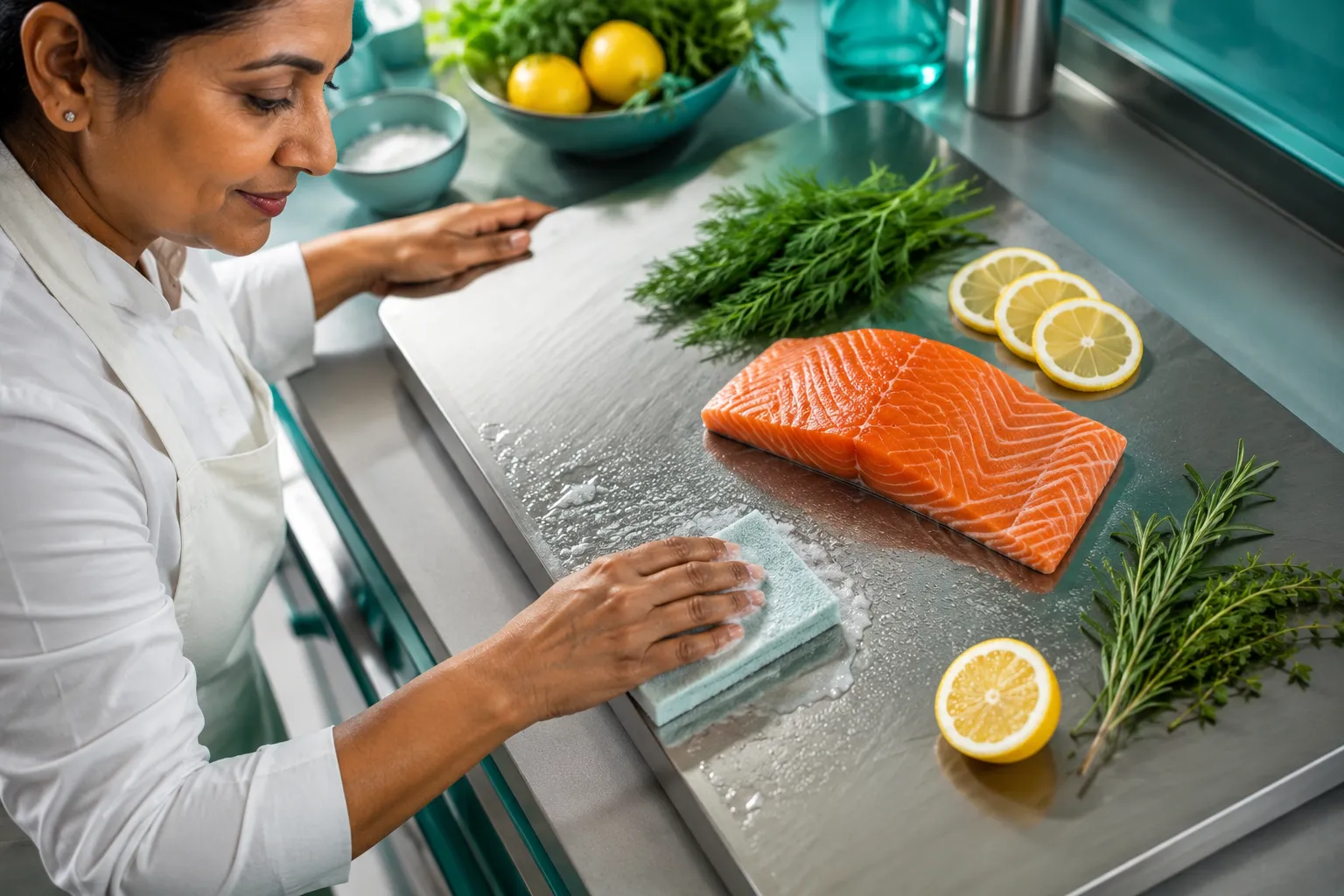
How to Clean and Maintain a Titanium Cutting Board
Titanium cutting boards are the easiest kitchen boards to maintain. The non-porous surface means a simple rinse removes most food residue, and the material tolerates nearly every cleaning method.
Standard cleaning routine:
- Rinse the board under warm water immediately after use.
- Apply a small amount of dish soap and scrub with a soft sponge or cloth.
- Rinse thoroughly and either air dry or hand dry with a clean towel.
- For deeper sanitization after raw meat, run through a dishwasher cycle or pour boiling water over the surface.
Maintenance tips for long-term performance:
- Never use steel wool, abrasive scrubbing pads, or metal scrapers. These scratch the brushed finish and can create micro-grooves over time.
- Store the board upright (vertically) rather than flat-stacked under heavy items, which prevents surface pressure marks.
- Use a non-slip silicone mat underneath during use to protect both the board and your countertop.
- Optional: pair with titanium or silicone-coated utensils to avoid any metal-on-metal surface marking.
- Dishwasher-safe, but hand-drying after the dishwasher cycle prevents water spots and keeps the finish looking sharp.
No oiling, seasoning, or special treatments are required, which is a significant time-saver compared to maintaining a wood board.
Titanium Cutting Board vs. Plastic vs. Glass
A titanium cutting board outperforms both plastic and glass on the most important kitchen metrics: hygiene, durability, and food safety. Here is how the three materials compare directly.
Plastic boards are the most common choice due to low cost, but they have a well-documented hygiene problem. Once knife grooves form in the surface (which happens quickly), bacteria colonize those channels and are difficult to remove even with dishwasher cleaning. Plastic boards also absorb odors and stains from pigmented foods like beets and turmeric.
Glass boards are non-porous and easy to sanitize, but they are the worst option for knives. Glass is harder than most knife steel, meaning every cut accelerates edge wear. Glass boards also chip and crack under heavy use, and the fragments create a food safety hazard.
Titanium boards combine the hygiene advantages of glass (non-porous, fully sanitizable) with far better knife compatibility and zero chipping or cracking risk.
| Factor | Titanium | Plastic | Glass |
|---|---|---|---|
| Hygiene (non-porous) | Excellent | Poor (grooves form) | Excellent |
| Knife edge wear | Moderate | Moderate to poor | Very high |
| Durability | Decades | 2-5 years | Chips/cracks |
| Odor absorption | None | Moderate to high | None |
| Dishwasher-safe | Yes | Yes (but degrades) | Yes |
| Safety risk | None | Microplastic shedding | Chipping |
| Price | $89-$179 | $10-$40 | $20-$60 |
A 2015 study published in the journal Food Control found that plastic cutting boards with knife grooves harbored significantly more bacteria than smooth surfaces, even after washing. Titanium’s non-porous surface avoids this problem entirely.
Who Should Use a Titanium Cutting Board
A titanium cutting board is best suited for health-conscious home cooks, professional chefs, and anyone who regularly handles raw meat, fish, or allergen-sensitive ingredients. It is also a strong choice for people who want to reduce kitchen maintenance time.
Best candidates for a titanium board:
- Home cooks who prepare raw poultry, fish, or meat frequently and want maximum sanitization confidence
- People with immune sensitivities or compromised health who need the most hygienic prep surface possible
- Minimalist cooks who want a single, durable board that handles everything without special care
- Professional or semi-professional kitchen setups where boards are used heavily and need to withstand daily dishwasher cycles
- Anyone who has dealt with persistent odors (garlic, fish, onion) on their current board and wants a fresh start
Who should skip it:
- Cooks on a tight budget who cannot justify the $89-$179 upfront cost
- People who love the look and feel of natural wood in their kitchen and prioritize aesthetics
- Those who use very delicate, thin Japanese knives exclusively and want the softest possible cutting surface
If you are interested in broader health and wellness upgrades for your kitchen and lifestyle, it is worth considering how your food prep environment connects to your overall health habits, from how to create a morning routine for better mental health to optimizing your nutrition practices.
Best Titanium Cutting Boards to Buy: The Katori Model Reviewed
The Katori Titanium Cutting Board is the most widely reviewed titanium board in 2026, and it earns its reputation through consistent build quality and genuine material purity. Here is what the product delivers in practice.
Build quality and design:
- Material: 100% pure titanium (Grade 1, medical-grade specification)
- Finish: Matte brushed surface that reduces glare and provides light tactile grip
- Thickness: Approximately 2 mm (rigid and stable without being heavy)
- Edges: Rounded for hand safety during use and cleaning
- Weight: Noticeably lighter than it looks, roughly 40% lighter than an equivalent steel surface
Katori vs. Taima: A direct comparison
The Taima Titanium Cutting Board is Katori’s main competitor in the premium segment. Here is how they differ:
| Factor | Katori | Taima |
|---|---|---|
| Purity claim | 100% pure titanium | Grade 1 certified (third-party verified) |
| Lab testing | Not publicly listed | Third-party verified |
| Price range | $89-$149 | $130-$200 |
| Non-slip backing | Optional add-on | Included standard |
| Warranty | Lifetime | Lifetime with proof of purchase |
| Best for | Value-focused home cooks | Premium/health-sensitive buyers |
Verdict: Taima edges ahead on verified purity documentation, which matters for buyers with specific health concerns. Katori wins on value and availability, making it the more practical choice for most households.
Real user feedback on the Katori board:
Positive highlights from verified buyers include zero smell transfer between ingredients, a premium and modern aesthetic, and confidence when handling raw meat. Constructive feedback centers on the metallic chopping sound (which most users adjust to within a week), the need for a non-slip mat, and the upfront price. Overall satisfaction sits at approximately 4.7 out of 5 stars.
Editor’s ratings (2026 update):
- Build Quality: 5 / 5
- Hygiene: 5 / 5
- Knife Compatibility: 4 / 5
- Durability: 5 / 5
- Value for Money: 4 / 5
- Overall: 4.8 / 5
Common Mistakes People Make With Titanium Cutting Boards
Most problems with titanium cutting boards come from treating them like stainless steel cookware or ignoring a few simple setup steps.
The most common mistakes:
Using steel wool or abrasive pads. This scratches the brushed finish and can create micro-grooves that defeat the purpose of a non-porous surface. Use only soft sponges or cloths.
Skipping the non-slip mat. Titanium on smooth granite or quartz countertops can slide during heavy chopping. A silicone mat underneath costs almost nothing and solves this immediately.
Buying from unauthorized third-party sellers. Counterfeit titanium boards made from cheaper alloys or stainless steel are sold on some marketplace platforms. Always buy from the official brand website or an authorized retailer.
Expecting it to feel like wood. New users sometimes find the hard, cool surface unfamiliar. The adjustment period is usually about a week before it feels natural.
Storing it flat under heavy objects. While titanium is extremely strong, stacking heavy pots or pans on top can cause minor surface marking. Store upright when possible.
Using it as a trivet without checking the surface first. While titanium handles heat well, placing a very hot cast iron pan directly on the board can cause slight discoloration of the brushed finish over time.
Where to Buy Titanium Cutting Boards
Buy titanium cutting boards only from the official brand website or a verified authorized retailer. This is not a minor recommendation, the market for premium titanium boards has attracted counterfeit products that use inferior metal alloys marketed as “titanium-coated” rather than solid titanium.
Safe purchasing sources:
- Official Katori website: The most reliable source for authentic boards, warranty registration, and bundle deals.
- Authorized Amazon store: Look for listings sold directly by the brand (not third-party marketplace sellers) with a verified brand badge.
- Specialty kitchen retailers: Some premium kitchen stores carry titanium boards, but verify the retailer is listed as authorized on the brand’s website.
What to look for when the package arrives:
- Warranty card included in the box
- Care guide with the brand’s official logo
- Logo engraving on the board surface (not a sticker)
- Packaging that lists the titanium grade specification
If any of these are missing, contact the seller before using the product. Authentic titanium boards are a significant investment, and verifying authenticity protects both your health and your money.

Are Titanium Cutting Boards Worth It
For most health-conscious cooks who use their kitchen regularly, yes, a titanium cutting board is worth the investment. The upfront cost is real, but the combination of superior hygiene, zero maintenance, and multi-decade durability makes the long-term value compelling.
The honest answer depends on your cooking habits:
- Worth it if you cook four or more times per week, regularly handle raw meat or fish, have had persistent odor or hygiene issues with your current board, or simply want to buy one board that never needs replacing.
- Not worth it if you cook occasionally, are on a strict budget, or strongly prefer the natural feel and aesthetics of wood.
The “buy once, use forever” claim is not marketing hyperbole in this case. Titanium does not crack, warp, stain, or develop the kind of deep grooves that require board replacement. A $149 board used daily for 20 years costs less per use than a $30 plastic board replaced every three years.
Just as investing in quality kitchen tools connects to broader health and wellness goals, the same principle applies to other areas of daily health. If you are interested in how food and lifestyle choices affect your body’s systems, our coverage of topics like gut bacteria and digestive health and the impact of diet on digestive enzyme production may offer useful context. Similarly, if joint health is a concern, perhaps from years of standing and cooking, our guide to good supplements for joint pain covers evidence-based options worth knowing about.
Key Takeaways Before You Decide
- Titanium cutting boards are non-porous, non-reactive, and fully sanitizable, making them the most hygienic kitchen prep surface available.
- The Katori Titanium Cutting Board earns a 4.8 out of 5 editor rating in 2026, with strong marks for build quality, hygiene, and durability.
- Expect to pay $89-$179 for a quality titanium board; the long-term cost-per-use is lower than replacing cheaper boards every few years.
- Titanium outperforms plastic on hygiene and durability, outperforms glass on knife safety, and outperforms wood on maintenance.
- Use a non-slip mat, avoid abrasive scrubbers, and buy only from authorized sources.
- The board is best for frequent cooks, raw meat handlers, and anyone prioritizing food safety.
Conclusion
A titanium cutting board represents a genuine upgrade in kitchen hygiene and long-term value for anyone who cooks regularly. The science is straightforward: a non-porous, non-reactive, biocompatible surface eliminates the bacterial harboring, odor absorption, and material degradation that make plastic and wood boards a recurring problem.
The Katori Titanium Cutting Board, in particular, delivers on its core promises. Build quality is excellent, the matte brushed finish is both functional and attractive, and the hygiene performance is difficult to match with any other material at this price point.
Actionable next steps:
- Assess your current cutting board, if it has deep grooves, persistent odors, or visible staining, it is time to replace it.
- Decide whether titanium fits your budget and cooking habits using the “worth it” criteria above.
- If you decide to buy, go directly to the official Katori website or an authorized retailer to ensure authenticity.
- Order a non-slip silicone mat at the same time, do not skip this step.
- Read the Katori Titanium Cutting Board reviews and complaints from real buyers before finalizing your purchase decision.
The kitchen is where food safety starts. A cutting board that you can fully sanitize, that never harbors bacteria in surface grooves, and that lasts for decades is not a luxury, it is a practical investment in your household’s health.
Frequently Asked Questions
Is titanium safe for food preparation?
Yes. Titanium is biocompatible and non-reactive, meaning it does not leach metals or chemicals into food. It is the same material used in surgical implants and dental hardware, making it one of the safest food contact surfaces available.
Does the Katori Titanium Cutting Board dull knives?
It causes less edge wear than glass or ceramic boards, but slightly more than a well-maintained end-grain wood board. For most kitchen knives, the difference is minimal and most users report no change in their sharpening frequency.
How do I clean a titanium cutting board?
Rinse with warm soapy water and a soft sponge for daily cleaning. For deeper sanitization, run it through the dishwasher or pour boiling water over the surface. Never use steel wool or abrasive pads.
Is the titanium cutting board heavy?
No. Titanium has an exceptional strength-to-weight ratio and is approximately 40% lighter than an equivalent steel surface. Most users describe it as surprisingly light for a metal board.
Can I cut bones or frozen food on a titanium board?
Yes. The hardness and rigidity of titanium make it suitable for heavy-duty cutting tasks. However, use a proper cleaver for bones rather than a standard chef’s knife, as the knife edge, not the board, is the limiting factor in those tasks.
Why does my titanium board make a metallic sound when I chop?
The hard surface produces more resonance than wood or plastic. This is normal and not a sign of a defect. Most users adjust to the sound within a few days of regular use.
Can I use a titanium cutting board for raw meat?
Yes, and this is one of its best use cases. The non-porous surface prevents meat juices from soaking in, and the board sanitizes completely with dishwasher cycles or boiling water.
How long does a titanium cutting board last?
With normal use and basic care, a quality titanium board should last several decades. The material does not crack, warp, or develop the deep grooves that require replacement in wood or plastic boards.
Where is the best place to buy a Katori Titanium Cutting Board?
The official Katori website and their authorized Amazon store are the safest options. Avoid third-party marketplace sellers who may sell counterfeit or inferior alloy boards.
Does titanium react with acidic foods like lemon or vinegar?
No. Titanium is chemically inert and does not react with acidic, salty, or fermented foods. This is one of its advantages over some lower-grade stainless steel surfaces.
What size titanium cutting board should I buy?
For most home cooks, a standard medium-sized board (approximately 12 x 18 inches) handles the majority of prep tasks. If you regularly butcher large cuts of meat or cook for groups, a large professional slab is worth the additional cost.
Is the Katori Titanium Cutting Board worth the price?
For frequent cooks who prioritize hygiene and long-term value, yes. The cost-per-use over decades makes it competitive with cheaper boards that require regular replacement. If you cook only occasionally, the upfront cost may be harder to justify.
Tags: titanium cutting board, Katori titanium cutting board, cutting board comparison, food safety kitchen, non-porous cutting board, titanium vs wood cutting board, best cutting boards 2026, kitchen hygiene, antibacterial cutting board, titanium cookware, cutting board maintenance, food prep safety

With over 13 years of experience in holistic health blogging, I aim to help you navigate your wellness journey with honest insights, expert-backed advice, and a sprinkle of real-world practicality.
Certified Wellness Writer | Herbal Nutrition Advocate | Wellness Research Enthusiast