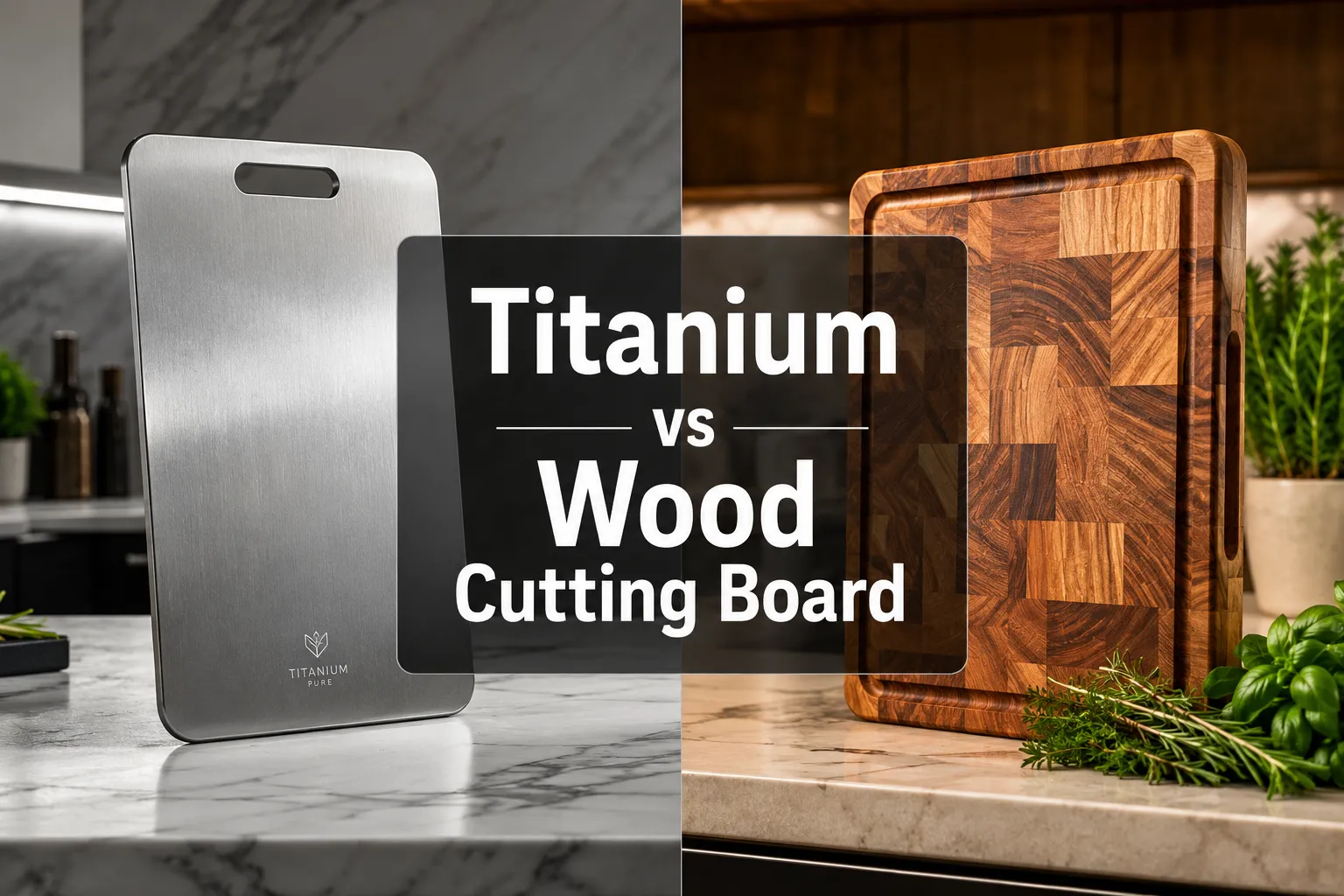
Titanium vs Wood Cutting Board: Which One Is Better for Your Kitchen?
Last updated: July 29, 2026
Quick Answer
Wood cutting boards remain the top choice for most home cooks because they protect knife edges, feel natural to use, and perform well hygienically when cleaned properly. Titanium cutting boards offer a genuinely non-porous, easy-to-sanitize surface that appeals to hygiene-focused cooks and professionals, but they cost significantly more and can accelerate knife wear if the surface hardness is not well managed. Your best choice depends on how you cook, how often you sharpen your knives, and what you’re willing to spend.
Key Takeaways
- Titanium cutting boards are made from food-grade (often Grade 1) titanium, making them non-porous, rust-proof, and dishwasher-safe.
- Wood cutting boards can self-limit certain bacteria in controlled studies and are gentler on knife edges than most metal surfaces.
- The biggest practical downside of titanium boards is the potential for knife-edge damage over time, despite marketing claims of being “knife-friendly.”
- Titanium boards are not inherently antimicrobial, their hygiene advantage comes from non-porosity and easy cleanability, not from any active antibacterial property.
- Premium titanium boards (such as the Katori and Apex Titanium) typically cost between $89 and $179, compared to $30 to $120 for a quality hardwood board.
- For raw meat prep and maximum sanitizability, titanium has a real edge over wood.
- Wood is still the preferred surface for professional chefs who prioritize knife longevity and tactile feedback.
- Hybrid titanium designs (titanium surface bonded to a composite base) are emerging as a middle-ground option.
- Both materials are safe for food contact when used and maintained correctly.
- Poor hygiene habits, not the board material itself, are the main driver of foodborne illness risk on any surface.
What Is a Titanium Cutting Board Made Of?
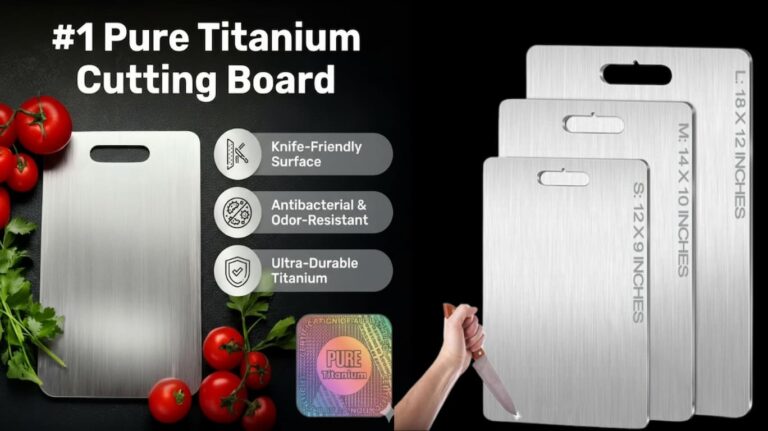
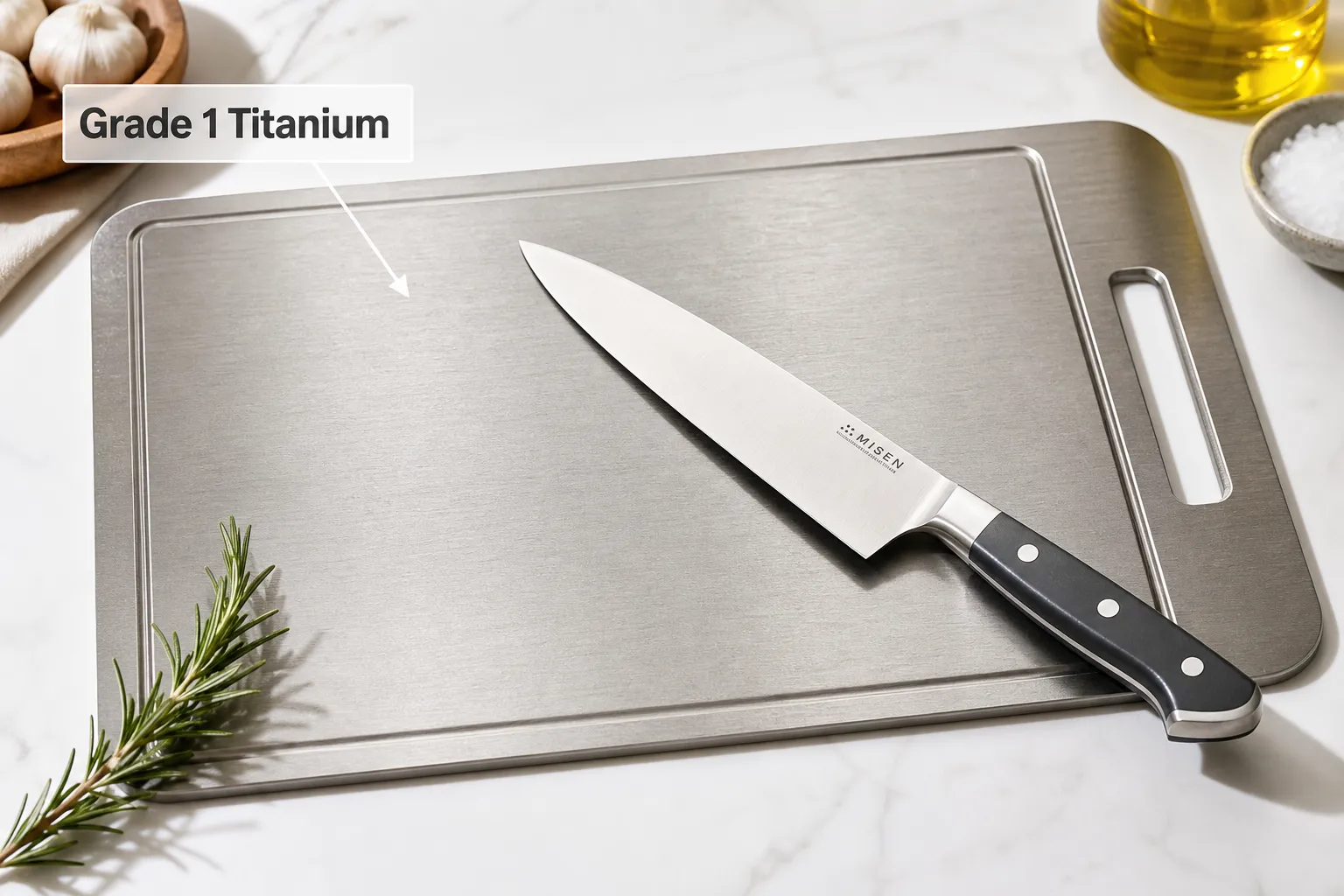
Titanium cutting boards are made from food-grade titanium, typically Grade 1 (commercially pure titanium), which is the same classification used in medical implants and surgical instruments. The boards are usually around 2 mm thick, with a matte brushed finish that reduces glare and provides some grip for food [2].
Grade 1 titanium is biocompatible, meaning it does not react with acidic foods, salty marinades, or moisture. Unlike stainless steel, it contains no nickel or chromium, which can leach into food under certain conditions. The surface is completely non-porous at a microscopic level, meaning there are no grooves or channels where bacteria, mold, or food odors can take hold [7].
Some newer products, including the Apex Titanium board launched in mid-2026, blend a titanium surface layer with a composite backing to reduce the metallic sound during chopping and add non-slip stability [6]. These hybrid designs address two of the most common complaints about pure titanium boards.
Key material facts:
- Grade 1 titanium: highest purity, used in medical and aerospace applications
- Typical thickness: 1.5 to 3 mm
- Surface finish: brushed matte (most common) or polished
- Weight: roughly 40% lighter than a steel board of the same size
- Non-reactive with acids, salts, and alkaline cleaners
For a detailed look at one of the leading products in this category, see our Katori Titanium Cutting Board reviews and complaints article, which covers real user experiences and verified specs.
Are Titanium Cutting Boards Safe to Use?
Yes, titanium cutting boards are safe for food preparation. Titanium is one of the most biologically inert materials available, which is why it is used in surgical implants and dental hardware. It does not leach metals into food, does not rust, and does not react with acidic ingredients like citrus, vinegar, or tomatoes [7].
The non-porous surface also means there is nowhere for bacteria to hide after washing. This is a meaningful safety advantage over wood or plastic boards that develop knife grooves over time. However, “safe” does not mean “sterile”, a titanium board that is not washed after raw meat contact is just as risky as any other surface.
What makes titanium boards safe:
- Biocompatible material (no metal leaching)
- Non-porous surface (no bacterial harborage sites)
- Resistant to rust and corrosion
- Dishwasher-safe at high temperatures
- No BPA, no plasticizers, no chemical coatings that can chip or flake
One important caveat: Some titanium boards on the market are not 100% pure titanium. They may be titanium-coated steel or aluminum, which carries different safety and durability implications. Always check whether the product is certified Grade 1 titanium or simply titanium-finished [4].
Titanium Cutting Board vs Wood: Which Is Better?
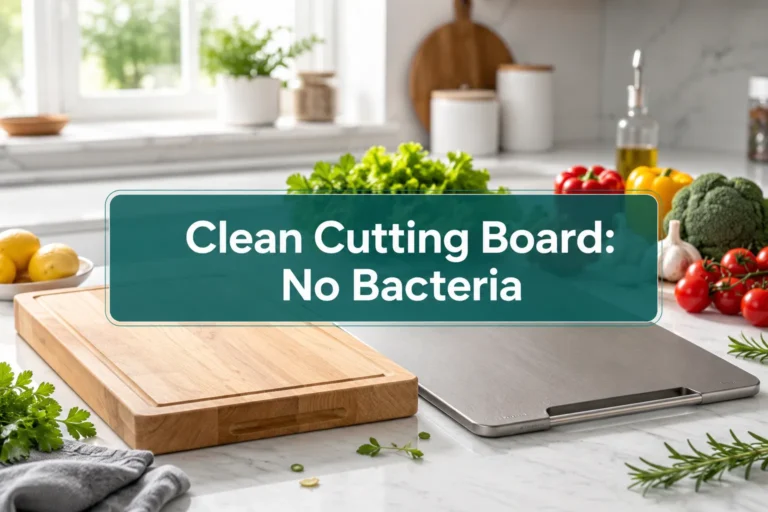
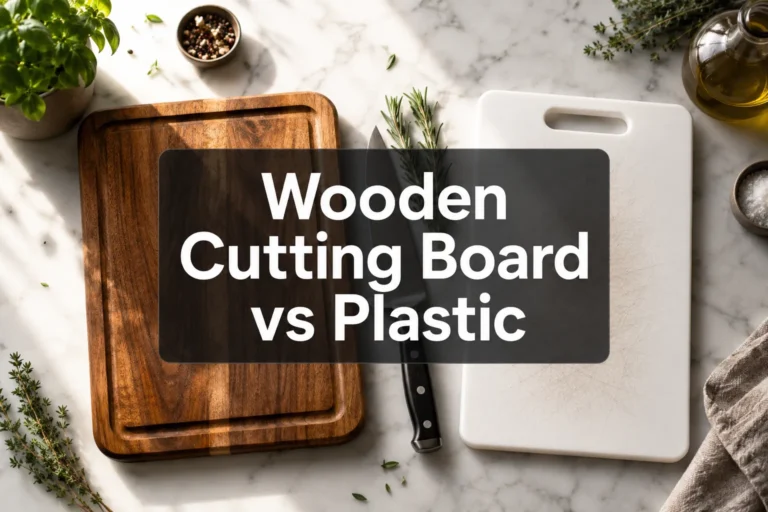
Neither material is universally better, the right choice depends on your priorities. Titanium wins on hygiene, durability, and ease of cleaning. Wood wins on knife protection, tactile feedback, and price-to-performance ratio for most home cooks.
Here is a direct comparison across the factors that matter most:
| Factor | Titanium Board | Wood Board |
|---|---|---|
| Hygiene | Non-porous, easy to sanitize fully | Porous, but can self-limit bacteria in some studies |
| Knife safety | Harder surface; risk of edge wear | Softer; gentler on knife edges |
| Durability | Decades; no warping, cracking, or staining | 5-15 years with proper oiling and care |
| Maintenance | Minimal; dishwasher-safe | Regular oiling required; no dishwasher |
| Cost | $89,$179 upfront | $30,$120 for quality hardwood |
| Odor resistance | Excellent; no absorption | Can absorb garlic, fish, onion odors |
| Feel and sound | Hard, metallic sound when chopping | Warm, quiet, satisfying to use |
| Sustainability | Long lifespan; titanium is recyclable | Renewable resource if sustainably sourced |
Decision rule:
- Choose titanium if you prioritize maximum sanitation, cook raw meat frequently, or want a low-maintenance board for decades.
- Choose wood if you value knife longevity, prefer a quieter prep experience, and are willing to maintain the board with regular oiling.
Do Titanium Cutting Boards Dull Knives?
This is the most debated question in the titanium vs wood cutting board conversation, and the honest answer is: it depends on the specific board and your knives. Titanium is harder than wood but softer than stainless steel. However, even a relatively soft metal surface is harder than the wood fibers that allow a knife edge to “sink in” slightly during a cut.
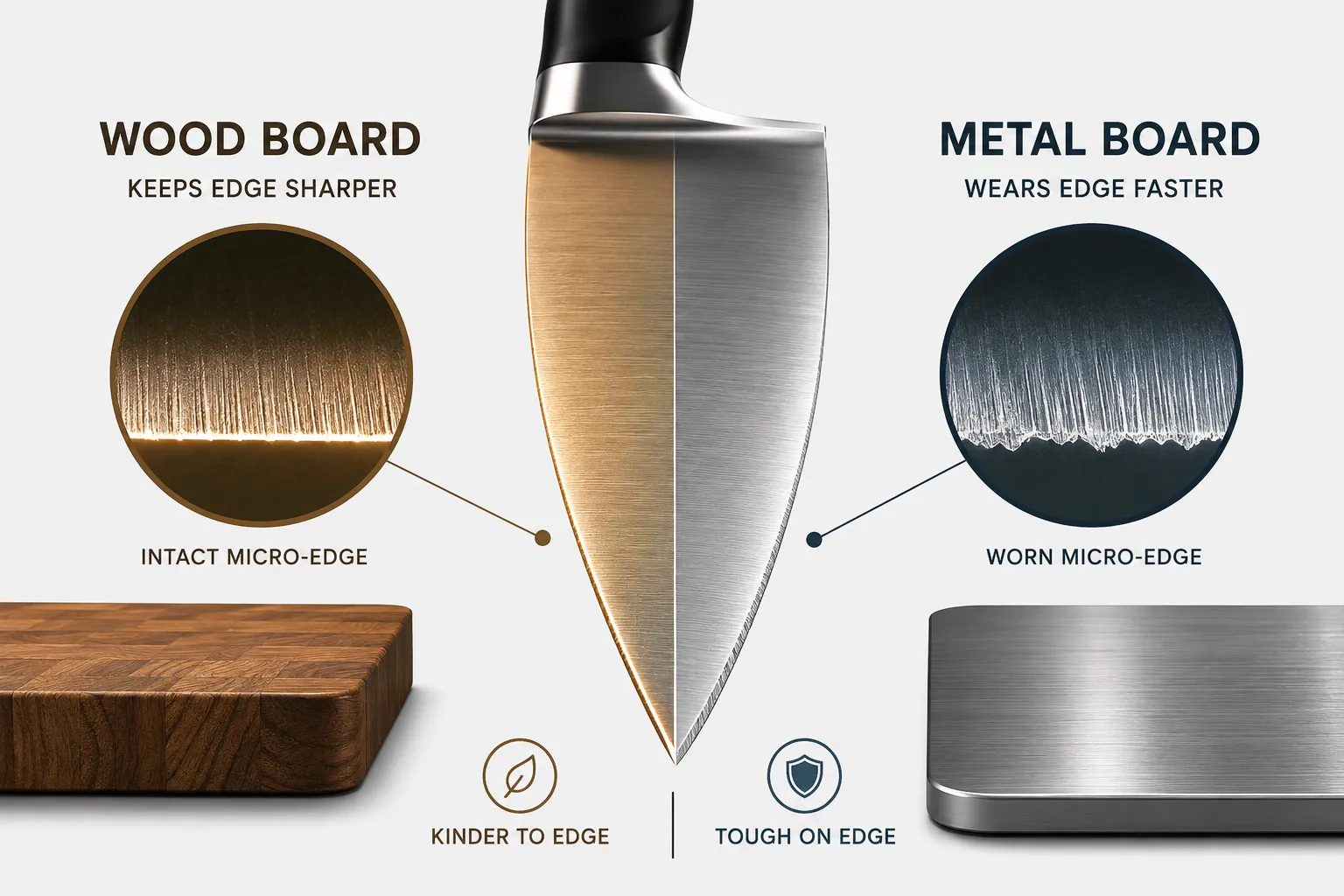
On a wood board, the knife edge parts the wood grain, which cushions the blade. On a titanium surface, the blade contacts a hard, flat plane with each stroke. Over time, this can round the micro-edge of a knife faster than wood would.
Marketing claims that titanium boards are “knife-friendly” are partially true, they are less damaging than glass, ceramic, or stainless steel boards. But they are not as gentle as end-grain hardwood, which remains the gold standard for knife preservation [7].
Practical guidance:
- If you use high-carbon Japanese knives (which have thin, brittle edges), a titanium board carries more risk of chipping or dulling than a wood board.
- If you use German-style knives (thicker, more robust edges), the difference is less pronounced.
- Expect to sharpen your knives slightly more often if you switch from wood to titanium.
Titanium Cutting Board Bacteria Resistant: What the Science Actually Says
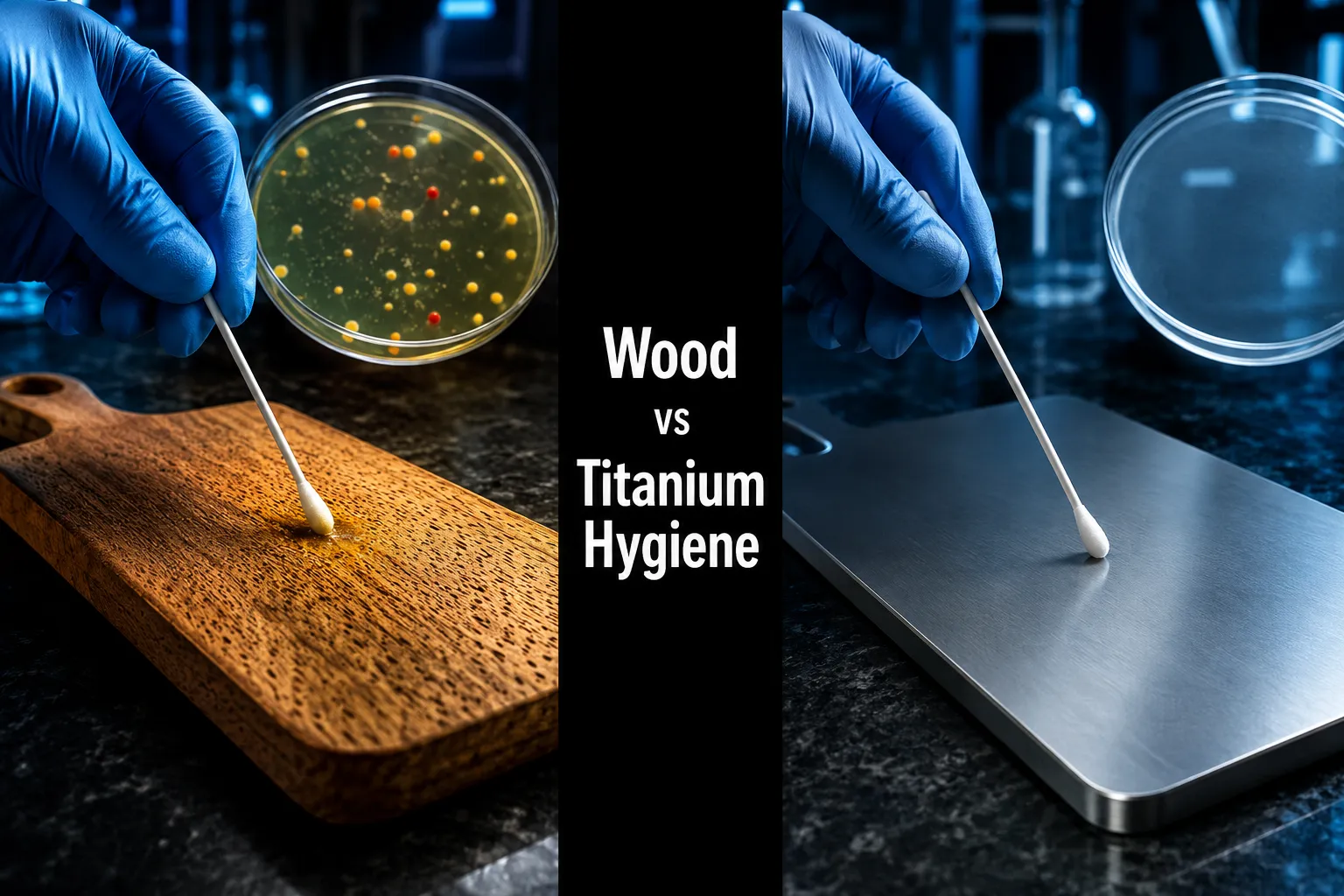
Titanium cutting boards are not inherently antimicrobial, they do not actively kill bacteria. Their hygiene advantage comes from being non-porous, which means bacteria cannot penetrate the surface or hide in grooves and scratches [7].
This is an important distinction. Some product marketing implies that titanium itself kills germs. It does not. What it does is deny bacteria the harborage sites they need to survive between washes. A wood board that develops deep knife grooves can trap bacteria even after washing. A titanium board, which does not groove in the same way, is easier to clean thoroughly.
Research into cutting board microbiology is nuanced. Studies have found that wood can actually self-limit certain bacteria, wooden boards absorb bacteria into the wood fibers, where they die off without multiplying, particularly in dry conditions [9]. However, this effect is inconsistent and depends on wood species, moisture levels, and how deeply grooved the board is.
A 2020 wet-market study and subsequent microbiome surveys through 2025 consistently found that hygiene outcomes are driven more by user behavior than by board material. A wood board washed promptly and dried thoroughly performs comparably to a non-porous surface for most home cooking scenarios [9].
Bottom line on bacteria:
- Titanium: non-porous, easy to sanitize, no harborage sites
- Wood: can self-limit bacteria in dry conditions, but inconsistently
- Both: safe when washed promptly after raw meat contact
- Neither: a substitute for proper food handling practices
Can You Use a Titanium Cutting Board for Raw Meat?
Yes, and this is one of the strongest use cases for titanium boards. The non-porous surface does not absorb meat juices, blood, or fat, which means pathogens from raw chicken, beef, or fish sit on the surface rather than soaking in. A thorough wash with hot soapy water, or a run through the dishwasher, removes them effectively [5].
Wood boards can also be used for raw meat, but they require more careful cleaning. If a wood board has deep knife grooves, bacteria from raw poultry or pork can persist in those grooves even after washing. This is why food safety guidelines from organizations like the USDA have historically recommended non-porous surfaces (plastic or metal) for raw meat, though recent research has complicated that picture.
Best practice for raw meat on any board:
- Wash immediately after use with hot water and dish soap.
- Sanitize with a diluted bleach solution (1 tablespoon bleach per gallon of water) or food-safe sanitizer.
- Allow to air-dry completely before storing.
- Use a dedicated board for raw meat if possible, regardless of material.
For titanium specifically: the dishwasher-safe property is a real advantage here. Running a titanium board through a hot dishwasher cycle after raw meat prep is a reliable sanitization method that wood boards cannot tolerate.
How Much Does a Titanium Cutting Board Cost?
Titanium cutting boards are a premium product. Most quality options fall in the $89 to $179 range for a standard chef-size board, though smaller prep boards can be found for $50 to $80 [2][4][6].
By comparison, a quality hardwood cutting board (maple, walnut, or teak end-grain) typically costs $40 to $120. A high-end edge-grain maple board from a brand like Boos runs $80 to $150 for a large size.
The value argument for titanium rests on longevity. A wood board that is properly maintained can last 10 to 15 years. A titanium board, barring physical damage, can last several decades with minimal upkeep. The cost-per-year calculation often favors titanium for frequent cooks.
Price ranges by product type (2026 estimates):
- Entry-level titanium boards: $50,$89
- Mid-range titanium boards (most popular): $89,$130
- Premium/large titanium boards: $130,$179+
- Hybrid titanium-composite boards: $95,$150
Common mistake: Buying a titanium-coated board (steel or aluminum with a titanium coating) thinking it is a solid titanium board. These are cheaper but do not offer the same durability or safety profile. Check product specifications carefully [4].
Best Titanium Cutting Board Brands in 2026
Several brands have established credibility in this category. Based on product specifications, verified user reviews, and available testing data, these are the most discussed options in 2026.
Katori Titanium Cutting Board
Katori is one of the most widely reviewed titanium boards available. It is marketed as 100% pure titanium with a matte brushed finish and rounded edges. User reviews highlight zero odor transfer and easy cleaning as standout benefits. Some users note a metallic sound during chopping and occasional slipping on smooth counters. Overall satisfaction runs approximately 4.7 out of 5 stars across verified purchase reviews. For a full breakdown of real customer experiences, see our Katori Titanium Cutting Board reviews and complaints article.
Apex Titanium (Apex IQO)
Launched in mid-2026, the Apex Titanium positions itself as a premium hygiene surface with a hybrid design that includes a non-slip composite backing [6]. It is priced at the higher end of the market and targets health-conscious home cooks and small food businesses.
Siraat’s Kitchen Titanium Cutting Board V2
The V2 version from Siraat’s Kitchen addresses earlier complaints about slippage and metallic noise. It features a slightly thicker profile and improved edge finishing [2].
Baker’s Secret Titanium Double Side Board
This option offers a double-sided design, giving users two usable surfaces. It is positioned as a mid-range option and is widely available through major retailers [4].
Decision rule:
- For verified purity and third-party testing: look for brands that publish lab certification.
- For value and availability: Katori and Baker’s Secret are the most accessible.
- For premium hybrid design: Apex Titanium is the newest entrant worth considering.
Wood Cutting Board Advantages Over Titanium
Wood boards still hold several genuine advantages that keep them the dominant choice for home kitchens in 2026. The most important is knife protection, but the case for wood goes beyond that.
Knife longevity: End-grain hardwood (maple, walnut, cherry) allows knife edges to part the wood fibers rather than striking a hard surface. This preserves the micro-edge of a blade significantly longer than any metal surface, including titanium.
Tactile and sensory experience: Many cooks, including professional chefs, prefer the feel and sound of wood. The quiet, warm thud of a knife on hardwood is more satisfying and less fatiguing during long prep sessions than the metallic ring of titanium.
Natural bacterial behavior: Some wood species, particularly maple and walnut, have natural properties that limit bacterial survival on the surface. Research published in peer-reviewed microbiology journals has found that bacteria drawn into dry wood fiber die off more reliably than bacteria left on plastic surfaces [9]. This does not apply to wet or deeply grooved wood, but it is a real phenomenon.
Cost and accessibility: A quality hardwood board is available at most kitchen stores for $40 to $100. Titanium boards require a larger upfront investment and are primarily sold online.
Repairability: A wood board that develops deep grooves can be sanded and re-oiled to restore a near-new surface. A titanium board cannot be refinished in the same way.
Aesthetic warmth: Wood boards are visually warm and fit naturally into most kitchen styles. Titanium boards have a sleek, modern look that suits some kitchens but can feel clinical in others.
How to Clean and Maintain a Titanium Cutting Board
Titanium boards are low-maintenance compared to wood, but a few simple practices will keep them performing well for decades.
Daily cleaning:
- Rinse the board immediately after use under hot running water.
- Apply a small amount of dish soap and scrub with a soft sponge or cloth.
- Rinse thoroughly and pat dry with a clean towel, or allow to air-dry upright.
Are titanium cutting boards dishwasher safe? Yes. Most titanium boards are fully dishwasher-safe and can handle high-temperature cycles without warping, rusting, or discoloring [5]. This is one of their most practical advantages over wood boards, which will crack and warp in a dishwasher.
Deep sanitizing (after raw meat):
- Run through a full dishwasher cycle on the hottest setting, or
- Soak for 2 minutes in a diluted bleach solution (1 tablespoon bleach per gallon of water), then rinse thoroughly.
What to avoid:
- Steel wool or abrasive scrubbers (will scratch the brushed finish)
- Harsh chemical cleaners that are not food-safe
- Leaving the board in standing water for extended periods (unnecessary and can affect any non-slip backing)
Storage tips:
- Store upright in a board rack to allow air circulation.
- If using a non-slip silicone mat, remove and dry it separately to prevent moisture buildup underneath.
- No oiling required, this is a meaningful time-saver compared to wood board maintenance.
Titanium Cutting Board Pros and Cons
Pros:
- Non-porous surface prevents bacterial harborage
- Dishwasher-safe for easy, thorough sanitization
- Rust-proof and corrosion-resistant (safe with acidic foods)
- Non-reactive with food (no metal leaching)
- Extremely durable, no warping, cracking, or staining
- No oiling or conditioning required
- Lightweight relative to steel boards of the same size
- Odor-resistant (garlic, fish, onion do not cling)
Cons:
- Higher upfront cost ($89,$179) compared to wood
- Can accelerate knife-edge wear compared to wood surfaces
- Metallic sound during chopping (can be fatiguing)
- May slip on smooth counters without a non-slip mat or backing
- Limited style variety compared to the wide range of wood options
- Primarily sold online; harder to evaluate in person before buying
- Some products are titanium-coated rather than solid titanium, buyer must verify
Who Should Use Titanium Cutting Boards?
Titanium cutting boards are best suited for specific types of cooks and kitchens, not everyone. They are a strong fit for people who prioritize hygiene above all else, cook raw meat frequently, or want a board they will never need to replace or maintain.
Titanium is a good fit if you:
- Prepare raw poultry, fish, or meat regularly and want maximum sanitizability
- Have a household member who is immunocompromised and requires stricter food safety practices
- Dislike the maintenance routine of oiling and conditioning a wood board
- Want a single board that can go straight into the dishwasher after every use
- Cook in a small space where one durable, easy-clean board makes sense
Titanium is probably not the right choice if you:
- Use high-end Japanese knives and want to protect their edges
- Prefer the tactile warmth and sound of wood during prep
- Are on a tight budget and need a quality board under $50
- Cook primarily vegetables and lighter foods where hygiene risk is lower
- Value the aesthetic of natural materials in your kitchen
Wood boards remain the better all-around choice for most home cooks. The combination of knife protection, natural feel, reasonable cost, and adequate hygiene (when properly maintained) makes hardwood the practical default. Titanium is a worthwhile upgrade for a specific profile of cook, not a universal replacement.

Is Wood Still Better Than Titanium for Most Home Cooks?
For most home cooks in 2026, a quality hardwood board still offers the best overall balance of performance, cost, and kitchen experience. Titanium boards solve real problems, bacterial harborage, maintenance burden, long-term durability, but they introduce trade-offs that matter to everyday cooking.
The knife-edge issue is the most practical concern. Most home cooks own mid-range knives that they sharpen infrequently. Switching from a wood board to titanium will accelerate the dulling of those knives, which is a real cost and inconvenience. Professional chefs and serious home cooks who sharpen regularly will notice this less, but it is not a trivial consideration.
Wood also has a more nuanced hygiene story than its critics suggest. A 2025 microbiome survey found that properly cleaned wood boards in home kitchens did not show significantly higher bacterial loads than non-porous surfaces [9]. The risk with wood is not the material itself, it is the behavior of the user. A wood board left wet, heavily grooved, or unwashed after raw meat contact is a genuine risk. A wood board washed promptly and dried thoroughly is not.
The honest verdict: If you already own a quality hardwood board and maintain it properly, there is no urgent reason to switch to titanium. If you are buying a new board, your cooking habits and priorities should drive the decision. Both materials are safe and functional when used correctly.
Key Takeaways Before You Decide
- Titanium boards win on hygiene, durability, and zero-maintenance cleaning.
- Wood boards win on knife protection, feel, and value for most home kitchens.
- The hygiene advantage of titanium is real but comes from non-porosity, not any active antimicrobial property.
- Knife-edge wear is the most significant practical downside of titanium vs wood cutting boards.
- For raw meat prep and dishwasher convenience, titanium is the stronger choice.
- Wood boards are safe when maintained correctly, material is not the main hygiene variable; behavior is.
- Budget matters: quality wood boards offer excellent performance at half the price of entry-level titanium.
Frequently Asked Questions
Is titanium safe for food prep?
Yes. Titanium is biocompatible, non-reactive, and does not leach metals into food. It is the same material used in surgical implants and dental hardware, making it one of the safest surfaces for food contact.
Does a titanium cutting board dull knives?
It can, over time. Titanium is harder than wood, so it does not cushion knife edges the way wood grain does. The effect is less severe than glass or ceramic boards, but more pronounced than end-grain hardwood. Expect to sharpen your knives slightly more often.
How do I clean a titanium cutting board?
Rinse with hot water and dish soap after every use. For raw meat, run through the dishwasher on a hot cycle or sanitize with a diluted bleach solution. No oiling or conditioning is needed.
Are titanium cutting boards dishwasher safe?
Yes. Most titanium boards are fully dishwasher-safe and will not warp, rust, or discolor in the dishwasher, a significant advantage over wood boards.
Can I use a titanium board for raw chicken?
Yes. The non-porous surface does not absorb meat juices, and the board can be thoroughly sanitized in the dishwasher. It is one of the best use cases for titanium boards.
How much does a quality titanium cutting board cost?
Expect to pay $89 to $179 for a reputable mid-to-large titanium board in 2026. Smaller prep boards start around $50. Titanium-coated boards (not solid titanium) are cheaper but offer different performance.
Is titanium antibacterial?
No. Titanium does not actively kill bacteria. Its hygiene advantage is that its non-porous surface provides no grooves or channels for bacteria to hide in, making it easier to clean thoroughly.
How long does a titanium cutting board last?
With normal use and basic care, a solid titanium board can last several decades. It will not warp, crack, stain, or rust. Surface scratches may appear over time but do not affect performance or hygiene.
Which is better for knives: wood or titanium?
Wood is better for knives. End-grain hardwood allows the blade to part wood fibers rather than striking a hard surface, preserving the micro-edge significantly longer than titanium or any metal surface.
Do titanium cutting boards smell?
No. The non-porous surface does not absorb food odors. Garlic, fish, and onion smells rinse off completely, which is one of the most appreciated features among titanium board users.
Can wood boards be as hygienic as titanium?
Yes, when maintained correctly. Research shows that properly cleaned and dried wood boards do not carry significantly higher bacterial loads than non-porous surfaces in typical home kitchen conditions. The key variable is user behavior, not material.
What is the best titanium cutting board brand in 2026?
Katori, Apex Titanium, and Siraat’s Kitchen V2 are among the most reviewed options. Katori offers strong value and wide availability. Apex Titanium is the newest premium option with a hybrid non-slip design.
Conclusion
The titanium vs wood cutting board debate does not have a single winner, it has a right answer for each type of cook. Titanium boards are a genuine upgrade for anyone who prioritizes hygiene, cooks raw meat often, and wants a board that goes straight into the dishwasher without a second thought. The non-porous surface, rust resistance, and decades-long durability make the upfront cost defensible for frequent cooks.
Wood boards, however, remain the better all-around choice for most home kitchens. They protect knife edges, feel warm and natural to use, cost less, and perform safely when cleaned properly. The idea that wood boards are inherently unhygienic is not well supported by current research, behavior matters far more than material.
Actionable next steps:
- If you currently own a quality hardwood board: maintain it with regular oiling, wash promptly after raw meat contact, and replace it when deep grooves develop. You do not need to switch.
- If you are buying a new board: assess your cooking habits. Heavy raw meat prep, immunocompromised household members, or a strong preference for low-maintenance cleaning are all good reasons to invest in titanium.
- If you want to try titanium: read verified reviews before buying, confirm the board is solid Grade 1 titanium (not coated), and budget $89 to $130 for a quality option. Our Katori Titanium Cutting Board reviews and complaints article is a good starting point for real-world feedback.
- Whatever board you choose: sharpen your knives regularly, wash your board immediately after raw meat contact, and dry it thoroughly before storing. Those habits matter more than the material under your knife.
References
[1] Food Quality and Safety Research – https://www.sciencedirect.com/science/article/pii/S0023643825002907
[2] Titanium Cutting Board V2 – https://siraatskitchen.com/products/titanium-cutting-board-v2
[3] PubMed – Cutting Board Microbiology Study – https://pubmed.ncbi.nlm.nih.gov/40609863/
[4] Titanium Double Side Cutting Board – https://www.bakerssecret.com/products/titanium-double-side-cutting-board
[5] Amazon – Titanium Cutting Board (Dishwasher Safe) – https://www.amazon.com/Titanium-Cutting-Board-Dishwasher-resistance/dp/B0DKDF38M2
[6] Apex Titanium Cutting Board – https://www.apexiqo.com/products/titanium
[7] Are Metal Cutting Boards Hygienic: A Real Answer – https://titaniumcuttingsboard.com/are-metal-cutting-boards-hygienic-a-real-answer/
[8] Amazon – Titanium Cutting Stainless Chopping Board – https://www.amazon.com/Titanium-Cutting-Stainless-Chopping-vegetable/dp/B0D7VW9FB3
[9] PMC – Cutting Board Bacteria Research – https://pmc.ncbi.nlm.nih.gov/articles/PMC7232214/
Tags: titanium cutting board, wood cutting board, titanium vs wood cutting board, cutting board hygiene, best cutting boards 2026, knife-friendly cutting board, food safety kitchen, Katori titanium board, cutting board bacteria, kitchen prep surfaces

With over 13 years of experience in holistic health blogging, I aim to help you navigate your wellness journey with honest insights, expert-backed advice, and a sprinkle of real-world practicality.
Certified Wellness Writer | Herbal Nutrition Advocate | Wellness Research Enthusiast