How to Remove Cutting Board Odors
Last updated: July 29, 2026
Quick Answer: To remove cutting board odors, sprinkle baking soda or coarse salt on the surface, rub it in with half a lemon, let it sit for 5 minutes, then rinse with warm water and dry completely. For persistent smells, a white vinegar soak or hydrogen peroxide treatment works on both wooden and plastic boards. Always wash with warm soapy water first before applying any deodorizing treatment.
Key Takeaways
- Wash the board with warm soapy water before any deodorizing treatment, skipping this step reduces effectiveness
- Baking soda, white vinegar, lemon, and coarse salt are the four most effective natural deodorizers for cutting boards
- Wooden boards absorb odors more deeply than plastic, but they respond better to natural treatments like lemon and salt
- Plastic boards develop deep knife grooves over time that trap bacteria and odors, these are nearly impossible to fully deodorize
- Using separate boards for raw meat, fish, and vegetables is the single most effective way to prevent cross-contamination and persistent smells
- Dry your board completely after every wash, moisture is what allows odor-causing bacteria to thrive
- A cutting board should be replaced when it has deep grooves, cracks, or persistent odors that do not respond to cleaning
- Storing boards upright in a ventilated space prevents moisture buildup and keeps them smelling fresh

What Causes Cutting Board Odors and Smells
Cutting board odors come from bacteria, mold, and volatile organic compounds left behind by food. When you cut garlic, onion, fish, or raw meat, microscopic food particles and juices soak into the surface, especially on wooden boards, and begin to break down. That decomposition process produces the sulfur compounds, amines, and other molecules you smell.
The deeper the knife grooves on your board, the worse the problem gets. Those grooves act as tiny reservoirs where food residue collects, stays moist, and feeds bacteria. According to food safety guidance, a warm, damp surface is ideal for bacterial growth, which is why a board that is not dried properly after washing will smell worse over time [2].
Common odor sources by food type:
- Garlic and onions: Release allicin and sulfur compounds that bind to wood fibers
- Raw fish: Leave behind trimethylamine (TMA), the compound responsible for that sharp fishy smell
- Raw meat and poultry: Introduce blood proteins and bacteria that decompose quickly
- Citrus and acidic foods: Generally mild, but can interact with existing bacteria to produce off-notes
- Herbs like cilantro: Leave terpene compounds that linger even after washing
The material of your board matters too. Wooden boards are porous, so odors penetrate more deeply. Plastic boards are technically non-porous when new, but knife cuts quickly create grooves that trap just as much, sometimes more, odor-causing residue.
How to Remove Garlic and Onion Smell from Cutting Boards
Garlic and onion smells are among the hardest cutting board odors to eliminate because the sulfur compounds they release bind strongly to both wood and plastic. The most effective approach combines a physical scrub with a neutralizing agent.
Step-by-step method for garlic and onion odors:
- Wash the board with warm water and dish soap, scrubbing all surfaces
- Rinse thoroughly and pat dry with a clean cloth
- Sprinkle 1 tablespoon of coarse kosher salt across the surface
- Cut a lemon in half and use the cut side to scrub the salt into the board in circular motions
- Let the lemon-salt mixture sit for 3 to 5 minutes
- Rinse with warm water and dry immediately
The salt acts as a mild abrasive that lifts food particles from the surface, while the lemon’s citric acid neutralizes the alkaline sulfur compounds responsible for the smell [3]. This method works on both wooden and plastic boards.
For very stubborn garlic odors on a wooden board, follow up with a light wipe of white vinegar. Let it sit for 2 minutes, then rinse and dry. The acetic acid in vinegar further breaks down the sulfur compounds [5].
Common mistake: Many people skip the initial soap wash and go straight to the lemon or vinegar treatment. That approach traps food particles under the deodorizing agent instead of removing them. Always wash first.
Best Methods to Deodorize a Wooden Cutting Board
The best methods to deodorize a wooden cutting board are the salt-and-lemon scrub, a baking soda paste, and a white vinegar rinse. Each works through a different mechanism, so choosing the right one depends on how severe the odor is and how often the board is used.
Here is a practical breakdown of each method:
| Method | Best For | How to Use | Contact Time |
|---|---|---|---|
| Salt + Lemon | Garlic, onion, everyday odors | Scrub with cut lemon over salt | 3-5 minutes |
| Baking Soda Paste | Fish, meat, deep odors | Mix with water, spread, let sit | 10-15 minutes |
| White Vinegar Rinse | Bacteria, mildew smell | Wipe or spray undiluted vinegar | 2-5 minutes |
| Hydrogen Peroxide | Disinfecting + deodorizing | Apply 3% solution, let bubble | 5 minutes |
| Mineral Oil + Beeswax | Prevention after deodorizing | Rub into clean, dry board | Overnight |
After deodorizing, conditioning a wooden board with food-grade mineral oil is a smart follow-up step. Oil fills the wood’s pores, making it harder for odor-causing particles to penetrate in the future [1].
Choose baking soda if the smell is fishy or meaty and has been sitting for more than a day. Baking soda is alkaline and neutralizes the acidic compounds that cause those specific odors.
Choose vinegar if you suspect mildew or a general musty smell from a board that was stored while still damp [8].
Does Vinegar and Baking Soda Remove Cutting Board Odors
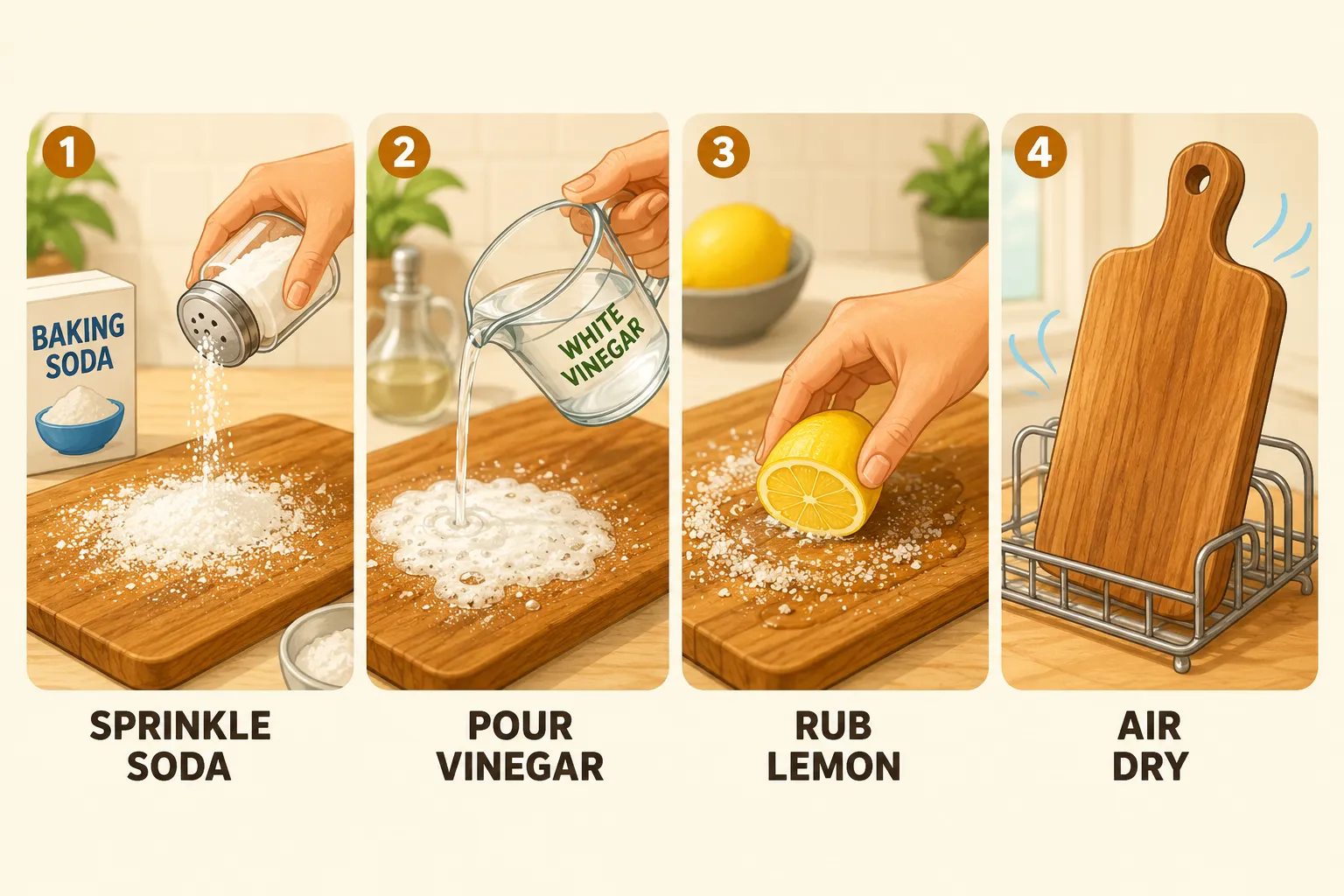
Yes, both vinegar and baking soda are effective at removing cutting board odors, but they work best when used separately rather than together. Combining them causes a fizzing reaction that neutralizes both compounds before they can do their job.
White vinegar (acetic acid) is particularly effective against bacteria and mildew smells. Baking soda (sodium bicarbonate) is better at absorbing and neutralizing fishy and meaty odors. Using them in sequence, baking soda first, rinse, then vinegar, gives you the benefit of both [4].
How to use baking soda on a cutting board:
- Mix 1 tablespoon of baking soda with just enough water to form a thick paste
- Spread the paste over the entire board surface
- Let it sit for 10 to 15 minutes
- Scrub gently with a soft brush or sponge
- Rinse thoroughly with warm water
How to use vinegar on a cutting board:
- Pour undiluted white vinegar into a spray bottle or small bowl
- Apply it to the clean, rinsed board surface
- Let it sit for 2 to 5 minutes
- Rinse with warm water and dry immediately
“Do not let vinegar sit on a wooden board for more than 5 minutes. Extended exposure can dry out the wood and cause cracking over time.” [5]
For plastic boards, vinegar is especially useful because it can reach into the fine grooves that form from knife cuts and kill the bacteria living there [7].
Can You Use Lemon to Remove Cutting Board Odors
Yes, lemon is one of the most effective and food-safe ways to remove cutting board odors, particularly for everyday smells from garlic, onion, and herbs. The citric acid in lemon juice breaks down odor-causing compounds and leaves a fresh scent behind.
Lemon works best when paired with coarse salt. The salt provides mechanical abrasion that lifts surface residue, while the lemon juice penetrates slightly into the wood or plastic surface to neutralize odor molecules at a chemical level [3].
Lemon treatment, step by step:
- Cut a fresh lemon in half
- Sprinkle coarse kosher or sea salt generously over the board
- Press the cut side of the lemon firmly onto the salt and scrub in circular motions, squeezing slightly to release juice
- Cover the entire surface, paying extra attention to areas where you cut garlic or onion
- Let the mixture sit for 5 minutes
- Rinse with warm water and dry the board standing upright
This method is safe for all cutting board materials, including wood, bamboo, and plastic. It is also completely food-safe, so there is no risk of chemical residue.
Edge case: If your board has a very strong fish smell, lemon alone may not be enough. In that case, follow the lemon-salt scrub with a baking soda treatment for better results.
Does Salt and Lemon Work for Cutting Board Odor Removal
Salt and lemon together form one of the most recommended natural treatments for cutting board odor removal. The combination is effective, inexpensive, and requires no special equipment. Most guides, including those from food safety and kitchen care sources, list this as the first-line treatment for mild to moderate odors [4] [7].
The salt acts as a gentle abrasive that physically removes food particles from the board’s surface, while the lemon’s citric acid neutralizes alkaline odor compounds and provides mild antibacterial action. Together, they address both the physical residue and the chemical cause of the smell.
When salt and lemon is the right choice:
- Everyday odors from vegetables, herbs, and fruit
- Garlic and onion smells
- Light surface discoloration alongside odors
- When you want a completely chemical-free treatment
When to use something stronger:
- Persistent fish or raw meat smells after multiple lemon treatments
- A board that smells musty (use vinegar instead)
- Visible mold or dark staining (use hydrogen peroxide, then consider replacement)
Why Does My Plastic Cutting Board Smell So Bad
Plastic cutting boards develop persistent odors because knife cuts create microscopic grooves in the surface that trap food particles, moisture, and bacteria. Even though plastic is technically non-porous when new, a used plastic board can harbor more bacteria than a wooden one once those grooves form.
A 2026 consumer kitchen hygiene survey cited by Real Simple found that plastic boards are among the most common sources of persistent kitchen odors precisely because home cooks assume they are easier to sanitize than wood, and so clean them less thoroughly [4].
Why plastic boards smell worse over time:
- Knife grooves create deep channels that standard washing cannot reach
- Plastic does not have the natural antimicrobial properties found in some hardwoods
- Dishwasher heat can warp plastic boards, creating uneven surfaces that collect residue
- Staining from turmeric, beet, and tomato often accompanies odor buildup
How to remove odors from a plastic cutting board:
- Wash with hot soapy water and a stiff brush, scrubbing the grooves
- Apply undiluted white vinegar and let it sit for 5 minutes
- Rinse, then apply a baking soda paste and scrub again
- For disinfection, use a diluted bleach solution (1 tablespoon bleach per gallon of water), safe for plastic, not for wood
- Rinse thoroughly and dry completely
If the grooves are deep enough to be visible and the smell returns within a day or two of cleaning, it is time to replace the board.
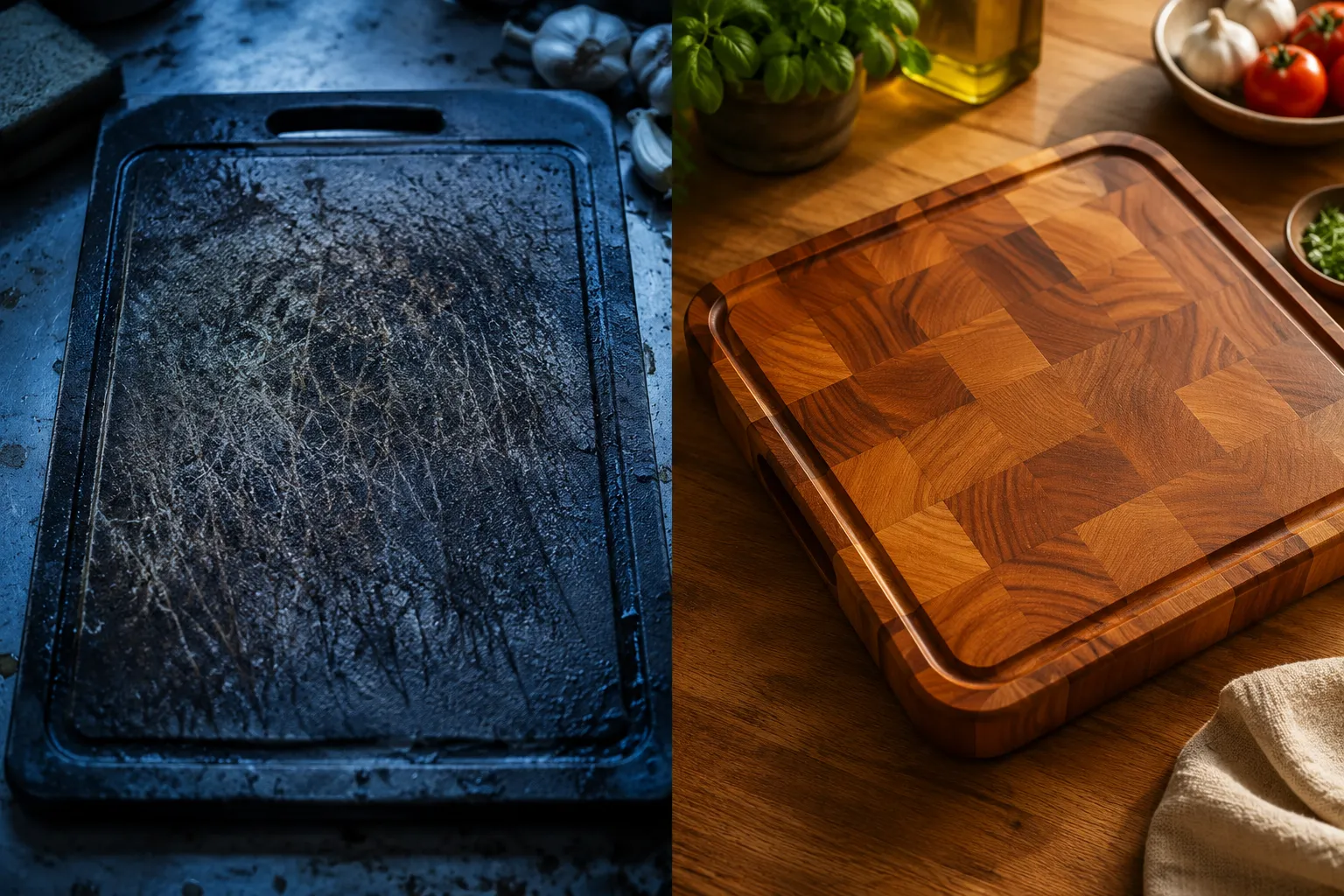
What’s the Difference Between Wooden and Plastic Cutting Boards for Odor
Wooden cutting boards absorb odors more deeply than plastic, but they also respond better to natural deodorizing treatments. Plastic boards develop surface grooves that trap bacteria in ways that are harder to clean, making them more likely to develop persistent, stubborn smells over time.
This is a genuinely counterintuitive finding. Many home cooks assume plastic is more hygienic because it looks cleaner and can go in the dishwasher. But research from UC Davis food scientist Dean Cliver found that bacteria on wooden boards tended to die off naturally, while bacteria in plastic board grooves survived and could multiply [1].
Wooden boards:
- Absorb odors into the grain, but natural antimicrobial compounds in hardwoods (like maple and walnut) help limit bacterial growth
- Respond well to lemon, salt, vinegar, and baking soda treatments
- Need regular oiling to keep pores sealed and reduce future odor absorption
- Cannot go in the dishwasher, heat and prolonged moisture cause warping and cracking
Plastic boards:
- Non-porous when new, but quickly develop knife grooves
- Can be sanitized with diluted bleach, which is not safe for wood
- Dishwasher-safe (though warping is a risk with thin boards)
- Odors in deep grooves are very difficult to eliminate completely
If you are interested in an alternative that avoids odor issues entirely, titanium cutting boards have become increasingly popular in 2026 for their non-porous, antibacterial surface. Our Katori Titanium Cutting Board review covers how titanium compares to wood and plastic for long-term hygiene.
How Often Should You Clean a Cutting Board to Prevent Smells
A cutting board should be washed with warm soapy water after every single use. For boards used with raw meat, poultry, or fish, a disinfecting step, vinegar, hydrogen peroxide, or diluted bleach for plastic, should follow every wash. A deeper deodorizing treatment with lemon, baking soda, or vinegar should be done at least once a week for boards in regular use.
The most common reason cutting boards develop persistent odors is infrequent cleaning combined with improper drying. A board that is rinsed quickly and left lying flat on a wet counter will develop mildew smell within 24 to 48 hours [2].
Cleaning frequency by use:
- After every use: Wash with warm water and dish soap, rinse, dry upright
- Weekly: Full deodorizing treatment (lemon-salt scrub or baking soda paste)
- Monthly: Deep clean with vinegar or hydrogen peroxide, followed by mineral oil conditioning for wooden boards
- Immediately: Any time you cut raw meat, fish, or poultry, do not let the board sit
The drying step is non-negotiable. Standing the board upright allows air to circulate on both sides, which is far more effective than laying it flat. Flat storage traps moisture between the board and the counter, creating exactly the conditions bacteria need to thrive.
Is It Better to Use Separate Cutting Boards for Fish and Vegetables
Yes, using separate cutting boards for fish, raw meat, and vegetables is one of the most effective ways to prevent persistent odors and reduce the risk of cross-contamination. The USDA and food safety authorities consistently recommend this practice.
The logic is straightforward: fish and raw meat leave behind the most potent odor compounds and the highest bacterial load. When you use the same board for vegetables immediately after, those compounds transfer to your produce and continue to break down, creating smells that are much harder to remove than if the board had been used for one food type only.
A practical color-coding system:
- Red board: Raw meat and poultry
- Yellow board: Raw fish and seafood
- Green board: Vegetables and fruit
- White board: Bread, cheese, and cooked foods
This system is used in professional kitchens and is equally practical at home. It costs very little to maintain a set of three or four inexpensive boards and eliminates the most common cause of persistent cutting board odors entirely.
Edge case: If you only have one board, clean and fully dry it between food types during meal prep. Do not cut vegetables on a board that just held raw chicken, even if it looks clean, a quick rinse is not sufficient.
How to Prevent Cutting Board Stains and Odors Permanently
Permanent prevention of cutting board odors comes down to three habits: clean immediately after use, dry completely every time, and condition wooden boards regularly. No single treatment eliminates odors forever, but consistent maintenance keeps them from building up.
The most effective prevention strategies:
- Wash immediately, do not let food residue sit on the board for more than a few minutes
- Use hot water and soap, warm water alone does not remove the fats and proteins that cause odors
- Dry upright, stand the board on its edge so both sides dry evenly
- Oil wooden boards monthly, food-grade mineral oil seals the wood’s pores, reducing how much food juice can penetrate [1]
- Use separate boards, as described above, this is the single biggest preventive measure
- Replace boards when grooved, deep knife marks are permanent odor traps that no cleaning method can fully address
A good kitchen routine also supports overall health. Just as you would maintain healthy gums and teeth with daily habits rather than occasional deep cleans, cutting board hygiene works the same way, consistency matters far more than intensity.
For wooden boards specifically: Apply a thin coat of food-grade mineral oil after every deep clean. Let it soak in overnight, then wipe off the excess. This step is what separates a wooden board that lasts decades from one that cracks and smells within a year.
When Should You Replace a Cutting Board Instead of Cleaning It
Replace a cutting board when it has deep knife grooves that cannot be cleaned, visible cracks or splits, persistent odors that return within 24 hours of a thorough cleaning, or visible mold that has penetrated below the surface. No amount of cleaning will make a severely damaged board safe or odor-free.
The general guideline from kitchen safety experts is that if you can feel the knife grooves with your fingernail and the board has a persistent smell, it has reached the end of its useful life [7]. For plastic boards, this point often comes sooner than most people expect, sometimes within one to two years of regular use.
Signs it is time to replace your cutting board:
- Deep grooves visible to the naked eye
- Cracks or splits in a wooden board (these harbor bacteria and cannot be cleaned)
- Odor returns within a day of a thorough cleaning and deodorizing treatment
- Black or green spots that do not scrub off (mold below the surface)
- Warping that makes the board rock on the counter (a safety hazard)
- Discoloration that has penetrated the material, not just the surface
Cost perspective: A quality wooden or plastic cutting board costs between $20 and $60. Replacing it every two to three years for plastic, or every five to ten years for a well-maintained wooden board, is a reasonable investment in food safety. If you want to avoid replacement cycles entirely, high-end non-porous surfaces like titanium boards are worth considering, our detailed Katori Titanium Cutting Board review covers the long-term value case.
How to Store Cutting Boards to Keep Them from Smelling
Store cutting boards upright in a ventilated rack or slot, never lying flat on a wet counter or stacked against each other while still damp. Poor storage is one of the most overlooked causes of cutting board odors.
When boards are stored flat or stacked, moisture gets trapped between surfaces. That moisture creates the warm, damp environment where odor-causing bacteria and mold thrive. Upright storage allows air to circulate on all sides, which dramatically reduces moisture retention and the smells that come with it [10].
Best storage practices:
- Use a vertical board rack or a deep slot in a drawer insert
- Ensure the board is completely dry before storing, at minimum 30 minutes of air drying after washing
- Do not store boards in a closed cabinet while still warm from washing
- Keep boards away from the area directly beside the sink, where ambient moisture is highest
- If you store multiple boards together, leave a small gap between them for airflow
For wooden boards: Avoid storing in direct sunlight for extended periods. UV exposure can dry out the wood and cause cracking, which creates new odor traps.
A well-stored board that is cleaned and dried properly after every use should not develop significant odors between uses. If yours does, the issue is almost always incomplete drying rather than the storage location itself.

How to Remove Cutting Board Odors: A Complete Step-by-Step Checklist
This checklist covers the full process for removing cutting board odors, from the baseline wash through deep treatment and prevention. Use it as a reference for both wooden and plastic boards.
Daily routine (every use):
- Wash with warm water and dish soap immediately after use
- Scrub all surfaces, including edges and the back
- Rinse thoroughly with warm water
- Pat dry with a clean cloth
- Stand upright to air dry completely
Weekly deodorizing treatment:
- Perform the daily routine first
- Apply salt-and-lemon scrub (or baking soda paste for fish/meat odors)
- Let the treatment sit for 5 to 15 minutes depending on severity
- Scrub with a soft brush
- Rinse and dry completely
Monthly deep clean:
- Perform the weekly treatment
- Apply white vinegar or 3% hydrogen peroxide and let sit for 5 minutes
- Rinse thoroughly
- For wooden boards: apply food-grade mineral oil and let soak overnight
- Wipe off excess oil and store upright
Immediate action for strong odors (fish, garlic, raw meat):
- Wash with hot soapy water first
- Apply baking soda paste and scrub
- Rinse, then apply white vinegar
- Rinse again and dry completely
- Assess whether the board needs replacement if odor persists
FAQ: How to Remove Cutting Board Odors
Q: What is the fastest way to remove cutting board odors?
The fastest method is the salt-and-lemon scrub. Sprinkle coarse salt on the board, rub with a cut lemon for 2 to 3 minutes, rinse, and dry. This takes under 10 minutes and works on most everyday odors.
Q: Can I put my wooden cutting board in the dishwasher to remove odors?
No. Dishwasher heat and prolonged water exposure will warp and crack a wooden board. Wash wooden boards by hand only with warm soapy water, then dry immediately.
Q: How do I get fish smell out of a cutting board?
Use a baking soda paste. Mix baking soda with a small amount of water, spread it over the board, and let it sit for 10 to 15 minutes before scrubbing and rinsing. Follow with a white vinegar wipe for best results.
Q: Is bleach safe to use on cutting boards?
Diluted bleach (1 tablespoon per gallon of water) is safe for plastic cutting boards and effective at disinfecting and deodorizing. Do not use bleach on wooden boards, it dries out the wood and can cause cracking.
Q: How do I know if my cutting board has mold versus just a stain?
Mold typically appears as fuzzy black, green, or gray spots and may have a musty smell. Stains from beets, turmeric, or berries are flat and do not have a musty odor. If you suspect mold that has penetrated the surface, replace the board.
Q: Does coffee grounds work to remove cutting board odors?
Used coffee grounds can absorb some surface odors from a cutting board, similar to how they absorb odors in a refrigerator. Rub them over the surface, let sit for a few minutes, then rinse. This works best as a supplementary method alongside soap and water.
Q: How long should I let baking soda sit on a cutting board?
Let baking soda paste sit for 10 to 15 minutes for moderate odors, or up to 30 minutes for very strong fish or meat smells. Rinse thoroughly afterward to remove all residue.
Q: Can I use essential oils to deodorize my cutting board?
Tea tree oil has some antibacterial properties and can help with odors, but it should be used sparingly and rinsed off thoroughly. It is not a substitute for proper washing and deodorizing with food-safe agents like lemon or baking soda.
Q: Why does my cutting board still smell after washing?
The most common reasons are: not using soap (water alone does not remove odor-causing fats and proteins), not drying the board completely, or having deep knife grooves that harbor bacteria. If the smell persists after a thorough cleaning and deodorizing treatment, the board likely needs to be replaced.
Q: How often should I oil my wooden cutting board?
Oil a new wooden board before its first use and then once a month during regular use. If the wood looks dry or lighter in color than usual, oil it sooner. Use only food-grade mineral oil or a beeswax-based board conditioner.
Q: Are bamboo cutting boards better or worse for odors than wood?
Bamboo is technically a grass, not a wood, and it is harder and less porous than most hardwoods. This makes bamboo boards slightly more resistant to odor absorption initially, but they are also harder on knife edges. The same cleaning and deodorizing methods that work for wood apply to bamboo.
Q: What household items remove cutting board odors?
The most effective household items are: white vinegar, baking soda, fresh lemon, coarse salt, and 3% hydrogen peroxide. All are inexpensive, food-safe, and available in most kitchens.
Conclusion
Learning how to remove cutting board odors is less about finding a magic solution and more about building consistent habits. The salt-and-lemon scrub handles most everyday smells. Baking soda tackles fish and meat odors. White vinegar addresses bacteria and mildew. And proper drying and storage prevent most odors from developing in the first place.
Your actionable next steps:
- Wash your cutting board with warm soapy water after every single use and stand it upright to dry
- Do a salt-and-lemon scrub this week on any board that has been in regular use
- Set a monthly reminder to condition your wooden board with food-grade mineral oil
- If you do not already use separate boards for meat, fish, and vegetables, pick up a second or third board this week, it is the single most impactful change you can make
- Inspect your current boards for deep grooves or cracks; if they are present and the smell persists after cleaning, replace the board
Maintaining clean, odor-free cutting boards is a straightforward part of kitchen hygiene that pays dividends in food safety and cooking quality. A board that smells clean is one that is genuinely clean, and that matters every time you prepare a meal.
If you are also thinking about your broader kitchen hygiene and health habits, it is worth noting that what happens in the kitchen connects to overall wellness. Our guides on how to improve digestive enzyme function naturally and how the immune system is linked to gut health explore how food preparation hygiene connects to what happens inside your body.
References
[1] How To Clean Wood Cutting Boards – https://www.nytimes.com/wirecutter/guides/how-to-clean-wood-cutting-boards/
[2] Wooden Cutting Board Disinfection Odor Removal – https://boazstore.com/wooden-cutting-board-disinfection-odor-removal/
[3] Remove Smells From Wooden Cutting Board – https://blueandhazel.com/remove-smells-from-wooden-cutting-board
[4] How To Deodorize Smelly Cutting Boards – https://www.realsimple.com/how-to-deodorize-smelly-cutting-boards-11878685
[5] How To Clean Cutting Board With Vinegar – https://www.southernliving.com/how-to-clean-cutting-board-with-vinegar-11892786
[7] Cutting Board Smell Removal Guide – https://kitchengearly.com/cutting-board-smell-removal-guide/
[8] How To Clean Cutting Board With Vinegar – https://cookindocs.com/how-to-clean-cutting-board-with-vinegar/
[10] How To Get Smell Out Of Wooden Cutting Board – https://timberlaketrussworks.com/how-to-get-smell-out-of-wooden-cutting-board/
Tags: cutting board odors, how to deodorize cutting board, remove cutting board smell, wooden cutting board cleaning, baking soda cutting board, lemon and salt cutting board, plastic cutting board smell, cutting board hygiene, kitchen cleaning tips, food safety, cutting board maintenance, prevent cutting board odors

With over 13 years of experience in holistic health blogging, I aim to help you navigate your wellness journey with honest insights, expert-backed advice, and a sprinkle of real-world practicality.
Certified Wellness Writer | Herbal Nutrition Advocate | Wellness Research Enthusiast