Best Cutting Boards for Japanese Knives (2026): Protect Your Blades and Improve Performance

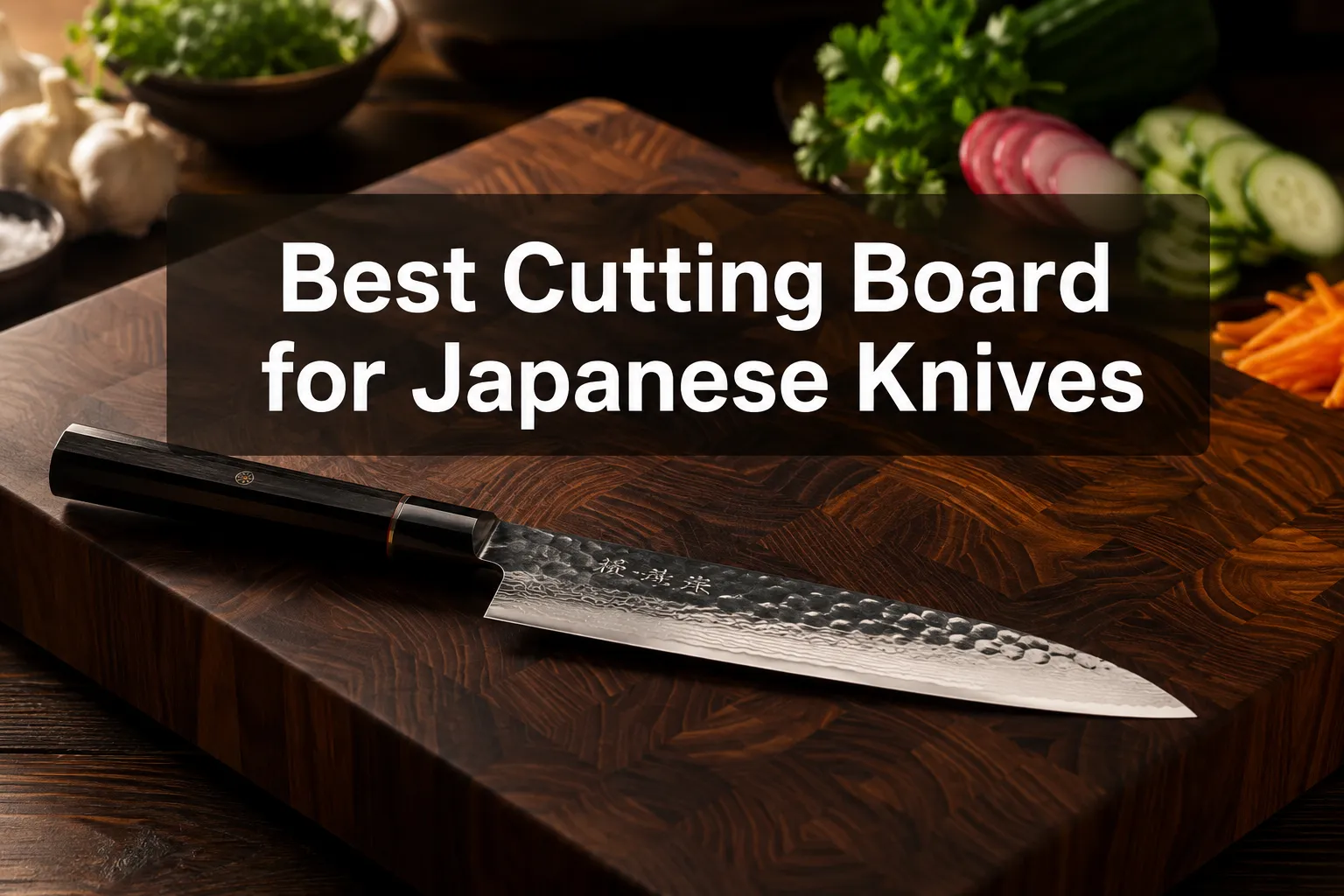
Quick Answer: The best cutting board for Japanese knives is a soft-wood end-grain board (such as hinoki or walnut) or a quality synthetic board like the Yoshihiro HAYATE Hi-Soft.
Japanese knives have harder steel (typically 60+ on the Rockwell hardness scale) and thinner edges than Western knives, so they need a softer, more forgiving surface to stay sharp longer. Avoid glass, ceramic, and bamboo boards entirely.
Key Takeaways
- Japanese knives require softer cutting surfaces because their harder, thinner steel edges chip and dull faster on hard boards.
- End-grain wood boards (walnut, maple, cherry) and hinoki cypress are the top natural material choices.
- Synthetic “Hi-Soft” boards made from materials like polyvinyl acetate offer excellent knife protection and easy cleaning.
- Glass and ceramic boards will destroy a Japanese knife edge within a single session, never use them.
- Bamboo is harder than most hardwoods and should be avoided despite its eco-friendly reputation.
- Plastic boards are acceptable for light use but degrade over time and are not ideal for premium knives.
- Board thickness matters: aim for at least 1.5 inches for end-grain boards to absorb impact and resist warping.
- A large board (at least 12 x 18 inches) gives you the working space a Japanese chef knife needs.
- Regular oiling and proper drying extend a wooden board’s life and maintain its knife-friendly surface.
- You can spend $30 to $300+ on a quality board; the sweet spot for most home cooks is $60 to $120.
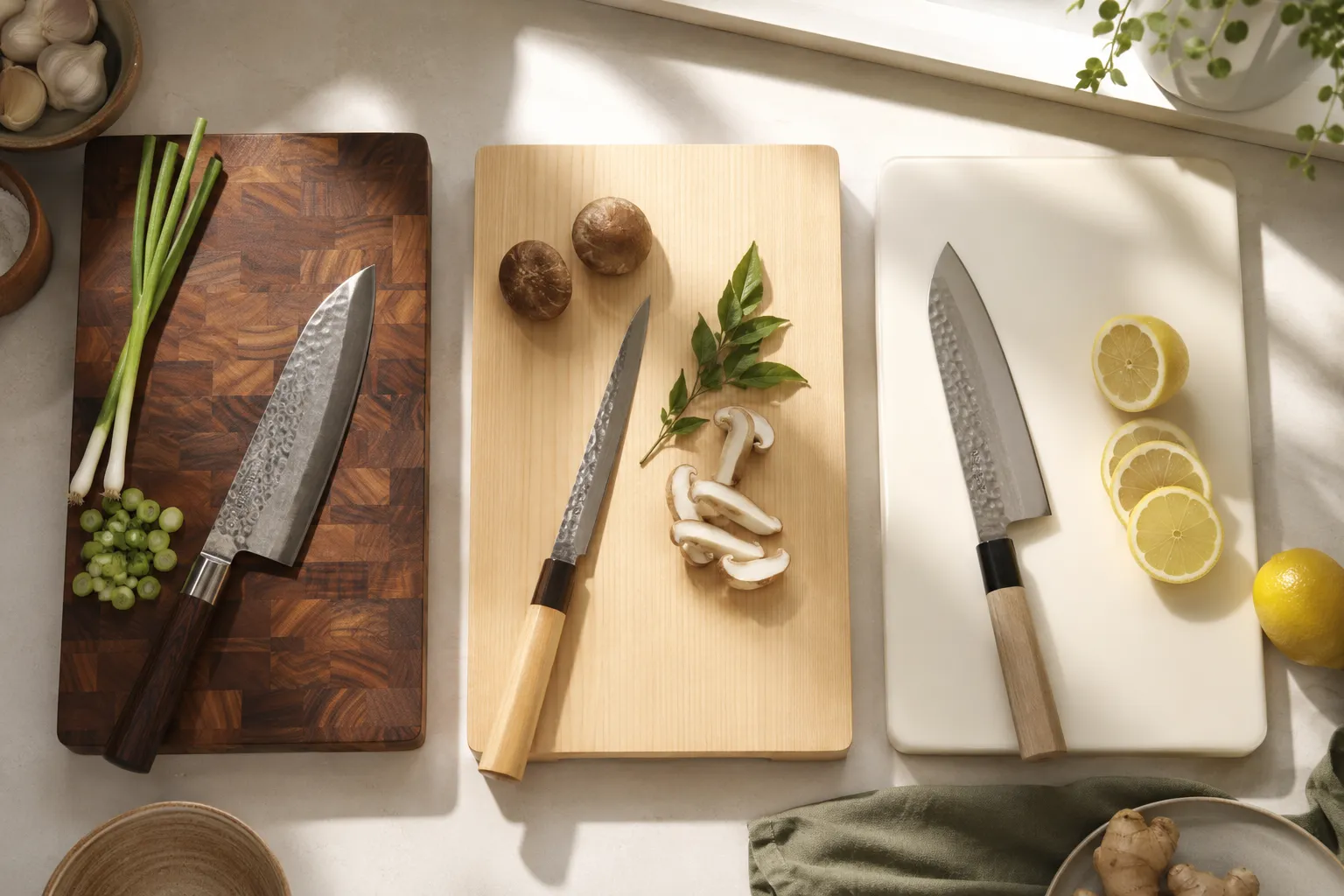
Why Do Japanese Knives Need Special Cutting Boards?
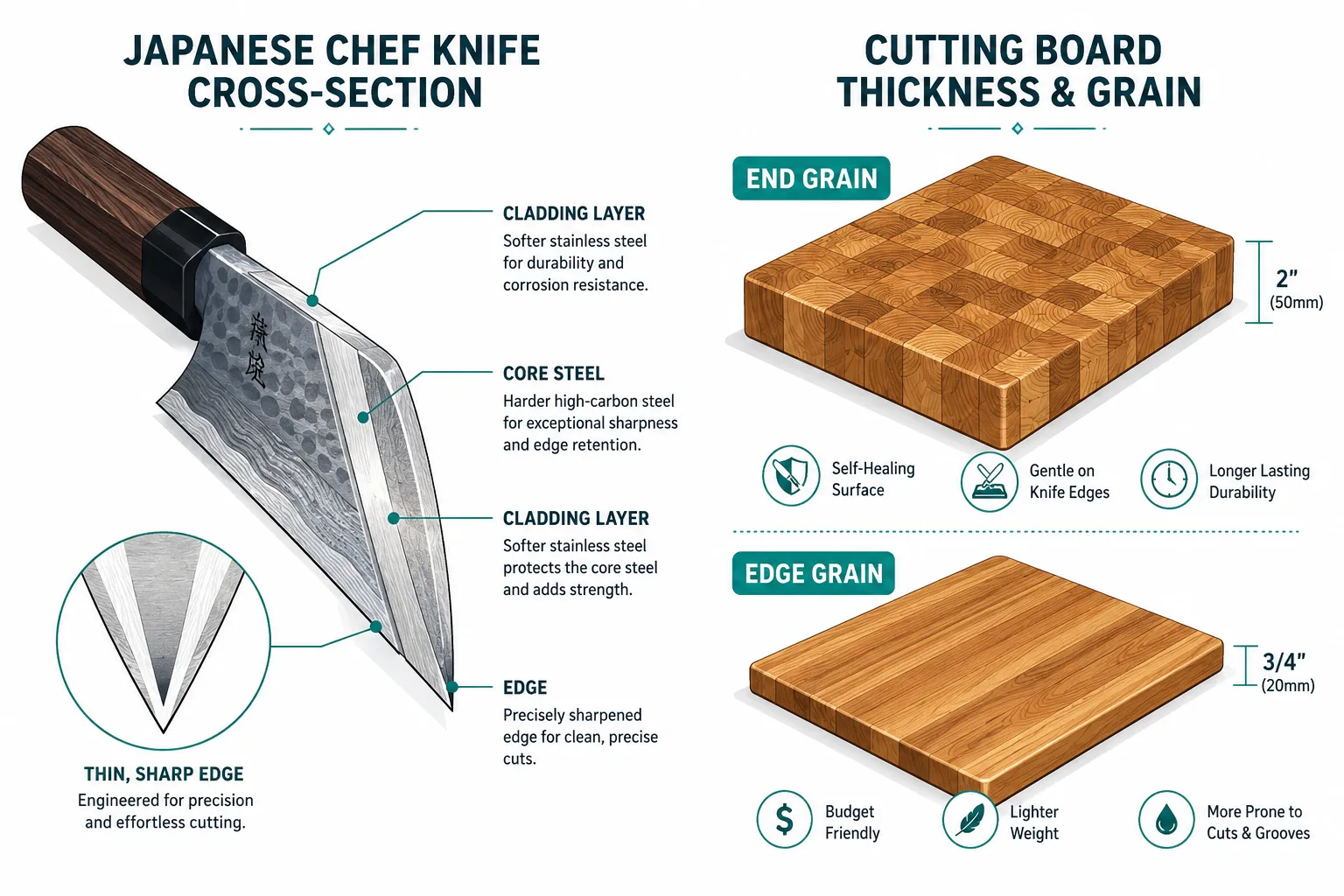
Japanese knives need softer, more forgiving cutting surfaces because their steel is significantly harder and their blades are ground thinner than Western knives. A typical Japanese knife sits between 60 and 66 on the Rockwell hardness scale, compared to 54 to 58 for most German knives. That extra hardness means the edge holds a sharper angle, but it also means the edge is more brittle and chips more easily when it strikes a hard surface [2].
The cutting style also matters. Many Japanese knife techniques involve a straight push-cut or tap-cut motion rather than the rocking motion common with Western knives. This push-cut style concentrates force on a very small point of the edge, which amplifies the damage a hard board can cause [3].
Here is what happens on the wrong board:
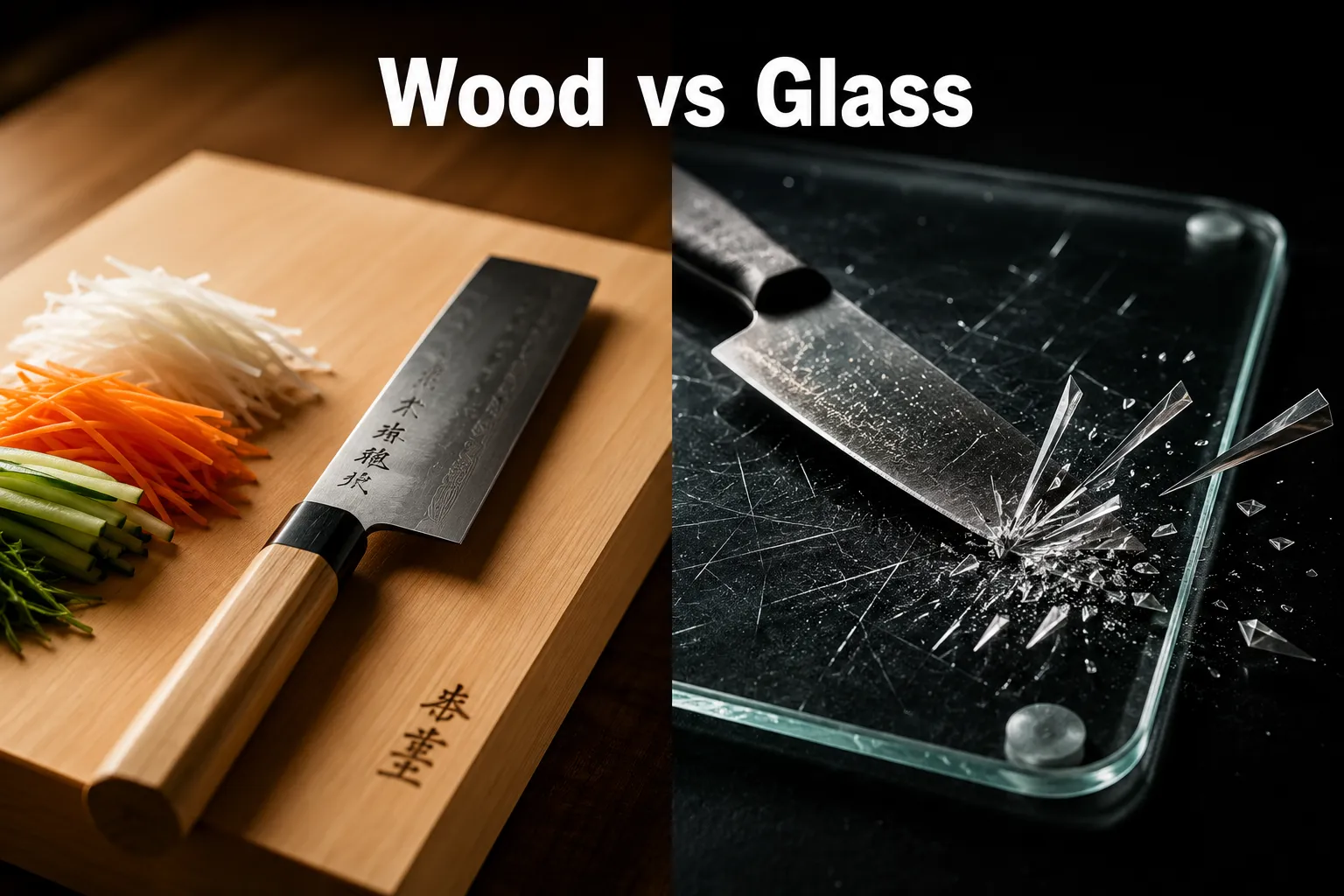
- Glass or ceramic boards: The edge contacts a surface harder than the steel itself. Microscopic chips form along the blade with every cut. A single prep session can set back weeks of sharpening work.
- Bamboo boards: Despite their “natural” reputation, bamboo is technically a grass with a Janka hardness rating higher than many hardwoods. It acts like sandpaper on a fine Japanese edge.
- Worn plastic boards: Deep grooves harbor bacteria and create uneven surfaces that catch and deflect the thin blade.
The rule is straightforward: match board softness to knife hardness. The harder the steel, the softer the board should be [1].
What Makes a Cutting Board Good for Japanese Knives?
A good cutting board for Japanese knives has three core qualities: surface softness that absorbs the blade rather than resisting it, enough stability to stay flat and not warp, and a non-porous or easy-to-clean surface that stays hygienic over time [5].
The four factors that matter most:
Surface hardness, The board should be softer than the knife steel. Hinoki cypress, paulownia, and synthetic Hi-Soft materials score well here. Hard maple and walnut end-grain are also acceptable because the end-grain orientation “closes” around the blade rather than cutting across the wood fibers.
Grain orientation, End-grain boards (where you see the tree rings on the cutting surface) are gentler on edges than edge-grain boards (where you see the long wood fibers). End-grain fibers part around the blade; edge-grain fibers resist it.
Thickness and stability, A board that flexes or warps creates an uneven surface that stresses the blade. Aim for at least 1.5 inches of thickness for end-grain boards and boards that have rubber feet or a non-slip base.
Surface maintenance, A dry, well-oiled wood surface is smooth and consistent. A neglected board develops grooves, raised grain, and rough patches that catch the knife.
“The board is not just a work surface, it is the last line of defense between a perfect edge and a ruined one.”
Best Wood Types for Japanese Knife Cutting Boards
Hinoki cypress is widely considered the best natural wood for Japanese knives, followed by end-grain walnut, cherry, and teak. Each has different trade-offs in softness, durability, and maintenance needs [3].
Hinoki (Japanese Cypress)
- Janka hardness: approximately 400 lbf (very soft)
- Natural antimicrobial properties from the wood’s essential oils
- Releases a pleasant cedar-like aroma when cut
- Self-healing surface: fibers close back together after cuts
- Requires regular oiling; can warp if not dried properly
- Best for: push-cut techniques, delicate slicing knives like yanagiba
End-Grain Walnut
- Janka hardness: approximately 1010 lbf (medium)
- Durable and resistant to deep scarring
- Beautiful dark grain that hides stains well
- Heavier than hinoki, which adds stability
- Best for: all-purpose prep, gyuto, santoku
End-Grain Maple
- Janka hardness: approximately 1450 lbf (medium-hard)
- Very tight grain, highly resistant to bacteria
- More affordable than walnut
- Slightly harder on knife edges than walnut or hinoki
- Best for: budget-conscious buyers who still want wood quality
Cherry
- Janka hardness: approximately 950 lbf
- Softer than maple, easier on edges
- Develops a rich patina over time
- Best for: home cooks who want an attractive board that is also knife-friendly
Teak
- Janka hardness: approximately 1155 lbf
- Naturally water-resistant due to high oil content
- The natural oils can dull knives faster than other woods over time
- Best for: outdoor or high-moisture environments, not ideal for premium Japanese knives
End Grain vs. Edge Grain for Japanese Knives
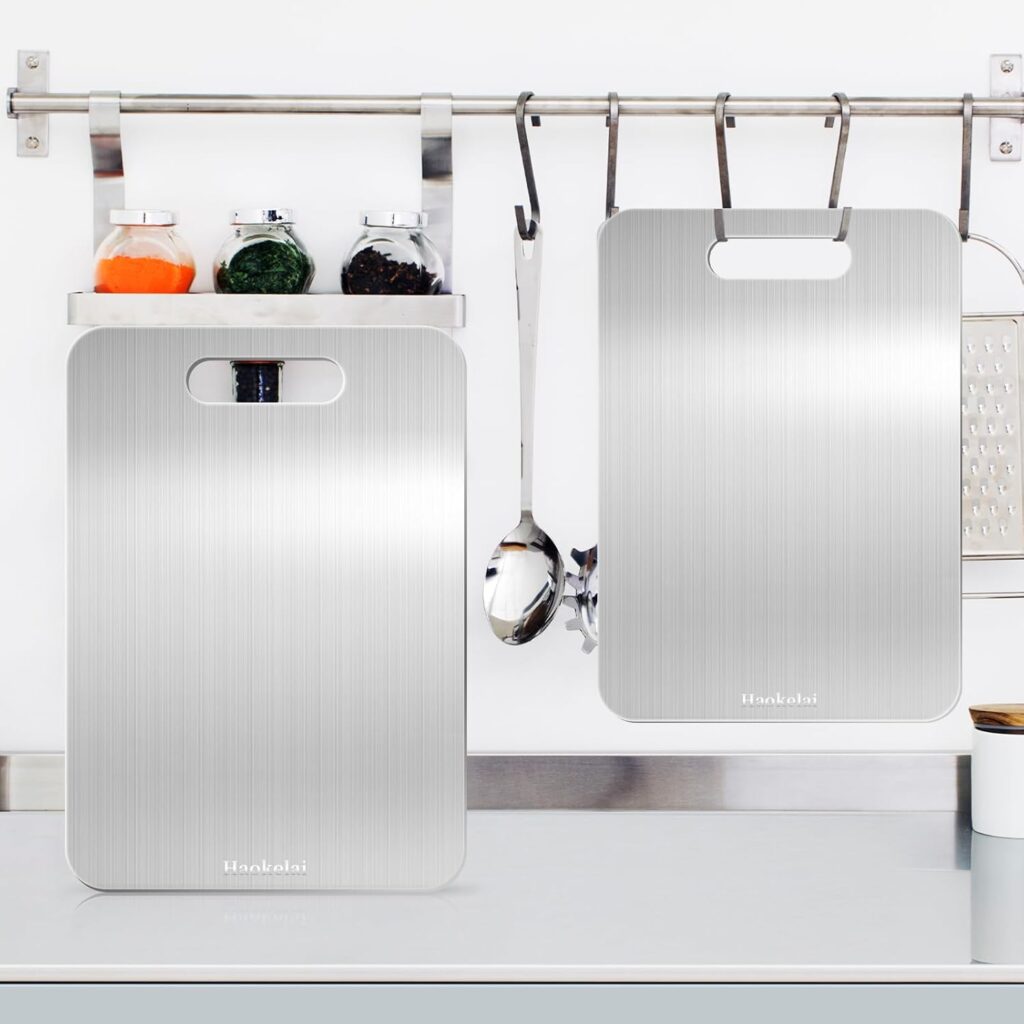
End-grain boards are better for Japanese knives than edge-grain boards. When a knife strikes an end-grain surface, it slides between the wood fibers rather than cutting across them, which reduces edge wear and allows the board to partially self-heal [2].
End-grain boards:
- Gentler on knife edges
- Self-healing surface (fibers close after cuts)
- Heavier and more expensive
- Require more oil to prevent cracking
Edge-grain boards:
- More affordable and widely available
- Easier to maintain flat
- Harder on knife edges because the blade cuts across wood fibers
- Still a solid choice if you use a softer wood like cherry or walnut
Decision rule: Choose end-grain if you own knives above $100 and sharpen them yourself. Choose edge-grain if you want a more affordable option and are willing to sharpen a bit more frequently.
Bamboo vs. Wood Cutting Board for Japanese Knives
Wood wins over bamboo for Japanese knives, and this is not a close comparison. Bamboo is harder than most hardwoods commonly used for cutting boards, and its dense, silica-rich fibers dull knife edges faster than walnut or maple [1].
Bamboo’s reputation as a “knife-friendly” material is largely a marketing claim. The silica content in bamboo grass acts as a mild abrasive. Over repeated use, a bamboo board will microchip and roll a fine Japanese edge much faster than a properly maintained wood board.
The only case for bamboo: It is inexpensive, lightweight, and resists water absorption better than untreated wood. If you are using a budget knife and need a quick prep surface, bamboo is acceptable. But for a $150+ Japanese knife, bamboo is a poor investment.
Can You Use a Plastic Cutting Board with Japanese Knives?
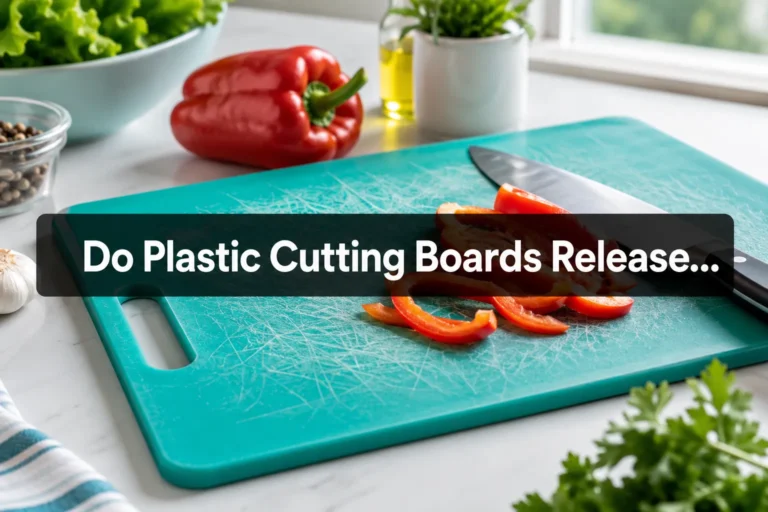
Plastic boards are acceptable for Japanese knives in the short term, but they are not ideal for long-term edge preservation. A new, smooth plastic board (HDPE or polyethylene) is soft enough to be gentle on edges. The problem is that plastic boards develop deep grooves quickly, and those grooves create uneven surfaces that catch and deflect thin Japanese blades [3].
When plastic works:
- New, smooth boards with no deep grooves
- Light prep tasks (herbs, soft vegetables)
- Situations where hygiene is the top priority (raw meat, fish)
When plastic fails:
- Heavily grooved boards that create an uneven cutting surface
- Dishwasher-warped boards that no longer lie flat
- Boards used for heavy chopping that have developed ridges
A practical approach many professional cooks use: keep a plastic board specifically for raw proteins (for easy sanitizing) and use a wood or synthetic board for all other prep work.
Why Glass Cutting Boards Are Bad for Japanese Knives
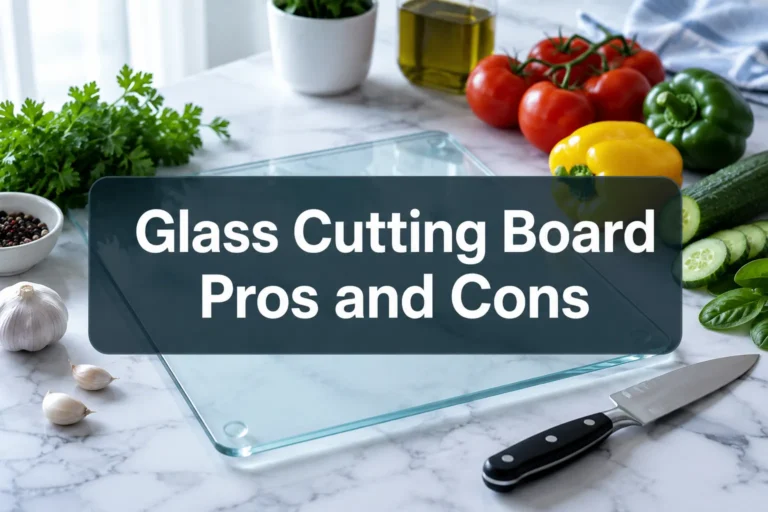
Glass cutting boards will damage a Japanese knife edge faster than any other common surface. Glass has a hardness of approximately 5.5 on the Mohs scale, while hardened Japanese steel sits at around 6 to 6.5. The surfaces are nearly equal in hardness, which means every cut creates microscopic chips and rolls along the blade edge [4].
Beyond edge damage, glass boards are also slippery, loud, and provide no tactile feedback during cutting. There is no scenario in which a glass board is a good choice for a Japanese knife. The same applies to ceramic, marble, and stone cutting surfaces.
Bottom line: If you own a Japanese knife, remove glass and ceramic boards from your kitchen entirely.
Cutting Board Thickness for Japanese Knives
For Japanese knives, aim for a cutting board that is at least 1.5 inches thick for end-grain boards and at least 0.75 inches for edge-grain or synthetic boards. Thicker boards absorb impact better, stay flatter over time, and provide a more stable cutting surface [5].
Thickness guidelines by board type:
| Board Type | Minimum Thickness | Ideal Thickness |
|---|---|---|
| End-grain wood | 1.5 inches | 2 to 2.5 inches |
| Edge-grain wood | 0.75 inches | 1 to 1.5 inches |
| Synthetic (Hi-Soft) | 0.5 inches | 0.75 to 1 inch |
| Plastic (HDPE) | 0.5 inches | 0.75 inches |
Thin boards flex under pressure, which is particularly problematic for Japanese knives because the blade can catch on a board that shifts during a cut. A heavy, stable board also reduces hand fatigue during long prep sessions.
Best Cutting Board Size for Japanese Chef Knives
For a Japanese chef knife (gyuto), the minimum useful board size is 12 x 18 inches. Most professional cooks and serious home cooks prefer 15 x 20 inches or larger. The long, straight blade of a gyuto needs room to complete a full stroke without the tip or heel hanging off the edge [2].
Size recommendations by knife type:
- Gyuto (chef’s knife, 210mm to 270mm): 15 x 20 inches minimum
- Santoku (165mm to 180mm): 12 x 18 inches works well
- Nakiri (vegetable knife): 12 x 15 inches acceptable
- Yanagiba (sashimi knife, 270mm to 360mm): 18 x 24 inches or longer
A board that is too small forces you to reposition food constantly, which increases the risk of the blade striking the board edge, a common cause of tip damage on Japanese knives.
Best Cutting Board for Maintaining a Sharp Japanese Knife
The best cutting board for maintaining a sharp Japanese knife is the Yoshihiro HAYATE Hi-Soft synthetic board or a hinoki cypress board from a reputable maker like Shun. Both surfaces are soft enough to protect a fine edge, stable enough for daily use, and easy to maintain [1][5].
Top picks in 2026:
Yoshihiro HAYATE Hi-Soft Board
- Material: Polyvinyl acetate synthetic rubber composite
- Surface hardness: Very soft, comparable to soft wood
- Pros: Dishwasher-safe, non-porous, no oiling required, gentle on edges
- Cons: Can develop surface stains; lacks the aesthetic of natural wood
- Best for: Cooks who want maximum edge protection with minimal maintenance
Shun Large Hinoki Cutting Board
- Material: Japanese hinoki cypress
- Surface hardness: Very soft (Janka ~400 lbf)
- Pros: Traditional Japanese material, natural antimicrobial properties, beautiful appearance
- Cons: Requires regular oiling, can warp if left wet
- Best for: Home cooks who prefer natural materials and traditional Japanese aesthetics
John Boos End-Grain Walnut Board
- Material: American black walnut, end-grain
- Surface hardness: Medium (Janka ~1010 lbf)
- Pros: Extremely durable, widely available, beautiful grain
- Cons: Heavier than hinoki, harder on edges than Hi-Soft
- Best for: All-purpose prep, cooks who want a long-lasting investment board
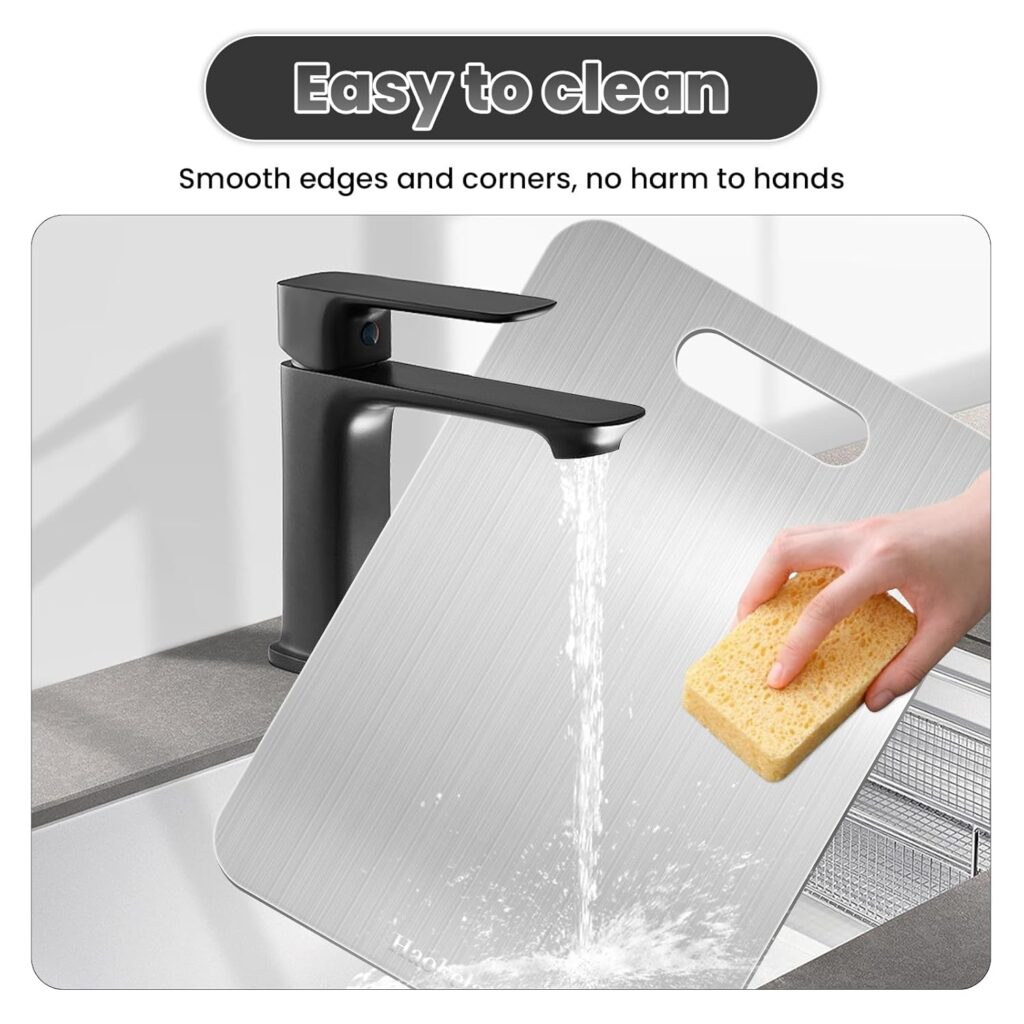
For a detailed look at how titanium compares as a cutting surface material, see our Katori Titanium Cutting Board review.
Do I Need a Special Board or Just a Regular One?
You do need a board that meets specific material criteria, but you do not need to buy an expensive specialty product. Any cutting board made from a soft to medium hardwood (walnut, cherry, maple end-grain) or a quality synthetic material will protect a Japanese knife well. What you must avoid are glass, ceramic, bamboo, and heavily worn plastic boards [3].
The “special” part is not about brand names or price tags. It is about surface hardness and grain orientation. A $40 end-grain cherry board from a local woodworker will protect your knife better than a $200 bamboo board sold as “premium.”
Choose a specialty board if:
- You own knives above $150 and sharpen them yourself
- You use a yanagiba or other single-bevel knife that is extremely sensitive to edge damage
- You cook daily and want to minimize sharpening frequency
A standard wood board is fine if:
- You own mid-range Japanese knives ($50 to $150)
- You sharpen regularly and do not mind touching up the edge more often
- You prefer the aesthetics and lower cost of a simple edge-grain board
How to Care for a Wooden Cutting Board with Japanese Knives
Proper care keeps a wooden board knife-friendly and extends its life by years. The two biggest mistakes are leaving the board wet and never oiling it. Both cause the wood to dry, crack, and develop rough surfaces that damage knife edges [5].
Step-by-step care routine:
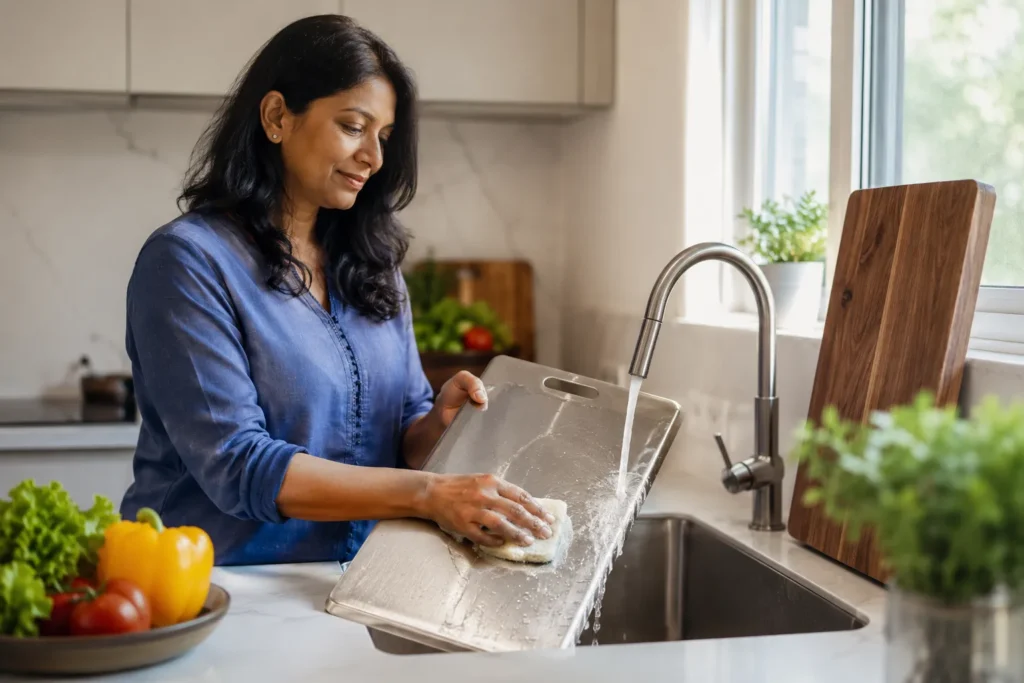
- After each use: Wipe the board clean with a damp cloth and mild dish soap. Do not submerge in water.
- Dry immediately: Stand the board upright or prop it at an angle so air circulates on both sides. Never lay it flat while wet.
- Oil monthly (or when the wood looks dry): Apply food-grade mineral oil or a beeswax-oil blend with a soft cloth. Let it soak in for at least two hours, then wipe off the excess.
- Deep clean quarterly: Scrub with coarse salt and half a lemon to remove odors and surface stains, then re-oil.
- Sand if needed: If the surface develops rough grooves, sand lightly with 220-grit sandpaper, then re-oil. A smooth surface is essential for protecting a fine edge.
What to avoid:
- Dishwasher (warps and cracks wood)
- Soaking in water
- Bleach or harsh chemical cleaners
- Storing flat while wet
A well-maintained hinoki or walnut board can last 10 to 20 years with this routine.
How Much Does a Quality Japanese Knife Cutting Board Cost?
A quality cutting board for Japanese knives costs between $40 and $200 for most buyers, with professional-grade options reaching $300 or more. The price range reflects material quality, size, and construction method [2].
Price ranges by category:
- Budget ($20 to $50): Edge-grain maple or plastic HDPE boards. Acceptable for mid-range knives. Limited longevity.
- Mid-range ($50 to $120): End-grain walnut or cherry boards, quality hinoki boards, entry-level Hi-Soft synthetic boards. Best value for most home cooks.
- Premium ($120 to $250): Large end-grain boards from premium makers (Boos, BoardSmith), Shun hinoki boards, Yoshihiro Hi-Soft. Best for serious cooks and premium knife collections.
- Professional ($250+): Custom end-grain boards, large-format hinoki slabs, professional-grade synthetic boards. Designed for daily heavy use.
The value calculation: A $100 end-grain walnut board that lasts 15 years costs less than $7 per year. A $25 plastic board replaced every two years costs $12.50 per year, and does more damage to your knives in the process. The upfront investment in a quality board pays for itself in reduced sharpening and longer knife life.
Comparing the Best Cutting Board Options for Japanese Knives
Here is a direct comparison of the top board types across the criteria that matter most for Japanese knife users.
| Board Type | Edge Protection | Hygiene | Maintenance | Price Range | Best For |
|---|---|---|---|---|---|
| Hinoki Cypress | Excellent | Very Good | High (regular oiling) | $50, $200 | Traditional Japanese use |
| End-Grain Walnut | Very Good | Good | Medium (monthly oil) | $60, $250 | All-purpose daily prep |
| Hi-Soft Synthetic | Excellent | Excellent | Low (dishwasher safe) | $40, $150 | Low-maintenance, hygiene-focused |
| Plastic (HDPE) | Fair | Good (when new) | Low | $15, $60 | Raw protein prep only |
| Bamboo | Poor | Good | Low | $20, $80 | Not recommended |
| Glass / Ceramic | Very Poor | Excellent | Very Low | $20, $100 | Avoid entirely |
Frequently Asked Questions
Can I use a regular wood cutting board with my Japanese knife?
Yes, as long as the wood is soft to medium hardness (walnut, cherry, maple end-grain). Avoid very hard woods like teak or acacia, which can dull a fine Japanese edge faster than softer options.
How often should I oil my wooden cutting board?
Oil your board once a month under normal use, or whenever the wood looks dry or pale. A well-oiled board maintains a smooth, consistent surface that is gentler on knife edges and more resistant to bacteria.
Is the Yoshihiro Hi-Soft board worth the price?
For anyone with a Japanese knife collection above $200 in total value, yes. The Hi-Soft surface is exceptionally gentle on edges, requires no oiling, and is dishwasher-safe. It is the top recommendation in multiple 2026 independent reviews for a reason [1].
Can I use both sides of my cutting board?
Yes, and you should. Flipping the board regularly ensures even wear and helps prevent warping by exposing both sides to air equally.
Why does my Japanese knife feel dull after only a few uses?
The most common cause is the cutting board surface. If you are using bamboo, glass, ceramic, or a heavily grooved plastic board, the board itself is dulling the edge. Switch to a softer wood or synthetic board and you will notice the difference immediately.
Is a titanium cutting board good for Japanese knives?
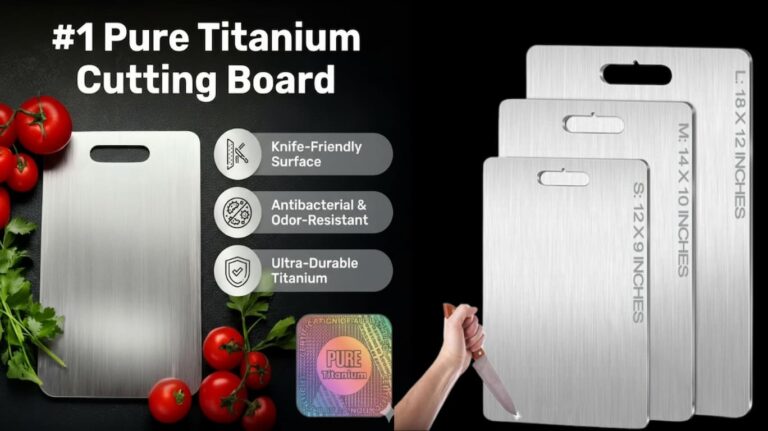
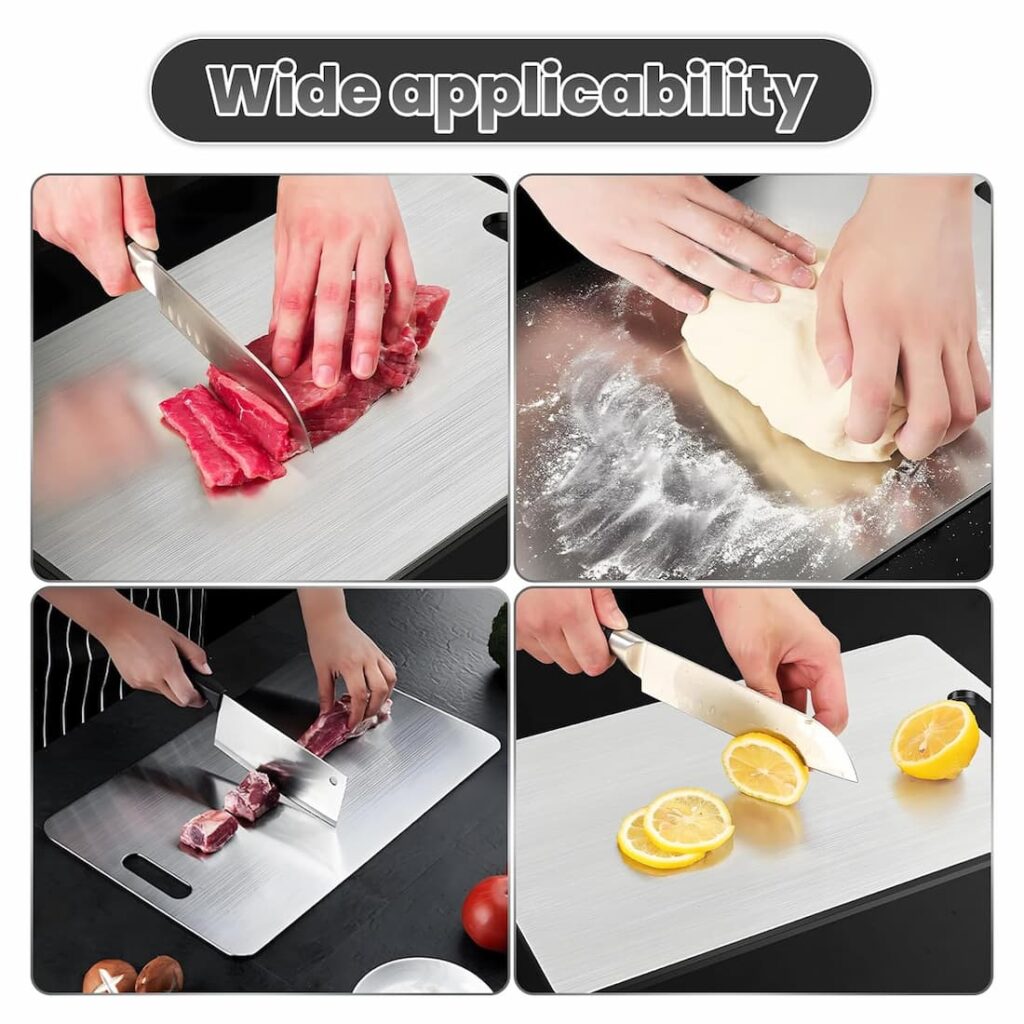
Titanium boards are marketed as knife-friendly, but the surface hardness varies by grade and finish. A brushed titanium surface can be gentler than glass but is generally harder than wood or Hi-Soft synthetics. For premium Japanese knives, wood or synthetic boards remain the safer choice. You can read a detailed breakdown in our Katori Titanium Cutting Board review and complaints analysis.
What size cutting board do I need for a 210mm gyuto?
A 210mm gyuto needs at least a 15 x 18 inch board for comfortable use. The full stroke of the blade should complete without the tip or heel leaving the board surface.
Does the color of the wood matter for knife protection?
No. Wood color reflects species and finish, not hardness. What matters is the Janka hardness rating and grain orientation, not the aesthetic appearance of the board.
Can I put a Japanese knife on a marble pastry board?
No. Marble is harder than Japanese steel and will chip the edge on contact. Marble boards are for rolling pastry dough, not cutting.
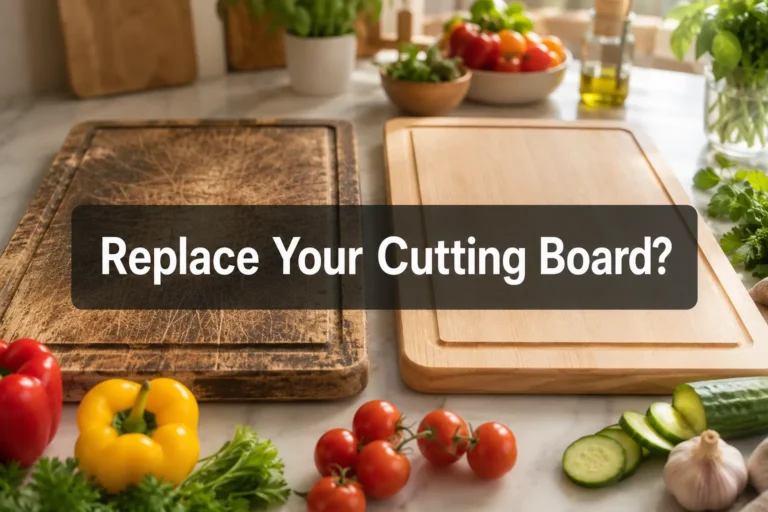
How do I know when to replace my cutting board?
Replace a wood board when it has deep grooves that cannot be sanded out, visible mold that does not clean off, or significant warping that prevents it from lying flat. Replace a plastic board when grooves are deep enough to trap food visibly.
Is end-grain or edge-grain better for a beginner?
Edge-grain is easier to maintain and more affordable, making it a better starting point for beginners. Once you are comfortable with board care, upgrading to end-grain pays off in better edge retention.
Do Japanese knife makers recommend specific boards?
Several Japanese knife brands sell their own boards. Shun recommends their hinoki board, and Yoshihiro sells the HAYATE Hi-Soft. These are genuine recommendations backed by the knife makers’ understanding of their own steel properties [5].
Conclusion: Choosing the Best Cutting Board for Japanese Knives
The best cutting board for Japanese knives comes down to one core principle: the board must be softer than the knife’s steel. For most home cooks, that means choosing between a hinoki cypress board, an end-grain walnut or cherry board, or a synthetic Hi-Soft board. All three protect a fine Japanese edge far better than bamboo, glass, or ceramic alternatives.
Actionable next steps:
- Identify your current board material. If it is glass, ceramic, or bamboo, replace it before your next prep session.
- Match board choice to your use case. If you want low maintenance, go Hi-Soft synthetic. If you prefer natural materials, start with end-grain walnut or hinoki.
- Get the right size. For a gyuto, do not go smaller than 15 x 18 inches.
- Start an oiling routine. If you choose wood, oil the board on the day it arrives and once a month after that.
- Inspect your board regularly. Deep grooves and rough surfaces are the silent killers of fine knife edges.
A quality cutting board is not an accessory for your Japanese knife, it is a necessary part of the system. The knife and the board work together, and a mismatch between the two undoes every hour you spend sharpening and caring for your blade.
Rereferences
Reason: This link leads to a review published in a biomedical journal detailing the inherent properties of titanium alloys, including their exceptional mechanical strength, corrosion resistance, and biocompatibility. This provides a materials science basis for the claims of durability and longevity.
For Titanium Biocompatibility and Safety:
Reason: This is an official summary from the U.S. Food and Drug Administration (FDA) regarding the safety profile of titanium used in implantable medical devices. This strongly supports the article’s claim that titanium is a non-toxic, safe, and biocompatible material suitable for food contact.
For Bacterial Contamination Comparison (Why Plastic Fails):
URL: https://pubmed.ncbi.nlm.nih.gov/31113021/
Reason: This PubMed citation links to a study on the survival of bacteria (like Salmonella and E. coli) on plastic and wooden cutting boards. It helps scientifically substantiate the article’s argument that plastic boards fail due to their tendency to harbor and allow bacteria to multiply in micro-grooves.
For Titanium’s Inherent Properties (Durability/Corrosion Resistance):
URL: https://pmc.ncbi.nlm.nih.gov/articles/PMC10780041/
Tags: best cutting board for Japanese knives, Japanese knife care, hinoki cutting board, end-grain cutting board, cutting board wood types, knife edge protection, Japanese chef knife, cutting board maintenance, Hi-Soft cutting board, bamboo vs wood cutting board, kitchen knife accessories, Japanese kitchen tools

With over 13 years of experience in holistic health blogging, I aim to help you navigate your wellness journey with honest insights, expert-backed advice, and a sprinkle of real-world practicality.
Certified Wellness Writer | Herbal Nutrition Advocate | Wellness Research Enthusiast