Healthiest Cutting Board Material: Which Is Safest in 2026?
Last updated: July 29, 2026
Quick Answer: The healthiest cutting board material for most home cooks is hard maple or teak wood, because their tight grain naturally resists bacteria and is gentle on knife edges. For those who prioritize zero chemical leaching and the easiest sanitization, food-grade titanium is the top choice. Plastic boards are the most common but carry real hygiene risks over time. Your best pick depends on how you cook, how often you clean, and whether you prepare raw meat regularly.
Key Takeaways
- Hard maple, teak, and walnut wood are the safest traditional cutting board materials because their dense grain limits bacterial penetration.
- Plastic cutting boards develop deep knife grooves over time that trap bacteria and are nearly impossible to fully sanitize once scored.
- Bamboo is harder than most wood but contains binders (formaldehyde-based glues in lower-quality boards) that raise chemical concerns.
- Glass and ceramic boards are non-porous and easy to clean but destroy knife edges quickly and are not recommended for daily use.
- Titanium boards are non-porous, non-reactive, and biocompatible, making them the gold standard for food safety, though they come at a higher price.
- Separate boards for raw meat and produce are one of the most effective ways to prevent cross-contamination, regardless of material.
- Replace plastic boards as soon as deep grooves appear; wood boards can often be sanded and re-oiled rather than replaced.
- End-grain wood boards are gentler on knives than edge-grain boards and self-heal minor cuts over time.
What Is the Healthiest Cutting Board Material?
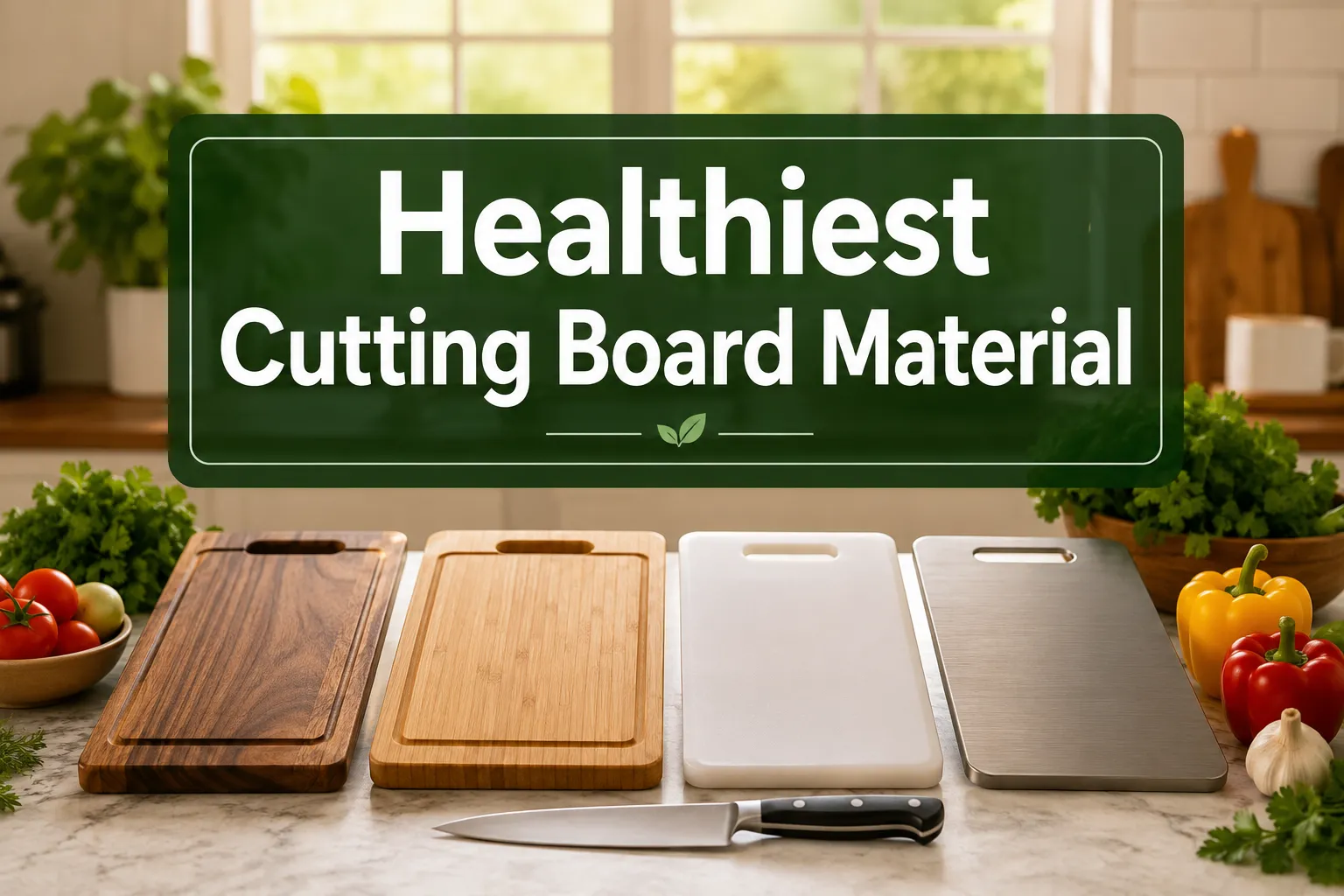
The healthiest cutting board material is one that resists bacterial growth, does not leach chemicals into food, and holds up to regular cleaning without degrading. For most kitchens, that means a dense hardwood like maple or teak, or a food-grade titanium board for those who want maximum hygiene with minimal maintenance.
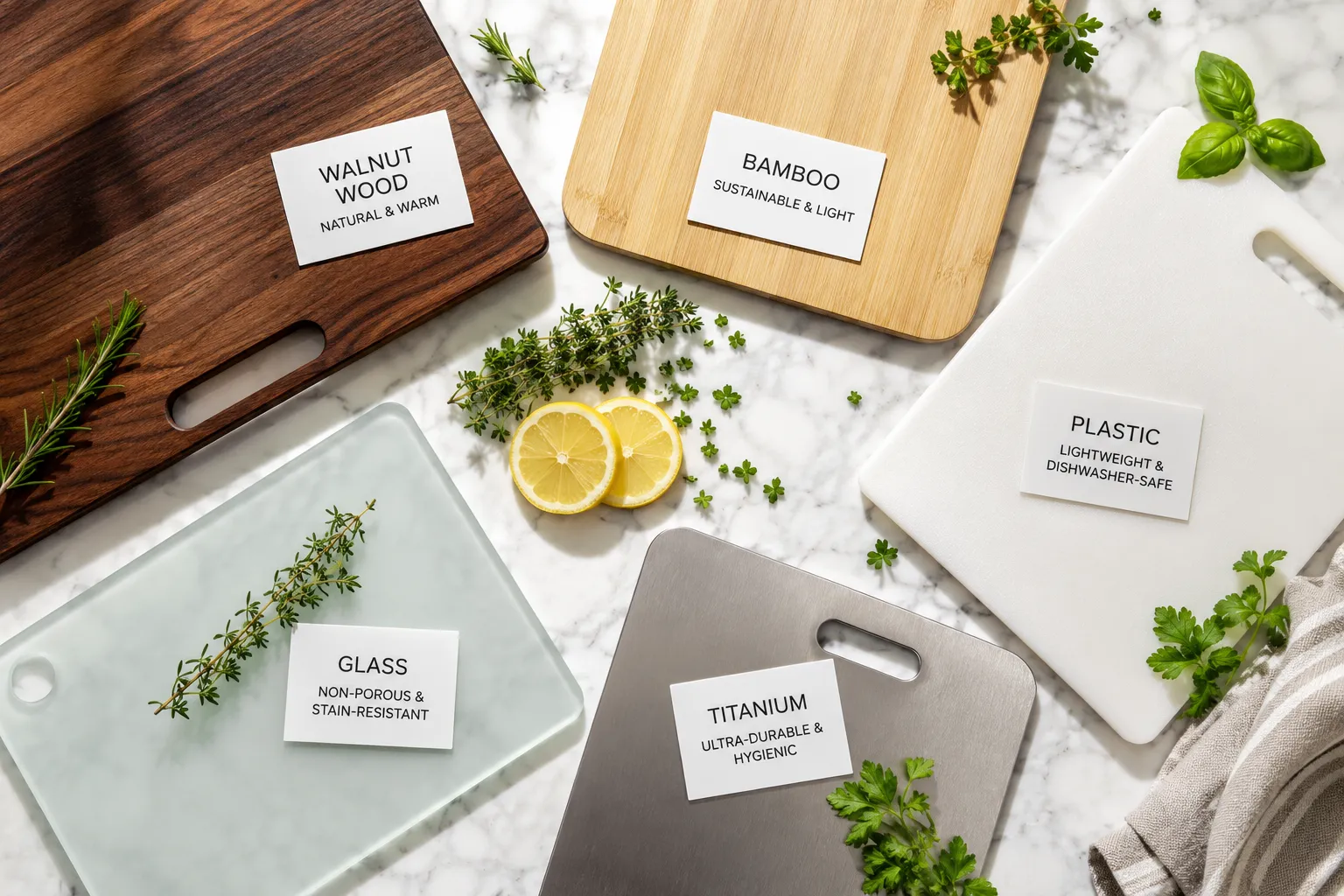
Here is how the main materials rank on health criteria:
| Material | Bacteria Resistance | Chemical Safety | Knife Friendliness | Ease of Cleaning |
|---|---|---|---|---|
| Hard Maple Wood | High | Excellent | Excellent | Moderate |
| Teak Wood | High | Excellent | Excellent | Moderate |
| Bamboo | Moderate | Varies by binder | Good | Easy |
| Plastic (HDPE) | Low (when grooved) | Good (new boards) | Poor | Easy |
| Glass/Ceramic | Very High | Excellent | Very Poor | Very Easy |
| Titanium | Very High | Excellent | Good | Very Easy |
Choose wood if you want a time-tested, knife-friendly surface and are willing to oil and maintain it regularly. Choose titanium if you want a set-it-and-forget-it board that never absorbs odors or bacteria.
Is Wood or Plastic Better for Cutting Boards?
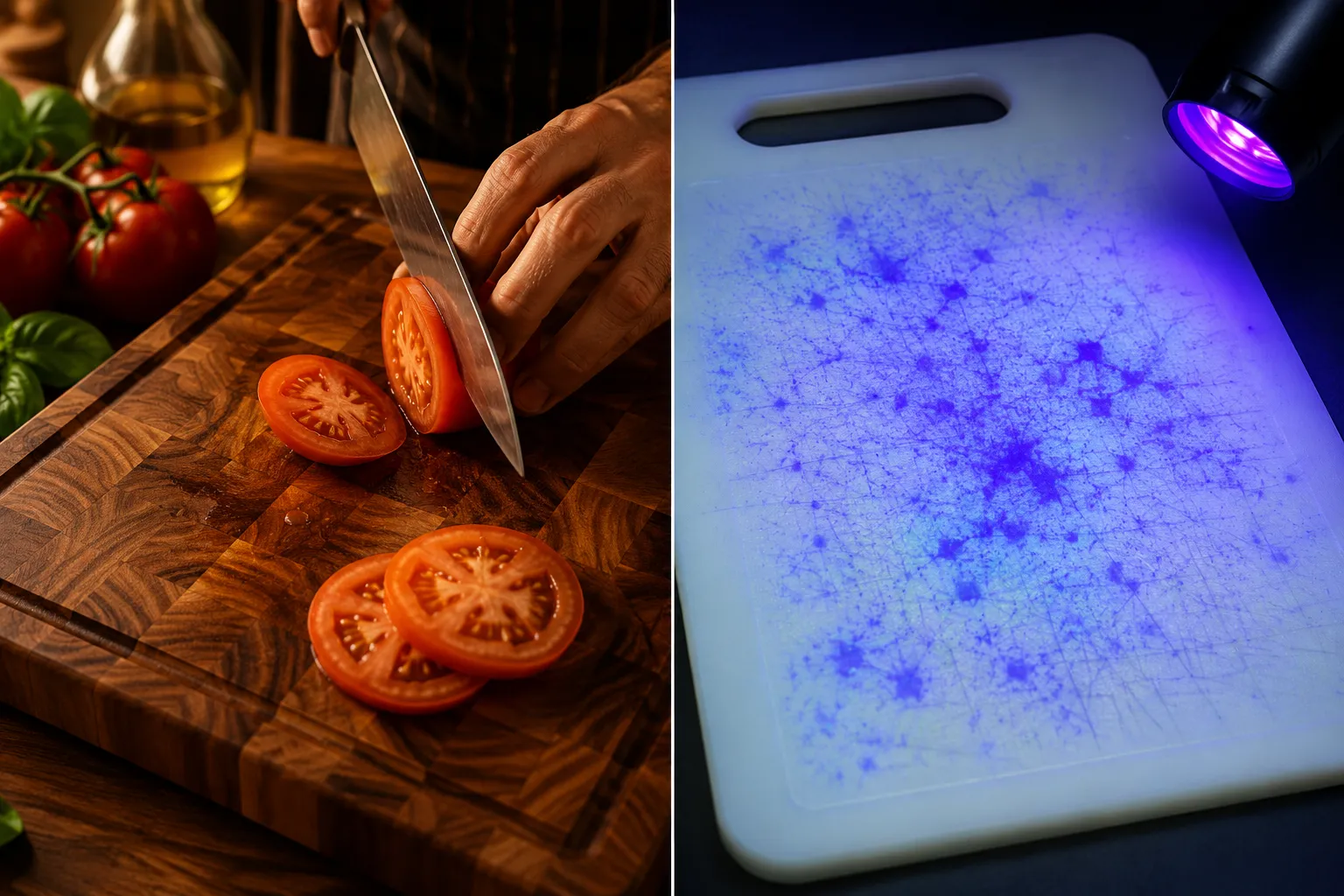
Wood is generally better than plastic for long-term food safety, despite what many people assume. Research published by UC Davis food scientists in 1994 (Cliver, D.O.) found that bacteria drawn into wood grain died off and were not recoverable, while bacteria in plastic knife grooves survived and multiplied. That finding has held up in subsequent food safety discussions.
Why plastic loses over time:
- New plastic boards are easy to sanitize and relatively safe.
- Once knife grooves appear, bacteria embed in the channels and resist scrubbing.
- Dishwasher heat can warp thinner plastic boards, creating more crevices.
- Worn plastic boards can shed microplastic particles into food.
Why wood wins:
- Dense hardwoods like maple have a self-healing property: knife cuts close back up somewhat as the wood fibers swell.
- Natural antimicrobial compounds in some woods (like teak’s natural oils) add a layer of protection.
- Wood boards can be sanded down and re-oiled when heavily scored, effectively resetting the surface.
Common mistake: Many people keep plastic boards long past their useful life because they look clean. If your plastic board has visible deep grooves, it is time to replace it.
Can Cutting Boards Leach Chemicals Into Food?
Yes, some cutting board materials can leach chemicals into food, and this is a legitimate health concern. Plastic boards made from low-quality polymers may release microplastics and chemical additives when cut repeatedly. Bamboo boards bonded with formaldehyde-based adhesives can off-gas and transfer trace amounts to food, especially with acidic ingredients. High-quality materials like solid hardwood and food-grade titanium do not leach chemicals.
What to watch for by material:
- Plastic (HDPE or polypropylene): Food-safe grades are generally low-risk when new, but microplastic shedding from knife grooves is a growing concern supported by recent research.
- Bamboo composite boards: Some lower-cost boards use urea-formaldehyde resin as a binder. Look for boards labeled “formaldehyde-free” or made with food-safe adhesives.
- Wood with finishes: Boards treated with mineral oil are safe. Boards finished with varnish, lacquer, or paint can chip and contaminate food.
- Titanium: Biocompatible and non-reactive. The same material used in surgical implants does not interact with acidic foods like lemon juice or vinegar.
- Glass: Completely inert, but the risk here is physical (glass chips) rather than chemical.
Decision rule: If you are buying a bamboo board, check the manufacturer’s adhesive specifications. If no information is listed, that is a red flag.
Since what touches your cutting board eventually touches your food, your overall digestive health matters too. Supporting your gut with the right nutrition is just as important as choosing safe kitchen tools. You can read more about how gut health connects to your immune system for a fuller picture of food safety from prep to digestion.
Best Cutting Board Material for Food Safety
For food safety specifically, the best cutting board materials are dense hardwoods (maple, teak, walnut) and food-grade titanium. Both resist bacterial colonization, do not leach harmful substances, and hold up to repeated sanitization. Glass is technically non-porous but is impractical for daily use because it ruins knives.
Top picks for food safety:
- Hard maple (end grain): Dense, self-healing, naturally antimicrobial. The industry standard in professional kitchens.
- Teak: Naturally oily, water-resistant, and highly durable. Requires less maintenance than maple.
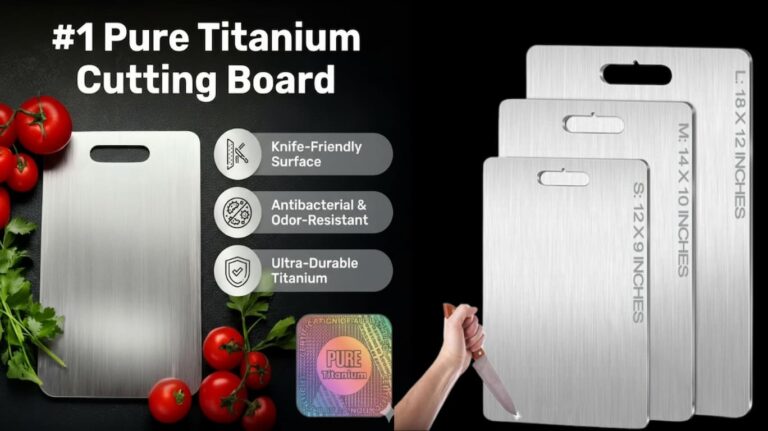
- Food-grade titanium: Non-porous, non-reactive, dishwasher-safe, and bacteria cannot colonize the surface. The Katori Titanium Cutting Board is one well-reviewed option in this category, made from medical-grade titanium with a brushed matte finish that resists odors and corrosion.
- High-density polyethylene (HDPE) plastic: Safe when new and replaced frequently. Not a long-term solution.
Food safety tip: No material replaces proper hygiene. Wash your board with hot soapy water after every use involving raw meat, poultry, or fish. Sanitize weekly with a diluted bleach solution (1 tablespoon bleach per gallon of water) or white vinegar for wood boards.
Bamboo vs. Wood Cutting Boards: Which Is Healthier?
Wood is generally healthier than bamboo for cutting boards, primarily because of concerns about the adhesives used in bamboo boards. Solid hardwood boards contain no binders, while bamboo boards are technically a grass pressed together with glue, and the quality of that glue varies widely by brand.
Bamboo pros:
- Harder surface than most softwoods, so it resists deep knife grooves better than pine or rubber wood.
- Grows faster than hardwood trees, making it more sustainable.
- Naturally contains an antimicrobial agent called bamboo kun (though this diminishes after processing).
Bamboo cons:
- Most boards are composite, meaning they use adhesive binders.
- Harder surface can dull knives faster than maple or walnut.
- Formaldehyde-based glues in lower-quality boards are a real concern, especially for people with chemical sensitivities.
Wood pros:
- Solid construction with no adhesives.
- Dense hardwoods like maple and walnut have proven antimicrobial properties.
- Gentler on knife edges.
Bottom line: If you choose bamboo, buy from a brand that explicitly states it uses formaldehyde-free, food-safe adhesives. For most people, a solid hardwood board is the safer and more knife-friendly choice.
Are Plastic Cutting Boards Toxic?
New, undamaged plastic cutting boards made from food-grade HDPE or polypropylene are not considered toxic. However, once plastic boards develop knife grooves, they present two health risks: bacterial colonization in the grooves and microplastic shedding into food. A 2023 study published in the journal Environmental Science and Technology estimated that heavily used plastic cutting boards could shed millions of microplastic particles into food annually (source: Bhatt, P. et al., 2023).
When plastic boards become a problem:
- Deep knife grooves that cannot be cleaned with a brush.
- Discoloration that does not wash off (a sign of embedded bacteria or mold).
- Warping from dishwasher heat, which creates new crevices.
- Soft or flexible boards that cut easily (these shed material faster).
Safer plastic alternatives: If you prefer plastic for its light weight and low cost, choose thick, rigid HDPE boards (at least 1/2 inch thick) and replace them as soon as significant scoring appears. Avoid thin, flexible plastic sheets entirely.
Edge case: People with food allergies may want to avoid plastic boards altogether, since grooves can harbor allergen residue even after washing. See the dedicated section on allergy-safe boards below.
Do Glass Cutting Boards Dull Knives?
Yes, glass cutting boards dull knives very quickly and are not recommended for regular cooking use. Glass has a Mohs hardness rating of around 5.5, while most kitchen knife steel rates between 5.5 and 8.5. When steel meets glass, the knife edge loses rather than the board, resulting in rapid dulling and micro-chipping of the blade.
Other problems with glass boards:
- Loud, unpleasant noise when cutting.
- Slippery surface that can cause accidents.
- Risk of glass chips if the board cracks or chips.
- No give, which causes hand and wrist fatigue during extended prep.
When glass makes sense: Glass boards are fine as a serving surface for cheese or charcuterie, where you are not actively cutting on them. They are also easy to sanitize and visually attractive. Just do not use them as a primary prep surface.
Ceramic boards share the same problems as glass and are not recommended for daily cutting use.
What Cutting Board Material Prevents Bacteria Growth?
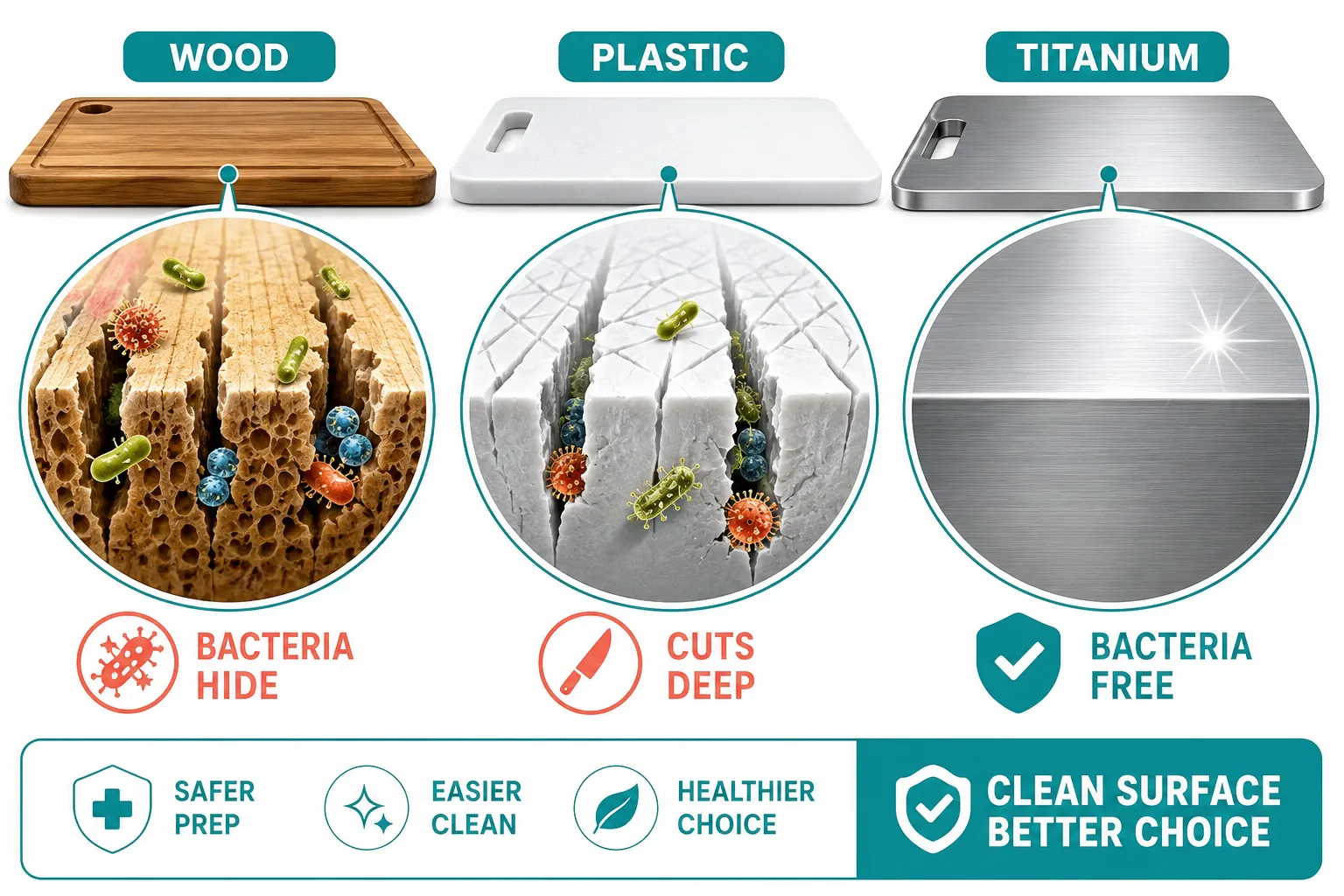
Non-porous materials like titanium and glass prevent bacteria from colonizing the surface most effectively. Among porous materials, dense hardwoods like hard maple and teak resist bacterial penetration better than softer woods or plastic with grooves. The key factor is surface integrity: any material with deep grooves, cracks, or porous channels becomes a bacteria reservoir.
How bacteria interact with different surfaces:
- Wood (dense hardwood): Bacteria are drawn into the grain but die off naturally in dry conditions. The wood’s capillary action pulls bacteria away from the surface.
- Plastic (grooved): Bacteria survive in knife grooves and are protected from cleaning agents. Wet plastic is an ideal bacterial environment.
- Titanium: Non-porous surface gives bacteria nowhere to hide. Easily sanitized with soap, dishwasher, or boiling water.
- Bamboo: Moderate resistance when new; adhesive seams can harbor bacteria over time.
Practical tip: Drying your cutting board completely after washing is one of the most effective ways to prevent bacterial growth on any material. Bacteria need moisture to survive and multiply.
How Often Should You Replace a Cutting Board?
Plastic cutting boards should be replaced as soon as they develop deep grooves, typically every one to two years with regular use. Wood boards can last decades with proper care, including periodic sanding and re-oiling. Titanium boards essentially never need replacing under normal use conditions.
Replacement guidelines by material:
- Plastic: Replace when grooves are deep enough to trap food and resist cleaning. Do not wait for visible discoloration.
- Bamboo: Replace when the surface splinters, cracks, or separates at the seams.
- Wood: Sand and re-oil rather than replace. Replace only if deep cracks develop that cannot be sanded out, or if the board warps severely.
- Titanium: No replacement needed under normal conditions. Minor surface scratches do not affect hygiene.
- Glass/Ceramic: Replace immediately if chipped or cracked.
Signs any board needs replacing:
- Persistent odors that do not wash out.
- Visible mold in grooves or cracks.
- Warping that makes the board rock on the counter (a safety hazard).
Is Stainless Steel Good for Cutting Boards?
Stainless steel cutting boards are durable and non-porous, but they are not ideal for everyday use because they dull knives quickly and can be noisy and slippery. Stainless steel is harder than most knife steel, which means the knife edge suffers during contact. Titanium, by comparison, is harder than stainless steel but has a slightly different surface structure that is less damaging to knife edges.
Stainless steel cutting board summary:
- Non-porous and easy to sanitize (a genuine hygiene advantage).
- Dishwasher-safe and rust-resistant.
- Dulls knives faster than wood or titanium.
- Loud metallic sound when cutting.
- Can be slippery without a non-slip backing.
Verdict: Stainless steel is a better choice than plastic for hygiene, but wood and titanium are better overall choices for a kitchen that values both food safety and knife longevity.
Cutting Board Material for Raw Meat vs. Vegetables
Use separate cutting boards for raw meat and vegetables regardless of material. This is the single most important food safety practice in any kitchen. Cross-contamination from raw poultry, beef, or fish to ready-to-eat produce is a leading cause of foodborne illness.
Recommended setup:
- Raw meat, poultry, fish: Use a non-porous board that is easy to sanitize. Plastic (replaced frequently), titanium, or a dedicated hardwood board work well. Sanitize with diluted bleach solution after every use.
- Vegetables, fruit, bread: Use your primary wood or bamboo board. These foods do not carry the same bacterial load as raw protein.
- Color-coding system: Many professional kitchens use color-coded plastic boards (red for meat, green for vegetables, yellow for poultry) to prevent mix-ups.
Edge case for allergy households: If someone in your home has a severe food allergy (peanuts, shellfish, gluten), use separate boards for allergen-containing foods and wash them separately from other boards. Non-porous materials like titanium are easier to fully decontaminate.
For people managing digestive sensitivities or food-related health conditions, safe food preparation practices are just one piece of the puzzle. Exploring the best gut health probiotic supplements can complement a clean-kitchen approach to overall digestive wellness.
Can You Get Splinters from Wooden Cutting Boards?
Splinters from wooden cutting boards are rare with high-quality, properly maintained boards but can occur with cheap, poorly finished wood or boards that have dried out and cracked. Hardwoods like maple and walnut have a tight grain that does not splinter easily under normal use. Softwoods like pine are more prone to splintering and are not recommended for cutting boards.
How to prevent splinters:
- Oil your wood board monthly with food-grade mineral oil or a beeswax blend.
- Sand the surface lightly (220-grit sandpaper) if it feels rough or shows raised grain.
- Avoid soaking wood boards in water or putting them in the dishwasher, which dries and cracks the wood.
- Buy boards from reputable manufacturers that use properly kiln-dried hardwood.
If you find a splinter in food: This is more likely from a cheap, poorly finished board than a quality hardwood board. It is a sign the board needs sanding and re-oiling, or replacement if the damage is extensive.
What Is the Difference Between End Grain and Edge Grain Cutting Boards?
End grain boards are cut so the end of the wood fibers face up, like looking at the top of a tree stump. Edge grain boards show the long side of the wood fibers. End grain boards are gentler on knives, more self-healing, and more attractive, but they are heavier and more expensive. Edge grain boards are thinner, lighter, and more affordable.
End grain advantages:
- Knife edges slide between wood fibers rather than across them, preserving sharpness longer.
- Minor cuts self-heal as fibers swell back together.
- Classic butcher block appearance.
Edge grain advantages:
- Less expensive to produce.
- Lighter and easier to handle.
- Still a good surface for everyday prep.
Decision rule: Choose end grain if you cook daily and want the best knife protection and longevity. Choose edge grain if you want a quality wood board at a lower price point.

Best Cutting Board for Someone with Food Allergies
For people with serious food allergies, the best cutting board material is non-porous: food-grade titanium is the top choice, followed by glass (for non-cutting use). Non-porous surfaces do not trap allergen proteins in grooves or grain, and they can be fully sanitized with hot water and soap.
Why allergen cross-contact is a board issue:
- Allergen proteins like gluten, peanut, and shellfish can survive washing on grooved plastic or wood surfaces.
- Porous materials retain microscopic food particles even after thorough scrubbing.
- A dedicated non-porous board for allergen-free food preparation is the safest approach.
Practical allergy-safe setup:
- Use a dedicated titanium or new plastic board exclusively for allergen-free food prep.
- Wash it separately from other boards.
- Store it separately to avoid accidental contact.
- Consider labeling it clearly.
Who this matters for most: Anyone cooking for someone with celiac disease, a peanut allergy, or a shellfish allergy should take cross-contact on cutting boards seriously. The stakes are higher than general food safety.
Since food allergies and sensitivities often intersect with gut health, it may be worth reading about how to improve digestive enzyme function naturally if you or someone in your household manages food-related digestive issues.
The Case for Titanium: Is It Worth the Investment?
Food-grade titanium is the most advanced cutting board material available in 2026, combining non-porous hygiene, chemical inertness, and exceptional durability. It is not the right choice for everyone, but for health-conscious cooks who want a long-term solution, it stands apart from every other material.
What makes titanium different:
- Biocompatible: The same material used in surgical implants and dental devices. It does not react with acidic foods like lemon, vinegar, or tomatoes.
- Non-porous: Bacteria have no surface to colonize. No grooves, no grain, no seams.
- Non-reactive: Does not absorb odors from garlic, onion, or fish.
- Dishwasher-safe: Can be sanitized with boiling water or alcohol.
- Lightweight: Approximately 40% lighter than a comparable stainless steel board.
- Durable: Does not crack, warp, or stain. Minor surface scratches do not affect hygiene.
Titanium vs. other materials at a glance:
- Compared to wood: Easier to clean, no maintenance required, but lacks the warmth and knife-cushioning of end-grain maple.
- Compared to plastic: Far superior hygiene over time; no microplastic shedding; no need for replacement.
- Compared to glass: Much gentler on knife edges; less noise; no risk of chipping.
Who should buy a titanium board:
- People who cook raw meat frequently and want the easiest sanitization.
- Anyone with food allergies who needs a fully decontaminable surface.
- Home cooks who want a one-time purchase that lasts decades.
Who should skip it:
- Those on a tight budget (quality titanium boards range from $89 to $179).
- Cooks who prefer the feel and aesthetics of wood.
The Katori Titanium Cutting Board is one of the more accessible titanium options, made from medical-grade titanium with a brushed matte finish. It earns high marks for hygiene and durability, though some users note the metallic sound during chopping and the need for a non-slip mat underneath.
Frequently Asked Questions
Q: What is the single healthiest cutting board material overall?
A: For most people, dense hardwood (hard maple or teak) is the healthiest practical choice. For maximum hygiene with minimal maintenance, food-grade titanium is the gold standard.
Q: Is it safe to use a plastic cutting board for raw chicken?
A: A new, ungrooved plastic board is safe for raw chicken if sanitized immediately after use with a bleach solution. Once the board develops deep grooves, replace it. Non-porous materials like titanium are safer for repeated raw poultry prep.
Q: Does wood harbor more bacteria than plastic?
A: Research suggests the opposite. Bacteria drawn into wood grain die off, while bacteria in plastic grooves survive and multiply. Dense hardwoods are safer than grooved plastic boards.
Q: Are bamboo cutting boards safe?
A: Quality bamboo boards made with food-safe, formaldehyde-free adhesives are generally safe. Cheaper boards with unknown binders carry a chemical risk. When in doubt, choose solid hardwood.
Q: How do I sanitize a wood cutting board?
A: Wash with hot soapy water after each use. For deeper sanitization, apply a solution of 1 tablespoon white vinegar per cup of water, let sit for a few minutes, then rinse and dry thoroughly. Bleach solutions can be used sparingly but may dry out the wood.
Q: Can I put a wood cutting board in the dishwasher?
A: No. Dishwasher heat and prolonged moisture exposure will warp, crack, and dry out wood boards. Hand-wash and dry immediately.
Q: How do I know when to replace my cutting board?
A: Replace plastic boards when deep grooves appear. Replace bamboo boards when they splinter or separate at seams. Sand and re-oil wood boards rather than replacing them, unless deep cracks develop. Titanium boards rarely need replacing.
Q: Is a titanium cutting board knife-friendly?
A: Better than plastic or glass, but not as forgiving as end-grain wood. Titanium boards are less damaging to knife edges than stainless steel, and the surface does not develop deep grooves that trap bacteria.
Q: What cutting board is best for someone with celiac disease?
A: A dedicated non-porous board (titanium or new plastic) used exclusively for gluten-free food prep is the safest approach. Non-porous surfaces can be fully decontaminated, unlike grooved plastic or wood grain.
Q: Does the color of a plastic cutting board matter?
A: The color itself does not affect safety, but using a color-coding system (red for meat, green for vegetables) helps prevent cross-contamination, which is a genuine food safety benefit.
Q: Are there cutting boards that are both knife-friendly and easy to sanitize?
A: End-grain hardwood boards are the most knife-friendly. Titanium boards offer the easiest sanitization. If you want both qualities in one board, a quality end-grain maple board maintained with regular oiling comes closest for most home kitchens.
Q: How does cutting board choice connect to overall health?
A: The surface you prep food on affects what enters your body, from bacteria to microplastics to chemical residues. Choosing a safe material is one part of a broader approach to health that also includes supporting your digestive health and immune function.
Key Takeaways
- The healthiest cutting board material depends on your priorities: hard maple and teak for knife-friendliness and proven antimicrobial properties; food-grade titanium for maximum hygiene and zero maintenance.
- Plastic boards are not inherently unsafe, but they become a health risk once grooved and should be replaced regularly.
- Bamboo boards vary widely in safety depending on the adhesives used. Always verify the binder is formaldehyde-free.
- Glass and ceramic boards are non-porous but destroy knife edges and are not practical for daily cooking.
- Titanium boards are non-porous, non-reactive, and biocompatible, making them the best choice for raw meat prep and allergy households.
- Always use separate boards for raw meat and produce, regardless of material.
- End-grain wood boards are gentler on knives and more self-healing than edge-grain boards.
- Replace plastic boards as soon as visible grooves appear. Maintain wood boards with monthly oiling and periodic sanding.
Conclusion
Choosing the healthiest cutting board material is not just a kitchen preference. It directly affects what you eat, how much bacteria reaches your food, and whether chemical residues end up in your meals. After reviewing all the evidence, the clearest guidance is this: dense hardwood boards (maple, teak, walnut) are the best all-around choice for most home kitchens, combining proven antimicrobial properties, knife-friendliness, and long-term durability. For cooks who want the highest hygiene standard with the least maintenance, food-grade titanium is the superior option.
Actionable next steps:
- Inspect your current cutting board. If it is a plastic board with deep grooves, replace it now.
- If you use a wood board, oil it this week with food-grade mineral oil and check for cracks.
- Set up a two-board system: one dedicated board for raw meat and one for produce.
- If you are in the market for a new board, consider a hard maple end-grain board or explore titanium options like the Katori Titanium Cutting Board for a long-term investment.
- Establish a weekly sanitization routine appropriate for your board’s material.
Your cutting board is the first surface your food touches in preparation. Treating it as a health tool rather than just a kitchen accessory is a simple, high-impact change that pays off every time you cook.
For a broader look at how kitchen habits connect to whole-body health, explore our resources on gut health and digestion and how the immune system is linked to gut health.
Tags: healthiest cutting board material, cutting board food safety, wood cutting board, titanium cutting board, bamboo vs wood cutting board, plastic cutting board bacteria, end grain cutting board, cutting board for raw meat, food safe cutting board, kitchen hygiene, Katori titanium board, cutting board material comparison

With over 13 years of experience in holistic health blogging, I aim to help you navigate your wellness journey with honest insights, expert-backed advice, and a sprinkle of real-world practicality.
Certified Wellness Writer | Herbal Nutrition Advocate | Wellness Research Enthusiast