est Dishwasher-Safe Cutting Boards (2026 Buyer’s Guide)
Last updated: July 29, 2026
Quick Answer
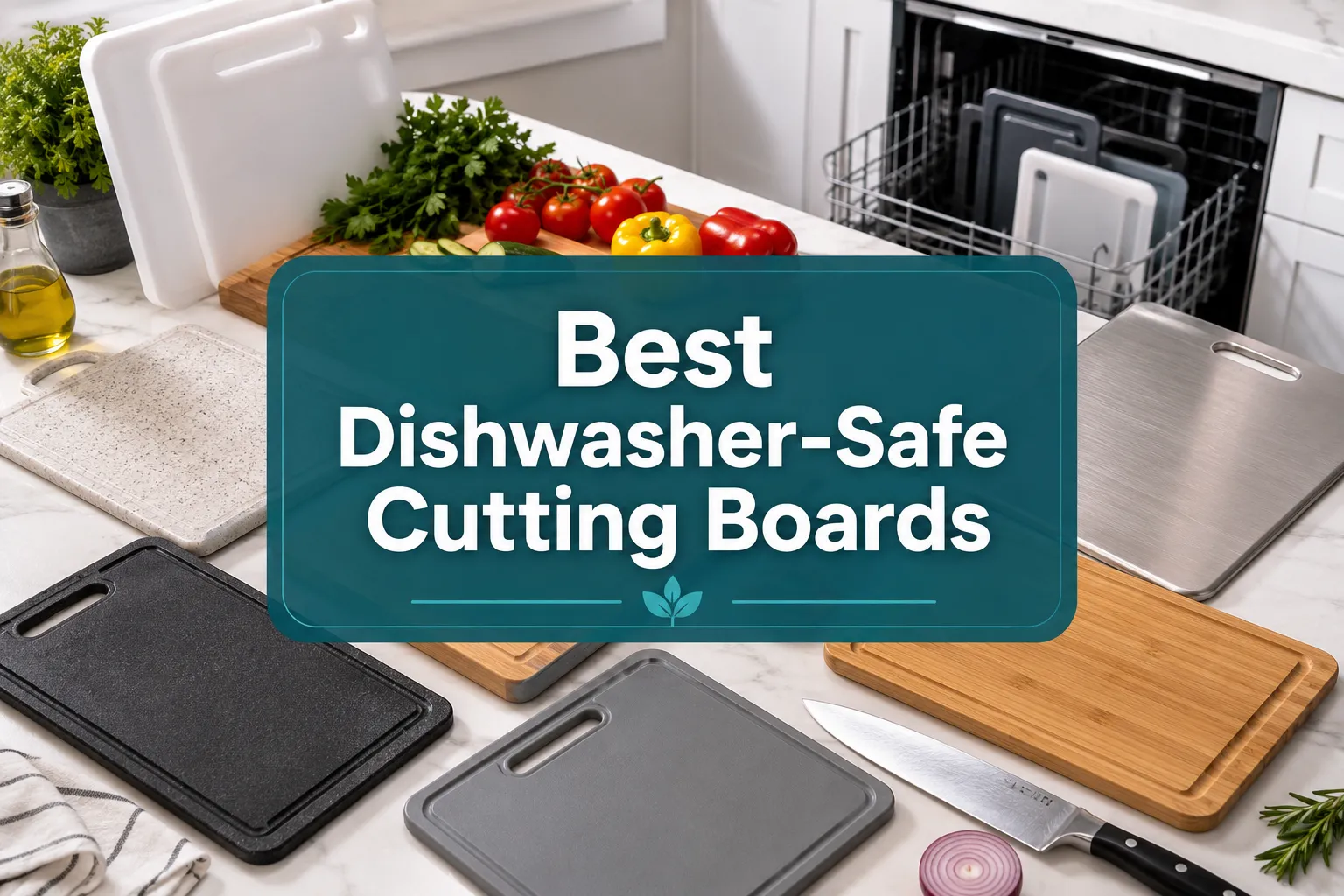
The best dishwasher-safe cutting boards in 2026 are made from BPA-free plastic, composite materials, or food-grade titanium, not wood or bamboo. For most home cooks, a high-density polyethylene (HDPE) board or a BPA-free composite board offers the best balance of hygiene, durability, and ease of cleaning. If you want a premium, lifetime investment, food-grade titanium boards like the Katori represent the top of the category.
Key Takeaways
- Wood and bamboo cutting boards are NOT truly dishwasher-safe, they warp, crack, and split under dishwasher heat and moisture cycles
- BPA-free plastic and composite boards are the most practical dishwasher-safe options for everyday cooking
- Food-grade titanium boards are non-porous, antibacterial, rustproof, and fully dishwasher-safe, the most hygienic option available
- Warping happens when boards are thin, low-density, or made from moisture-absorbing materials; choose boards at least 0.5 inches thick
- Dedicated cutting boards for raw meat reduce cross-contamination risk, use color-coded boards for different food types
- Dishwasher-safe boards can still dull knives if the surface is too hard (glass, ceramic) or too abrasive; HDPE and titanium are gentler on edges
- Budget-friendly options start around $15,$25 for quality HDPE boards; premium titanium boards range from $89,$179
- NSF-certified boards meet commercial food safety standards and are worth seeking out for raw meat prep [6]
- Stains on dishwasher-safe boards are best prevented by rinsing immediately after use and avoiding prolonged contact with turmeric or beet juice
- Hand-drying after the dishwasher cycle extends the life of any cutting board, even dishwasher-safe ones
What Makes a Cutting Board Dishwasher Safe
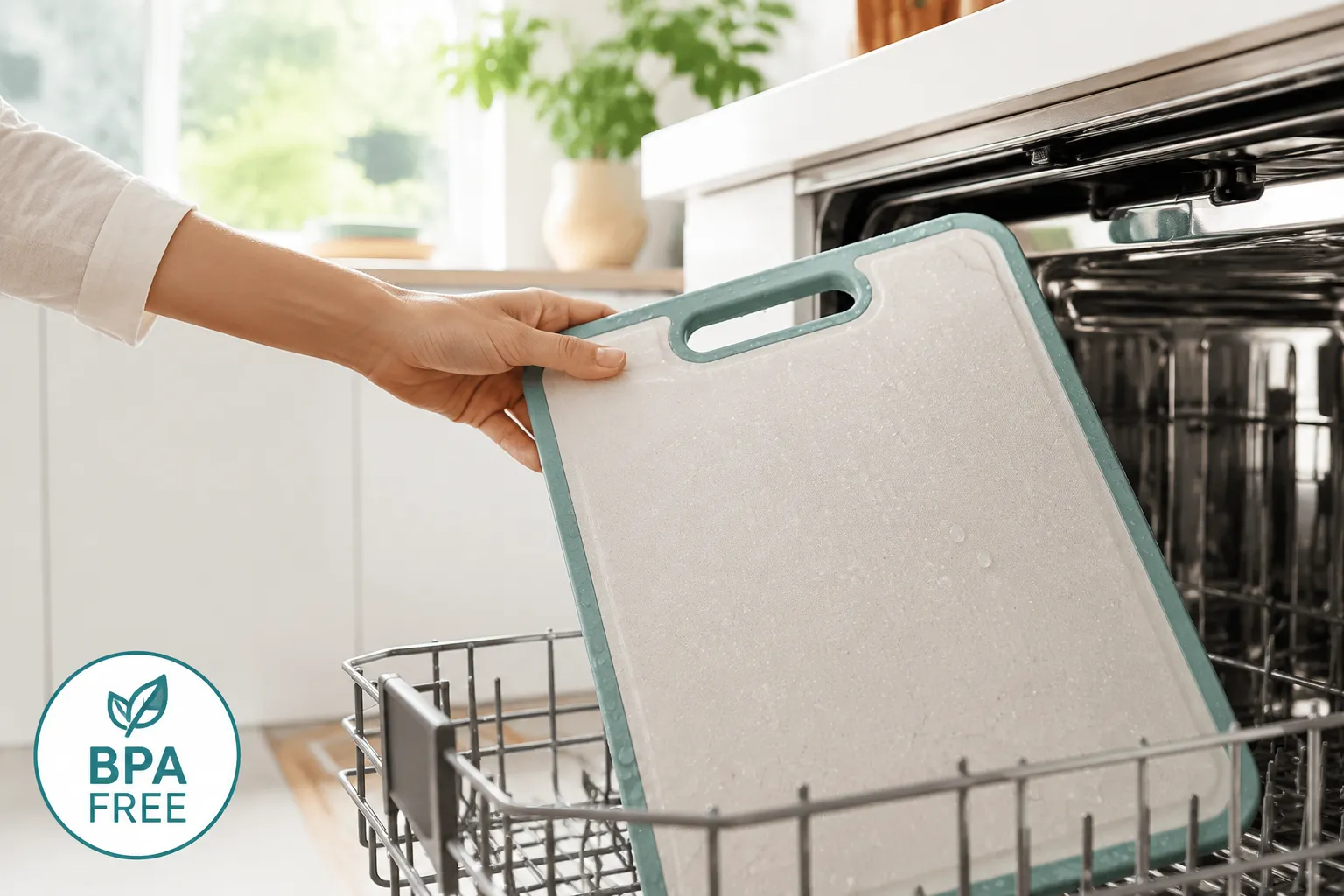
A cutting board is genuinely dishwasher-safe when its material can withstand repeated exposure to high heat (typically 140-160°F in a standard dishwasher cycle), strong detergents, and high-pressure water jets without warping, cracking, splitting, or absorbing moisture. The key factors are non-porosity, dimensional stability under heat, and chemical resistance.
Here is what separates truly dishwasher-safe boards from those that merely claim to be:
- Non-porous surface: Water and detergent cannot penetrate the material, so the board does not swell or warp
- Heat stability: The material holds its shape at dishwasher temperatures without bending or deforming
- Chemical resistance: The surface does not degrade, leach, or discolor when exposed to dishwasher detergents
- Structural integrity: The board is thick and dense enough to resist stress from repeated thermal cycling
Materials that meet all four criteria include high-density polyethylene (HDPE), BPA-free composite plastics, and food-grade titanium [9]. Materials that fail one or more criteria include standard wood, bamboo, and thin or low-grade plastic.
“A board labeled ‘dishwasher-safe’ should be tested against all four criteria, not just one. Many cheap plastic boards warp after three or four cycles because they lack the density to resist thermal stress.”
Best Dishwasher-Safe Cutting Board Materials
The best materials for dishwasher-safe cutting boards are BPA-free HDPE plastic, composite materials, and food-grade titanium. Each has distinct trade-offs depending on your budget, cooking habits, and hygiene priorities [1].
High-Density Polyethylene (HDPE) Plastic
HDPE is the workhorse of commercial and home kitchens. It is non-porous, easy to sanitize, and holds up well in repeated dishwasher cycles. NSF-certified HDPE boards are standard in professional kitchens for exactly this reason [6].
- Gentle on knife edges compared to glass or ceramic
- Available in color-coded sets for food safety (red for meat, green for vegetables)
- Budget-friendly: $15,$40 for quality options
- Can develop deep knife grooves over time, which harbor bacteria, replace when grooved
BPA-Free Composite Boards
Composite boards combine materials (often wood fiber and resin) to create a surface that is harder and more durable than standard plastic while remaining dishwasher-safe. They are less likely to develop deep grooves and often have a more attractive appearance [1].
- Harder surface means slower groove development
- Heavier than standard plastic, which adds stability
- Mid-range price: $35,$80
Food-Grade Titanium
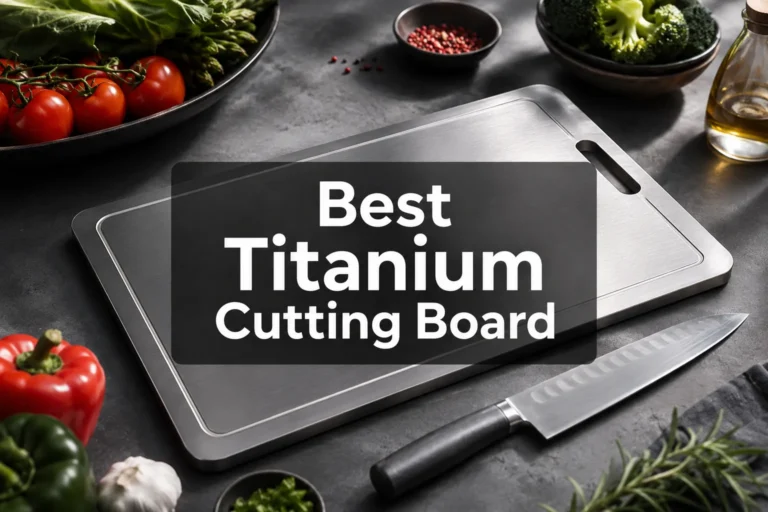
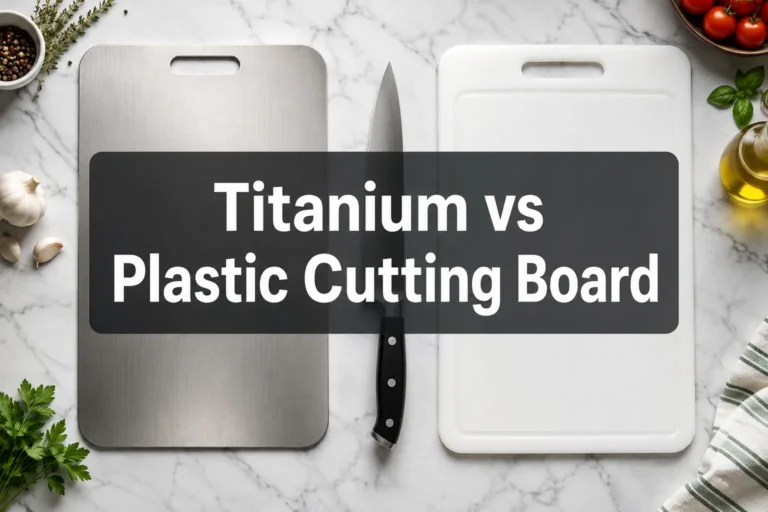
Titanium boards represent the premium end of the dishwasher-safe category. The Katori Titanium Cutting Board is a well-reviewed example in this space. Food-grade titanium is non-porous, antibacterial, non-reactive with acidic foods, and fully rustproof. It will not absorb odors from garlic, fish, or onions, a genuine advantage over every other material.
- Biocompatible (the same material used in surgical implants)
- No leaching of metals or chemicals into food
- Fully dishwasher-safe with zero warping risk
- Premium price: $89,$179, but designed to last a lifetime
Choose HDPE if you want reliable performance at a low cost. Choose composite if you want a step up in durability without going premium. Choose titanium if hygiene and longevity are your top priorities and you cook frequently.
Are Wooden Cutting Boards Dishwasher Safe
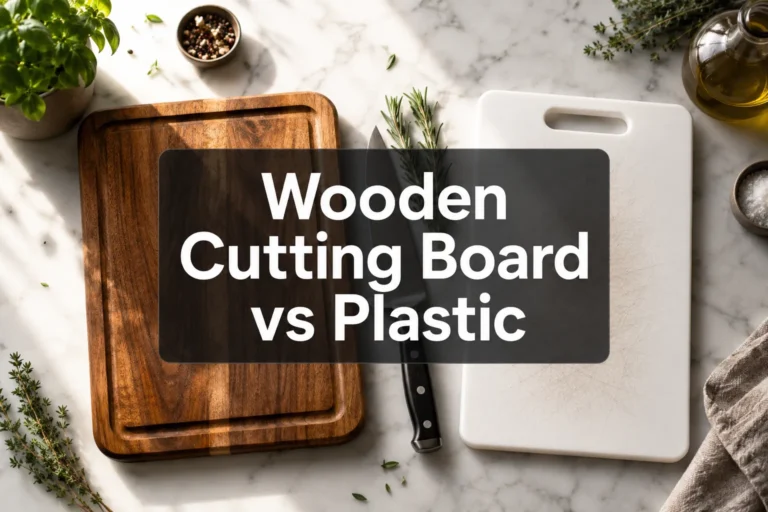
Wooden cutting boards are not dishwasher-safe, and neither are bamboo boards. Both materials are porous and will absorb water during a dishwasher cycle, causing them to swell, warp, crack, and eventually split. Even a single dishwasher cycle can permanently damage a quality wooden board.
This is not a matter of board quality or brand, it is a property of the material itself. Wood expands when wet and contracts when dry. The rapid wet-dry-heat cycle of a dishwasher accelerates this process dramatically.
The cross-contamination problem with wood: Because wood is porous, bacteria from raw meat can penetrate below the surface where neither dishwasher jets nor surface scrubbing can reach them. A 2003 study frequently cited in food safety literature found that bacteria can survive in wood grain even after surface cleaning (though the same study noted wood has some natural antimicrobial properties, the evidence is genuinely mixed). For raw meat prep, a non-porous dishwasher-safe board is the safer choice [4].
Bottom line: If you love wooden boards for bread, cheese, or dry prep, keep them, but hand-wash only, oil regularly, and use a separate dishwasher-safe board for meat and fish.
Plastic vs. Bamboo Dishwasher-Safe Cutting Boards
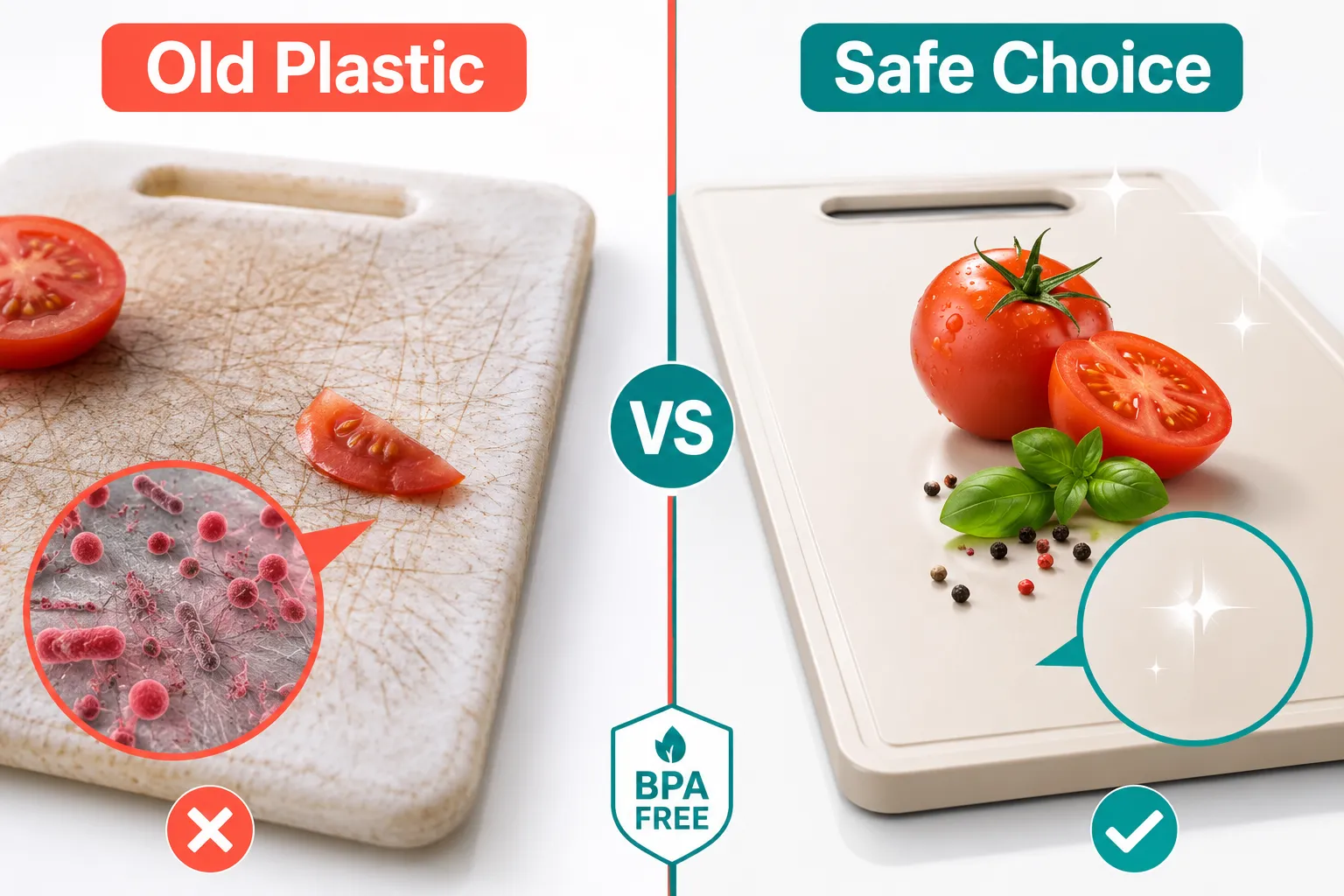
For dishwasher use, BPA-free plastic wins clearly over bamboo. Bamboo is harder than wood but still porous and moisture-sensitive, it will warp and crack in a dishwasher. Plastic (specifically HDPE or BPA-free composite) is non-porous and designed to handle dishwasher conditions [5].
Here is a direct comparison:
| Feature | BPA-Free Plastic (HDPE) | Bamboo |
|---|---|---|
| Dishwasher Safe | Yes | No |
| Non-Porous | Yes | No |
| Knife Friendly | Moderate | Moderate |
| Warp Resistance | High | Low |
| Odor Absorption | Low | Moderate |
| Eco-Friendliness | Moderate | High (if hand-washed) |
| Price Range | $15,$40 | $20,$60 |
Common mistake: Many shoppers buy bamboo boards because they are marketed as eco-friendly and “natural,” then put them in the dishwasher because the packaging says “easy to clean.” Within a few cycles, the board splits along the grain. If sustainability matters to you, a titanium board that lasts decades has a far lower lifetime environmental footprint than replacing bamboo boards every year or two [8].
Best Dishwasher-Safe Cutting Boards for Meat
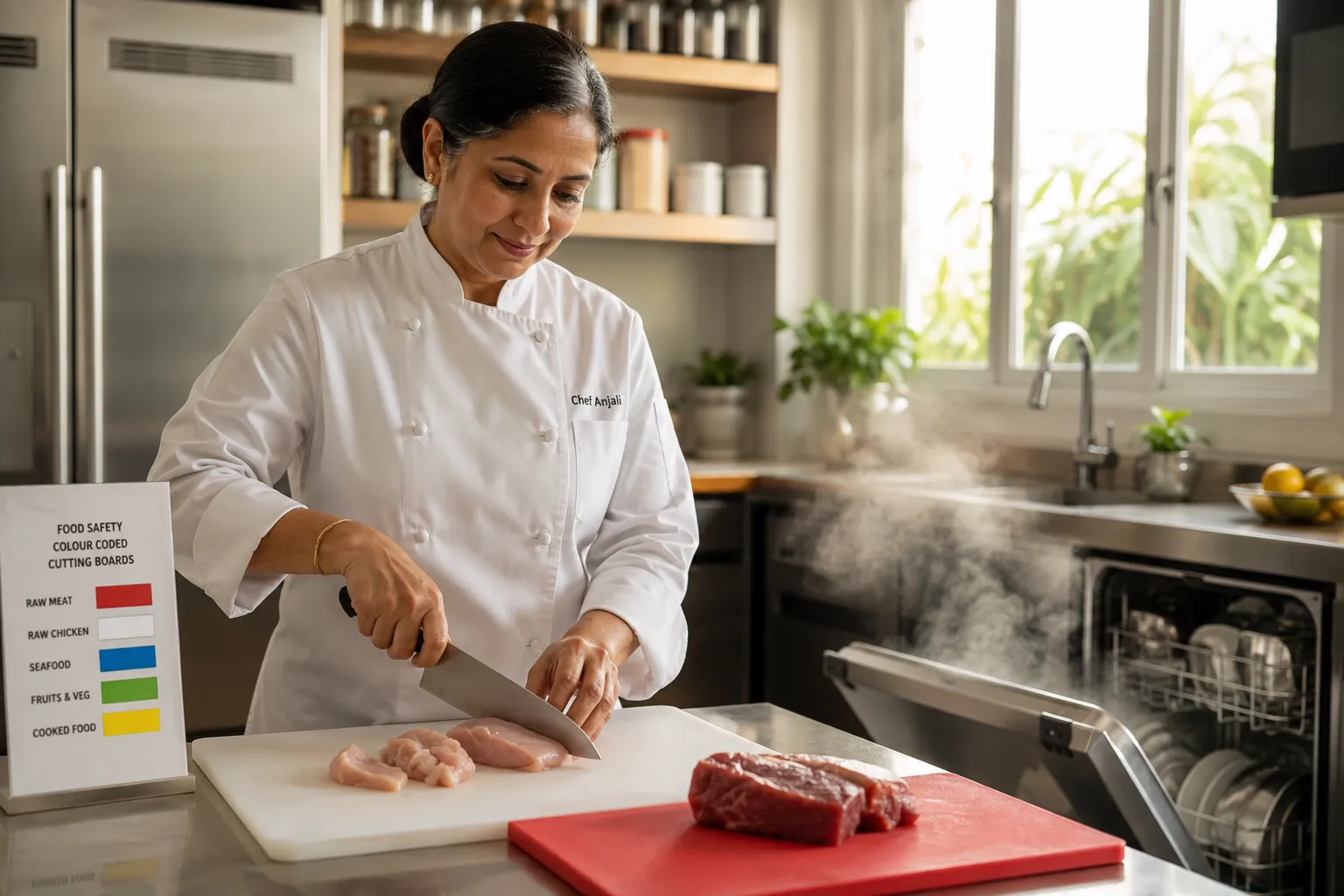
For raw meat prep, the best dishwasher-safe cutting boards are non-porous, NSF-certified, and ideally color-coded red to prevent cross-contamination. HDPE boards meeting NSF/ANSI standards are the professional standard in commercial kitchens [6].
Key features to prioritize for meat cutting boards:
- Non-porous surface: Bacteria from raw chicken, beef, or fish cannot penetrate below the surface
- NSF certification: Confirms the board meets commercial food safety standards [7]
- Color-coding: Red boards designated for raw meat reduce the risk of cross-contamination with produce or cooked food
- Groove resistance: A harder surface develops fewer deep grooves where bacteria can hide
- High-temperature tolerance: Must withstand sanitizing cycles (140°F or higher)
The Katori Titanium board is particularly well-suited for raw meat because its non-porous titanium surface harbors no bacteria, absorbs no odors, and can be sanitized with boiling water or alcohol in addition to standard dishwasher cycles. For a detailed look at how the Katori performs in real-world use, see the Katori Titanium Cutting Board review and user feedback.
Edge case, “dishwasher-safe but not for raw chicken”: Some cutting board manufacturers note that while their board is dishwasher-safe, it is not recommended for raw poultry. This usually applies to boards with surface coatings or adhesive-bonded layers that can degrade under repeated high-heat sanitizing cycles. Always check whether the board is NSF-certified for meat contact, not just labeled “dishwasher-safe” [9].
Do Dishwasher-Safe Cutting Boards Dull Knives Faster
The short answer is no, the dishwasher itself does not dull knives, but the board material matters enormously. Hard, non-yielding surfaces like glass and ceramic dull knife edges very quickly. HDPE plastic and food-grade titanium are gentler on knife edges than glass, stone, or ceramic [10].
Here is how common dishwasher-safe materials rank for knife friendliness, from best to worst:
- Food-grade titanium, Slightly yielding surface minimizes edge wear; users report knives stay sharp longer
- HDPE plastic, Soft enough to absorb impact without damaging the edge; the standard for professional kitchens
- BPA-free composite, Harder than HDPE, so slightly more edge wear, but still far better than glass
- Tempered glass, Destroys knife edges quickly; dishwasher-safe but a poor choice for regular cutting
- Ceramic, Similar to glass; avoid for daily knife use
The real knife-dulling culprit is not the dishwasher cycle itself but cutting on a surface that is harder than the knife steel. A quality chef’s knife has a Rockwell hardness of around 58-62 HRC. Glass and ceramic surfaces exceed this, which is why they damage edges. HDPE and titanium are softer than knife steel, so they give slightly rather than grinding the edge.
Why Is My Dishwasher-Safe Cutting Board Warping
Warping happens when one side of a cutting board expands or contracts at a different rate than the other. Even on boards labeled dishwasher-safe, warping can occur if the board is too thin, made from low-density material, or loaded incorrectly in the dishwasher [2].
Common causes of warping in dishwasher-safe boards:
- Thin boards (under 0.4 inches): Lack the structural mass to resist thermal stress; the top surface heats faster than the bottom
- Low-density plastic: Cheaper plastic boards have more internal air pockets, making them less dimensionally stable
- Improper loading: Standing a board vertically on one edge in the dishwasher exposes one face to more heat than the other
- Heated dry cycle: The intense heat of the drying cycle is the most common cause of warping, air-dry when possible
- Material mismatch: Boards with a rubber base or grip layer can warp if the base material and the board surface expand at different rates
How to prevent warping:
- Choose boards at least 0.5 inches thick
- Look for HDPE boards with a density of 0.94-0.96 g/cm³ or higher
- Load boards flat in the bottom rack, not standing upright
- Turn off the heated dry cycle and air-dry instead
- Avoid leaving boards in a hot dishwasher after the cycle ends
Are Glass Cutting Boards Dishwasher Safe
Glass cutting boards are fully dishwasher-safe from a cleaning perspective, glass is non-porous, chemically inert, and unaffected by dishwasher heat or detergents. However, glass is a poor choice for regular cutting use because it destroys knife edges and is slippery under food [3].
When glass boards make sense:
- Pastry work (rolling dough, cutting chocolate)
- Serving boards where no knife contact occurs
- Households where hygiene is the only concern and knives are not being used on the board
When to avoid glass boards:
- Any task involving a quality chef’s knife, paring knife, or cleaver
- Households with children (glass can shatter if dropped)
- Daily prep work where knife longevity matters
The Guardian’s 2026 review of non-plastic cutting board options noted that glass and ceramic boards, while hygienic, are increasingly being replaced by composite and titanium alternatives that offer the same non-porous hygiene benefits without destroying knife edges [8].
How Much Does a Good Dishwasher-Safe Cutting Board Cost
Good dishwasher-safe cutting boards range from $15 for a basic HDPE board to $179 for a premium titanium option. The right price point depends on how often you cook, what you are cutting, and how long you want the board to last [9].
Budget tier ($15,$40):
- Basic HDPE plastic boards, often color-coded
- NSF-certified options available in this range
- Best for: occasional cooks, households that want a dedicated meat board, renters
- Limitation: develop grooves over time and need replacing every 2-4 years
Mid-range tier ($40,$90):
- BPA-free composite boards, thicker HDPE boards, NSF-certified sets
- Better groove resistance and longer lifespan (5-10 years with care)
- Best for: regular home cooks who want quality without premium pricing
Premium tier ($89,$179):
- Food-grade titanium boards (Katori and similar)
- Designed as a lifetime purchase, no replacement needed
- Best for: health-conscious cooks, frequent meat prep, anyone prioritizing hygiene above all else
- Cost-per-use over 20 years is actually lower than replacing budget boards every few years
Best budget-friendly dishwasher-safe cutting board: For most households, a thick HDPE board in the $20,$35 range from a brand with NSF certification delivers excellent performance. Look for boards at least 0.75 inches thick to resist warping and groove development [7].
How to Prevent Stains on Dishwasher-Safe Cutting Boards
Stains on dishwasher-safe cutting boards are most often caused by turmeric, beet juice, red cabbage, and berries, pigments that bind to plastic surfaces quickly. The best prevention is rinsing the board immediately after contact with staining foods, before the pigment has time to set [1].
Practical stain-prevention steps:
- Rinse immediately after cutting staining foods, do not let juice sit on the surface
- Run the dishwasher promptly rather than leaving a stained board on the counter overnight
- For stubborn stains on HDPE boards, a paste of baking soda and water left for 10 minutes before washing removes most pigment
- Lemon juice or diluted white vinegar can lighten stains on plastic boards without damaging the surface
- Titanium boards resist staining naturally because the non-porous surface does not allow pigment to penetrate
Common mistake: Using bleach directly on plastic boards to remove stains. While bleach is effective, repeated use degrades the plastic surface and creates micro-pits that actually make future staining worse. Use it sparingly and diluted (1 tablespoon per gallon of water) if needed.
Dishwasher-Safe vs. Hand-Wash: Which Cutting Board Lasts Longer
For non-porous boards (HDPE, composite, titanium), hand-washing extends lifespan slightly compared to dishwasher washing because it avoids repeated thermal stress. However, the difference is modest for quality boards, and the hygiene advantage of dishwasher sanitization often outweighs the minor longevity trade-off [4].
Key comparison:
- Dishwasher washing sanitizes more thoroughly (higher temperatures kill more bacteria), but the heated dry cycle adds thermal stress
- Hand-washing is gentler on the board surface but requires thorough technique, many home cooks under-wash, leaving bacteria behind
- For raw meat boards specifically: The dishwasher’s high-temperature cycle is worth the minor wear trade-off because thorough sanitization matters more than board longevity
Best practice for maximum lifespan: Wash in the dishwasher on a normal cycle, but disable the heated dry setting and allow the board to air-dry. This gives you the sanitization benefit of the dishwasher without the thermal stress of the drying cycle.
If you are interested in how overall kitchen hygiene connects to broader health habits, our guides on best supplement for gut health and how to stay fit and active at home after age 50 cover related wellness topics.
The Katori Titanium Cutting Board: Premium Dishwasher-Safe Option Reviewed
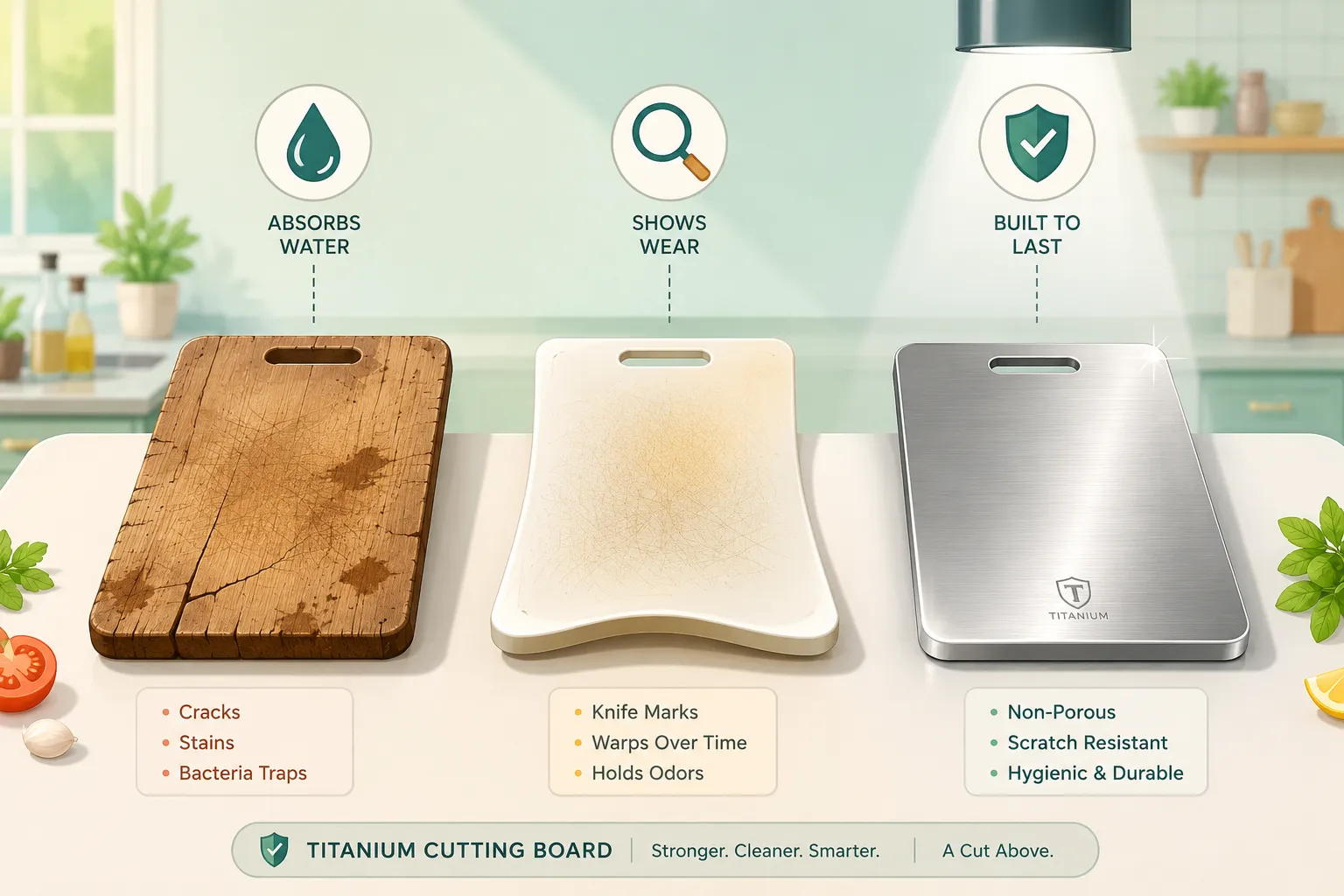
The Katori Titanium Cutting Board sits at the top of the dishwasher-safe cutting board category. It is made from food-grade (Grade 1/medical-grade) titanium with a matte brushed finish, rounded edges, and approximately 2mm thickness. The board is non-porous, antibacterial, non-reactive with acidic foods, and fully rustproof [9].
What real users report:
- Zero odor transfer between foods (garlic, fish, and onion smells do not linger)
- Knives glide smoothly and stay sharper longer than on plastic or bamboo
- Easy to sanitize, dishwasher, boiling water, or alcohol all work
- Feels premium and stable on the counter
- Occasional note about metallic sound during chopping (a minor adjustment)
Pros:
- Non-porous: no bacteria, no mold, no odors
- Fully dishwasher-safe with no warping risk
- Non-reactive with acidic foods (lemon, tomato, vinegar)
- Knife-friendly surface
- Rustproof and corrosion-resistant
- Biocompatible, same material as surgical implants
Cons:
- Premium price point ($89,$179)
- Requires a non-slip silicone mat on smooth countertops
- Metallic sound during heavy chopping takes adjustment
- Limited style options compared to wooden boards
- Primarily available through official channels
Who should buy it: Frequent cooks, households with food safety concerns, anyone who preps raw meat regularly, and buyers who want a true lifetime kitchen tool. For a full breakdown of user experiences and complaints, see the Katori Titanium Cutting Board review.
Who should skip it: Cooks on a tight budget, occasional home cooks, or anyone who strongly prefers the look and feel of wood.
Editor’s rating for 2026:
| Category | Rating |
|---|---|
| Build Quality | 5 / 5 |
| Hygiene | 5 / 5 |
| Knife Compatibility | 4 / 5 |
| Dishwasher Performance | 5 / 5 |
| Value for Money | 4 / 5 |
| Overall | 4.8 / 5 |
Frequently Asked Questions
Q: Can I put any plastic cutting board in the dishwasher?
Not all plastic boards are dishwasher-safe. Look for boards specifically labeled dishwasher-safe and made from HDPE or BPA-free composite. Thin, low-density plastic boards will warp. Boards with rubber grip bases may degrade if the base material is not dishwasher-rated.
Q: How often should I replace a dishwasher-safe plastic cutting board?
Replace HDPE plastic boards when deep knife grooves develop, typically every 2-4 years with regular use. Deep grooves harbor bacteria that even dishwasher cycles cannot fully reach. Composite and titanium boards last significantly longer.
Q: Is it safe to cut raw chicken on a dishwasher-safe plastic board?
Yes, provided the board is non-porous, NSF-certified, and washed in the dishwasher at a sanitizing temperature after each use. Use a dedicated color-coded board (red) for raw poultry to prevent cross-contamination.
Q: Do titanium cutting boards really not dull knives?
Titanium boards are gentler on knife edges than glass, ceramic, or stone. Users consistently report better edge retention compared to plastic and bamboo. The surface is slightly softer than knife steel, so it yields rather than grinding the edge.
Q: Why does my dishwasher-safe board still smell after washing?
If a plastic board retains odors after dishwasher washing, the surface likely has deep grooves where food residue is trapped. A paste of baking soda and water scrubbed into the grooves, followed by a dishwasher cycle, usually resolves this. If odors persist, the board needs replacing.
Q: Are composite cutting boards better than HDPE for the dishwasher?
Composite boards are harder and develop grooves more slowly, which means they stay hygienic longer. However, quality HDPE boards perform well in the dishwasher and cost less. For most home cooks, HDPE is the better value; composite is worth the upgrade for heavy daily use.
Q: What is the best dishwasher-safe cutting board for a small kitchen?
A thin but dense HDPE board (at least 0.5 inches thick) in a compact size (around 10 x 14 inches) works well for small kitchens. Look for boards with a non-slip base to keep them stable on limited counter space.
Q: Can I use the same dishwasher-safe board for vegetables and meat?
Technically yes if the board is thoroughly sanitized between uses, but food safety guidelines recommend separate boards for raw meat and produce. Color-coded sets (red for meat, green for vegetables) make this easy and are available in most HDPE board lines.
Q: How do I know if a cutting board is truly BPA-free?
Look for boards explicitly labeled “BPA-free” and ideally NSF-certified. Reputable brands will list the material composition on packaging. If the material is not listed, contact the manufacturer before purchasing.
Q: Is a glass cutting board a good choice for hygiene?
Glass is non-porous and fully dishwasher-safe, so it is hygienic. However, it destroys knife edges quickly and can shatter if dropped. For hygiene without knife damage, HDPE or titanium are better choices.
Q: What thickness should a dishwasher-safe cutting board be?
At minimum 0.5 inches (1.25 cm) for reliable warp resistance in the dishwasher. For heavy chopping or meat prep, 0.75-1 inch is better. Thicker boards are heavier but significantly more stable.
Q: Where is the safest place to buy the Katori Titanium Cutting Board?
Purchase only from the official Katori website or an authorized retailer to ensure you receive a genuine product with the included warranty card and care guide. Third-party listings on marketplace sites carry a risk of counterfeit products.
Conclusion
The best dishwasher-safe cutting boards in 2026 come down to one core principle: non-porous materials win. Wood and bamboo, despite their appeal, simply cannot survive repeated dishwasher cycles and should not be used for raw meat prep. BPA-free HDPE plastic is the smart, affordable choice for most households, especially when NSF-certified and color-coded for food safety. For cooks who want a lifetime solution with zero compromise on hygiene, food-grade titanium boards like the Katori represent a genuine upgrade.
Your next steps:
- Assess your current cutting board, if it is wooden, bamboo, or showing deep knife grooves, replace it with a non-porous option
- Choose your tier: budget HDPE ($15,$40), mid-range composite ($40,$90), or premium titanium ($89,$179) based on how often you cook and your hygiene priorities
- For raw meat prep, use a dedicated NSF-certified board, ideally color-coded red
- Disable the heated dry cycle on your dishwasher to extend board life
- Replace HDPE boards every 2-4 years when grooves develop; titanium boards should last indefinitely
If you are also focused on overall kitchen health and wellness habits, our resources on best supplement for gut health and how to create a morning routine for better mental health offer practical guidance that pairs well with a cleaner, safer kitchen setup.
References
[1] Best Non Toxic Dishwasher Safe Cutting Boards – https://allaroundkitchens.com/best-non-toxic-dishwasher-safe-cutting-boards/
[2] Best Cutting Boards Kitchen Prep 2026 – https://www.theconsumers.guide/reviews/best-cutting-boards-kitchen-prep-2026
[3] Best Cutting Boards 143129324 – https://shopping.yahoo.com/home-garden/kitchen/article/best-cutting-boards-143129324.html
[4] Best Cutting Boards – https://www.bonappetit.com/story/best-cutting-boards
[5] Best Cutting Boards – https://www.superfooddrive.org/best-cutting-boards/
[6] NSF Rubber Cutting Board Sani Tuff T45 Rectangle – https://www.webstaurantstore.com/documents/specsheets/nsf_rubber_cutting_board_sani_tuff_t45_rectangle.pdf
[7] Dexas 4-Pack NSF Certified Polysafe Cutting Boards – https://villageofgreenwoodlake.gov/products/dexas-4-pack-nsf-certified-polysafe-cutting-boards-with-hand/212270644/
[8] Best No Plastic Cutting Boards – https://www.theguardian.com/thefilter-us/2026/mar/12/best-no-plastic-cutting-boards
[9] Best Dishwasher Safe Cutting Boards – https://koppenhouse.com/blog/best-dishwasher-safe-cutting-boards/
[10] Best Cutting Boards – https://www.foodnetwork.com/how-to/packages/shopping/product-reviews/best-cutting-boards
Tags: dishwasher-safe cutting boards, best cutting boards 2026, HDPE cutting board, titanium cutting board, Katori cutting board, food-safe cutting board, BPA-free cutting board, cutting board for raw meat, NSF certified cutting board, kitchen hygiene, bamboo vs plastic cutting board, composite cutting board

With over 13 years of experience in holistic health blogging, I aim to help you navigate your wellness journey with honest insights, expert-backed advice, and a sprinkle of real-world practicality.
Certified Wellness Writer | Herbal Nutrition Advocate | Wellness Research Enthusiast