Titanium vs Plastic Cutting Board: Which One Should You Buy?
Last updated: July 29, 2026
Quick Answer
Titanium cutting boards outperform plastic in hygiene, durability, and long-term value, but they cost significantly more upfront. Plastic boards are cheap and widely available, but their porous, groove-prone surfaces harbor bacteria over time. For anyone who cooks frequently and cares about food safety, titanium is the stronger long-term choice.
Key Takeaways
- Titanium cutting boards are non-porous, meaning bacteria cannot hide in surface grooves the way they do in plastic boards.
- Plastic boards develop knife grooves quickly, and those grooves are nearly impossible to fully sanitize.
- Titanium is biocompatible and non-reactive, so it will not leach metals or chemicals into food, even with acidic ingredients.
- A quality titanium board costs $89 to $179, while plastic boards typically run $10 to $40, but titanium lasts decades.
- Titanium boards are generally gentler on knife edges than hard materials like glass or ceramic, though wood remains the softest option.
- Dishwasher-safe titanium boards are easier to maintain than plastic boards, which can warp in high heat.
- Recent research from Aston University (late 2025) found that used plastic boards carry higher microbial counts than wood, raising concerns about their long-term hygiene.
- Titanium is rust-proof, odor-resistant, and will not stain from foods like beets, turmeric, or berries.
- For raw meat prep, titanium’s non-porous surface is one of the safest options available.
- If budget is the primary concern, wood is a better alternative to plastic, not titanium.
What Is a Titanium Cutting Board and How Does It Work?
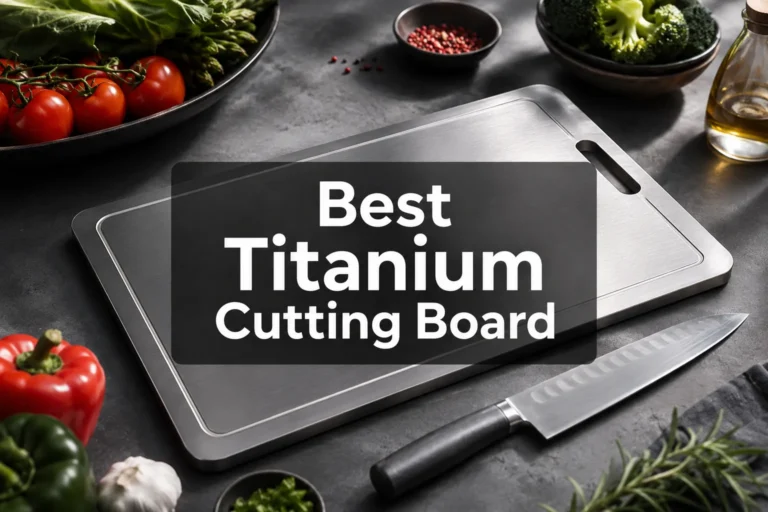
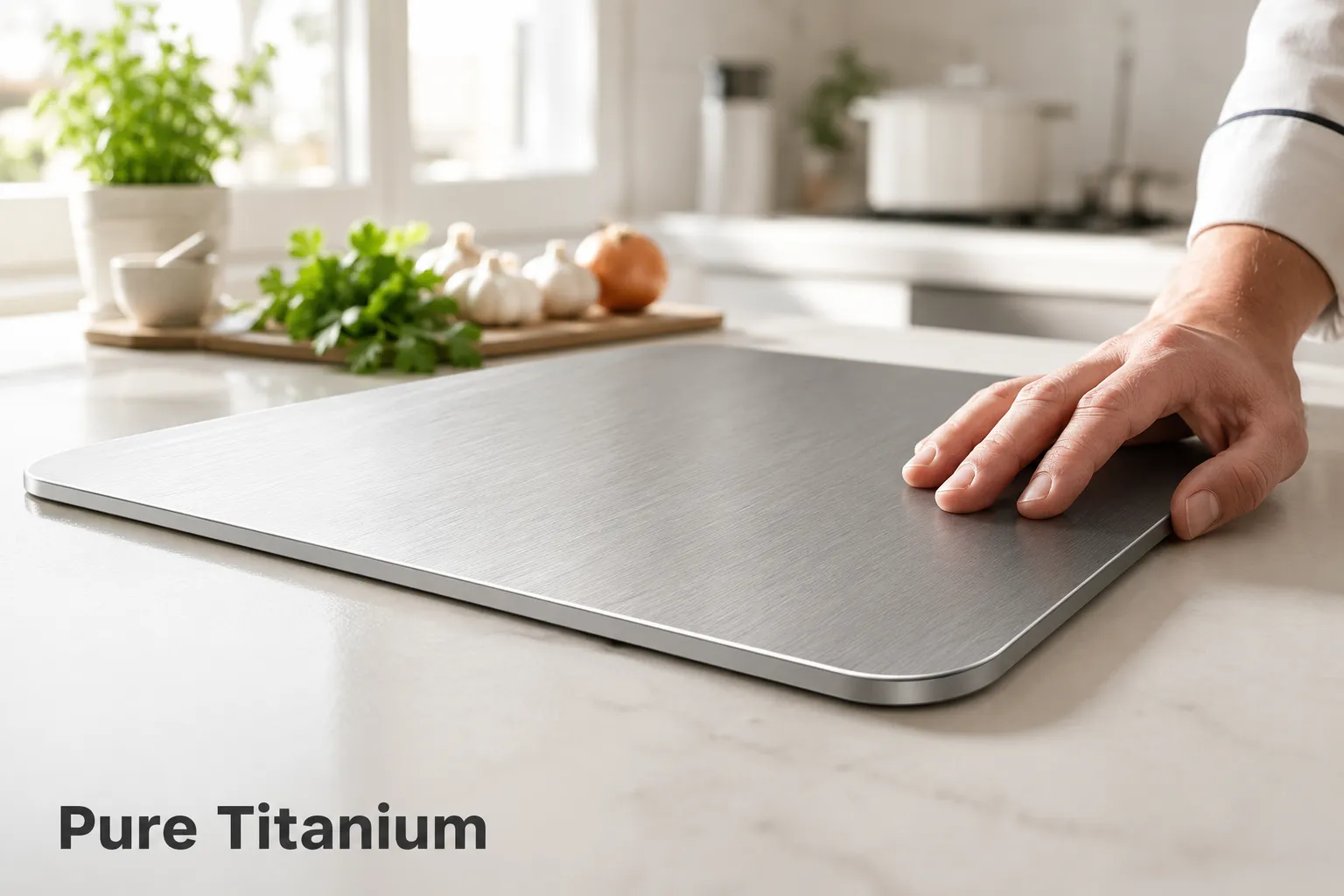
A titanium cutting board is a kitchen prep surface made from food-grade titanium, typically Grade 1 or medical-grade purity. Unlike wood or plastic, titanium is a non-porous metal, meaning its surface has no microscopic gaps where food particles or bacteria can settle and multiply.
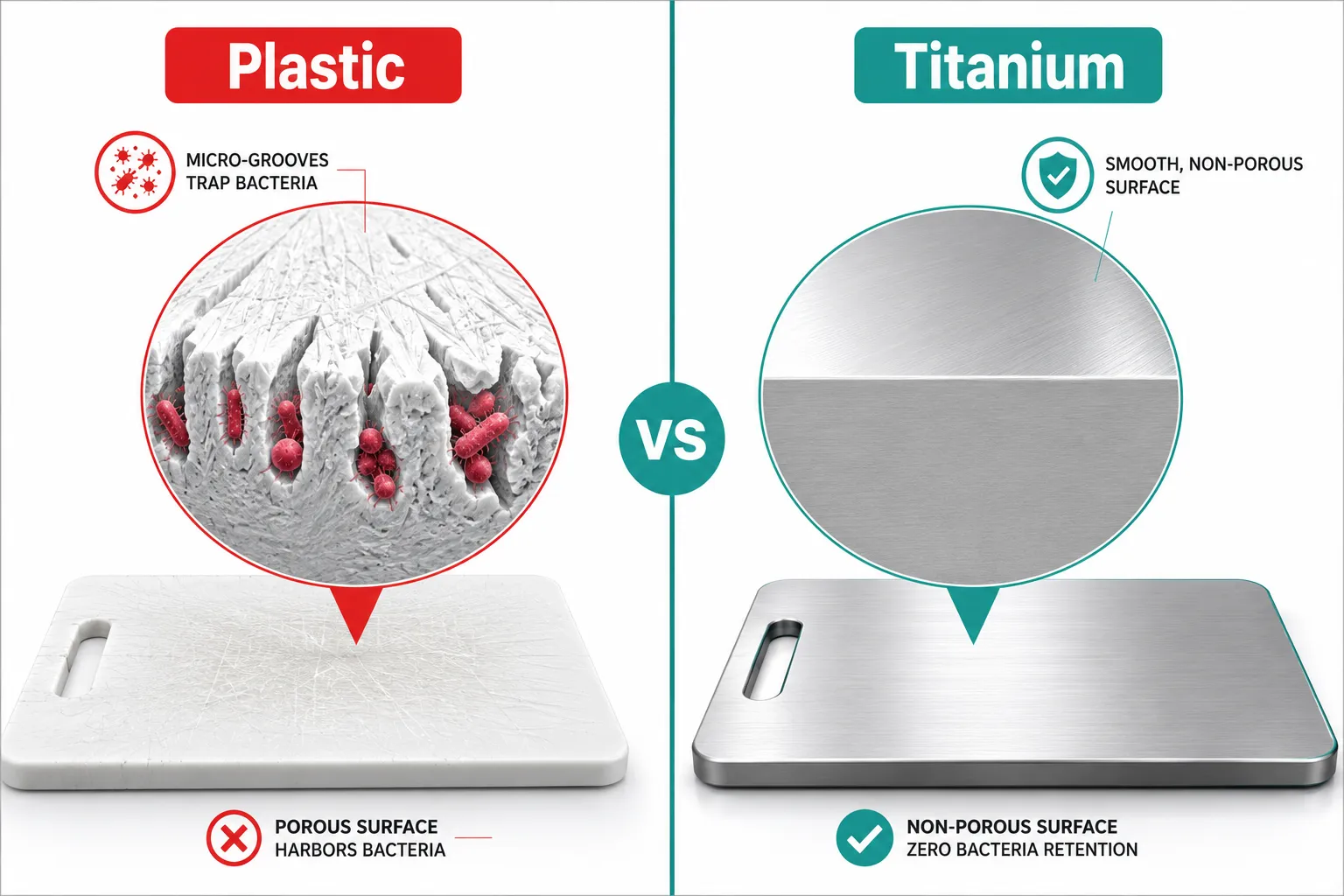
The boards work the same way as any cutting surface: you place food on them and cut with a knife. The difference is in what happens at the microscopic level. Plastic and wood both develop tiny grooves from knife contact over time. Those grooves trap food residue, moisture, and bacteria. Titanium’s hardness means it resists those grooves far longer, keeping the surface smooth and easier to clean.
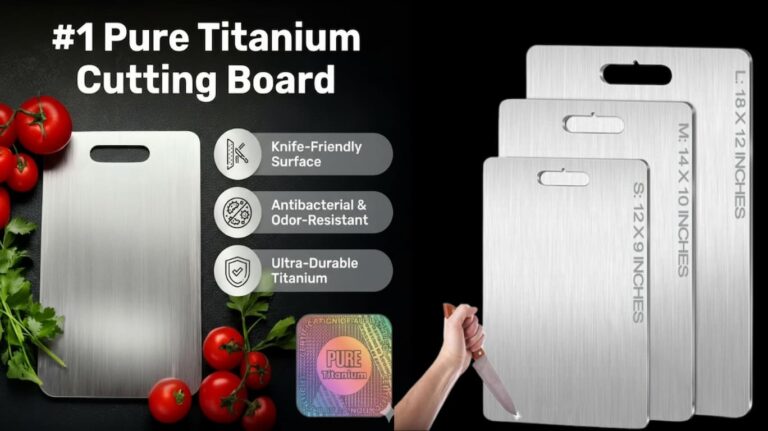
Most titanium boards on the market, including products like the Katori Titanium Cutting Board, are constructed from pure titanium sheets approximately 2 mm thick, with a matte brushed finish to reduce glare and improve grip [1]. They are lightweight, roughly 40% lighter than stainless steel, and can handle direct contact with acidic foods, hot cookware, and repeated dishwasher cycles without degrading [2].
How it differs from stainless steel boards: Stainless steel is harder and heavier, which means it dulls knives faster. Titanium sits in a middle ground: harder than wood and plastic, but with a surface that is slightly more forgiving on knife edges than steel or glass.
For a detailed look at one popular model, see our Katori Titanium Cutting Board reviews and complaints article, which covers real user experiences in depth.
Titanium vs Plastic Cutting Board: Which Is Better?
Titanium is better for hygiene, durability, and food safety. Plastic is better for budget-conscious buyers who replace their boards regularly.
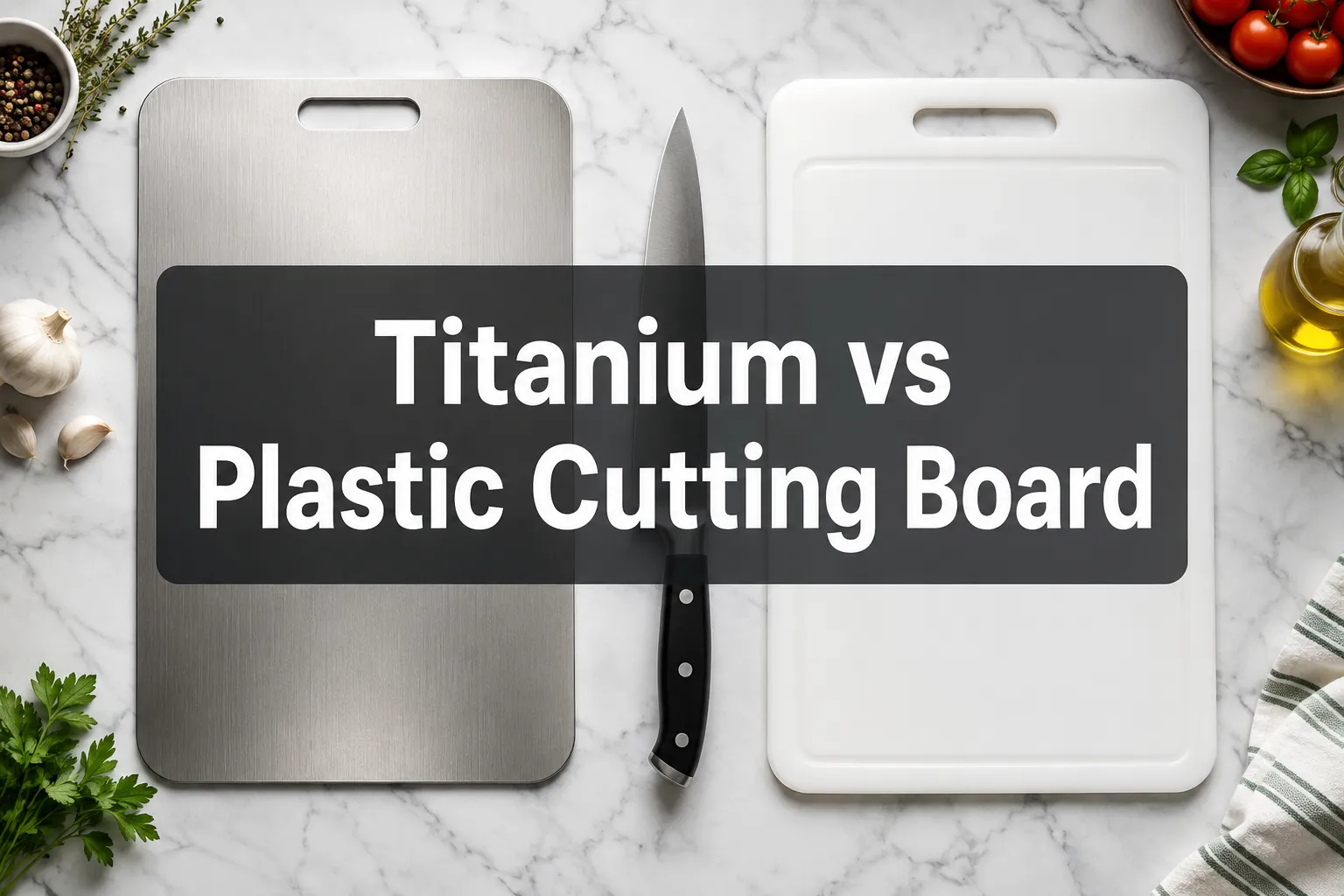
Here is a direct comparison across the factors that matter most:
| Factor | Titanium | Plastic |
|---|---|---|
| Hygiene | Non-porous; resists bacteria | Grooves trap bacteria over time |
| Knife Safety | Better than glass/steel; harder than wood | Soft initially; dulls knives as grooves deepen |
| Durability | Decades of use; no warping or cracking | Warps, stains, and grooves within 1-3 years |
| Maintenance | Dishwasher-safe; odor-free | Can warp in dishwasher; retains odors |
| Upfront Cost | $89 – $179 | $10 – $40 |
| Long-Term Cost | Low (buy once) | Moderate to high (replace every 1-3 years) |
| Odor Resistance | Excellent; no smell transfer | Poor; garlic and fish smells linger |
| Sustainability | Long lifespan reduces waste | Frequent replacement adds plastic waste |
Choose titanium if: You cook frequently, prep raw meat, or want a board that will last 10 to 20 years without degrading.
Choose plastic if: You need a temporary solution, are outfitting a rental kitchen, or are working with a strict budget under $30.
Are Titanium Cutting Boards Safe for Food?
Yes, titanium cutting boards are among the safest food prep surfaces available. Titanium is biocompatible, meaning it is used in surgical implants, dental fixtures, and medical devices because it does not react with human tissue or bodily fluids.
For food prep, this matters because titanium will not leach metals or chemicals into your food, even when you cut highly acidic ingredients like citrus, tomatoes, or vinegar-marinated proteins. Stainless steel boards, by contrast, can release trace amounts of nickel or chromium under certain conditions, particularly with prolonged contact with acidic foods.
Key food safety advantages of titanium:
- Non-reactive with acids, salts, and oils
- No chemical coatings that can chip or flake (unlike some non-stick surfaces)
- Antibacterial properties due to the non-porous surface
- Odor-neutral: garlic, fish, and onion smells do not absorb into the surface
- Corrosion-proof: no rust even after years of wet use [3]
Recent microbiome research from Aston University (late 2025) found that used plastic boards carry higher microbial counts than wood boards, which challenges the long-held assumption that plastic is more hygienic than natural materials. Titanium, with its smooth non-porous surface, avoids this problem entirely.
Plastic Cutting Board Health Risks Compared to Titanium
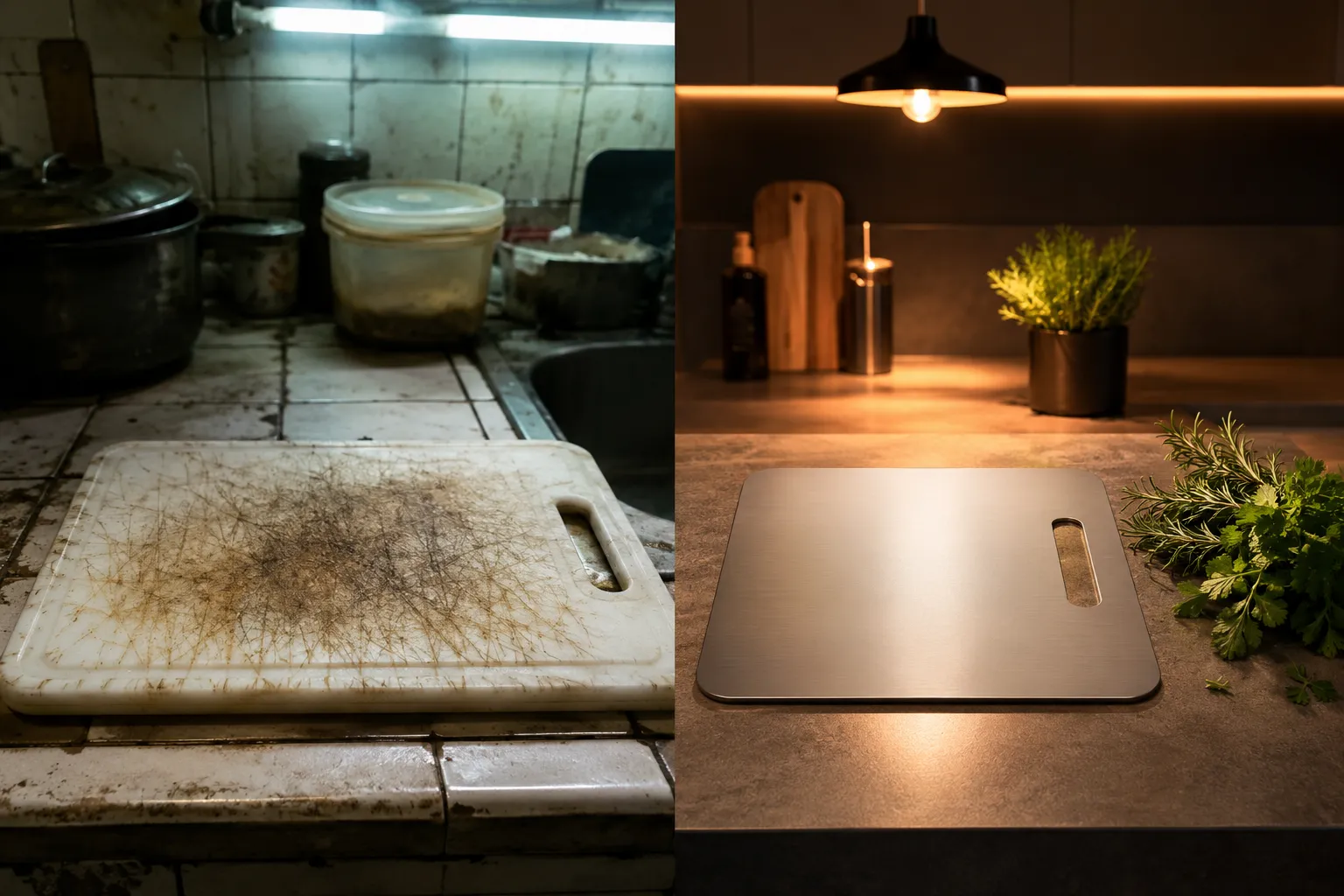
Plastic boards carry real hygiene risks that are often underestimated. The core problem is not the plastic itself when new, but what happens after a few months of regular use.
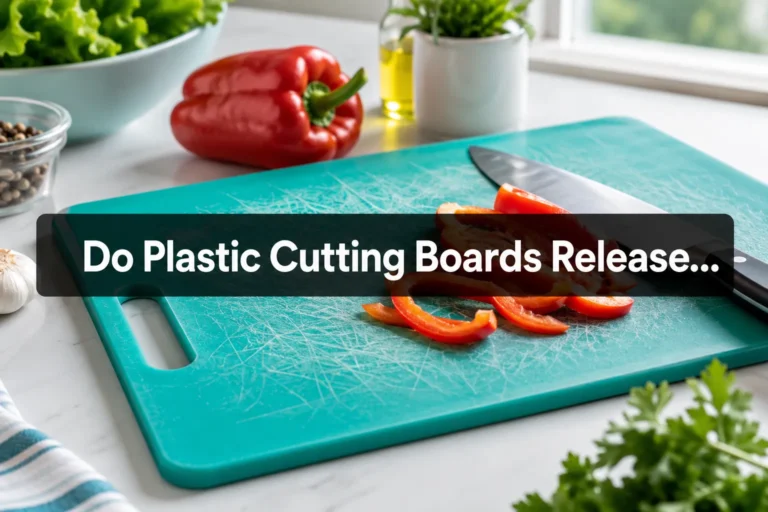
Every knife stroke creates a microscopic groove in the plastic surface. These grooves are warm, moist, and filled with food residue, which makes them ideal environments for bacterial growth. A study published in research compiled by Boosblocks found that cutting board surfaces, particularly plastic ones with visible knife marks, harbor significantly higher bacterial loads than smooth, non-porous surfaces [6].
Specific risks associated with used plastic cutting boards:
- Cross-contamination: Bacteria from raw meat can survive in grooves and transfer to the next food item you cut, even after wiping the surface.
- Microplastic shedding: Some research suggests that plastic boards shed microplastic particles into food during cutting, particularly with softer plastics. This is an emerging area of concern in 2026.
- Odor and mold: Moisture trapped in grooves can lead to mold growth, especially if the board is stored wet.
- Chemical leaching: Certain plastic boards, particularly older ones made with BPA-containing polymers, can leach chemicals under heat or with acidic foods.
Titanium eliminates all of these risks. Its surface does not groove easily, does not absorb moisture, and contains no synthetic polymers or chemical coatings [1].
“The hygiene gap between a new plastic board and a used one is enormous. After six months of daily use, a plastic board is a very different object than what you bought.”, Expert analysis on metal vs. plastic cutting surfaces, July 2026
Do Titanium Cutting Boards Dull Knives?
Titanium boards are harder than wood and plastic, which means they do cause slightly more wear on knife edges than a wood board would. However, they are significantly gentler on knives than glass, ceramic, or stainless steel boards.
The practical reality is that most home cooks will not notice a meaningful difference in knife sharpness when switching from plastic to titanium, provided they maintain their knives with regular honing. Professional chefs who sharpen their knives frequently tend to find titanium boards acceptable.
Knife compatibility by board material (from softest to hardest on knives):
- End-grain wood (softest, best for knives)
- Face-grain wood
- Bamboo
- Plastic (new boards)
- Titanium
- Stainless steel
- Glass or ceramic (hardest, worst for knives)
Titanium boards marketed as “knife-friendly” are not misleading, but that claim should be understood in context. They are knife-friendly relative to glass and steel, not relative to wood. If preserving your knife edge is the top priority, a high-quality end-grain wood board remains the gold standard. If hygiene is the top priority, titanium wins [2].
Titanium Cutting Board Pros and Cons
Titanium cutting boards offer genuine advantages, but they are not perfect for every kitchen or every cook.
Pros:
- Non-porous surface prevents bacterial buildup in grooves
- Dishwasher-safe without warping or degrading
- Non-reactive with all food types, including acidic and salty ingredients
- Rust-proof and corrosion-resistant
- Odor-resistant: no smell transfer between foods
- Extremely durable, with a lifespan measured in decades
- Lightweight compared to stainless steel
- No chemical coatings to chip or flake
Cons:
- High upfront cost ($89 to $179 for quality boards)
- Harder on knife edges than wood boards
- Can be slippery on countertops without a non-slip base or silicone mat
- Produces a metallic sound when chopping, which some users find jarring
- Limited aesthetic variety compared to wood boards
- Best models are primarily available through official channels or select retailers [9]
Common mistake: Buying a titanium-coated board instead of a pure titanium board. Titanium-coated products use a thin titanium layer over a steel or aluminum core. These are cheaper but do not offer the same non-porous properties as a solid titanium surface. Always check for “100% pure titanium” or “Grade 1 titanium” labeling [10].
How to Clean and Maintain a Titanium Cutting Board
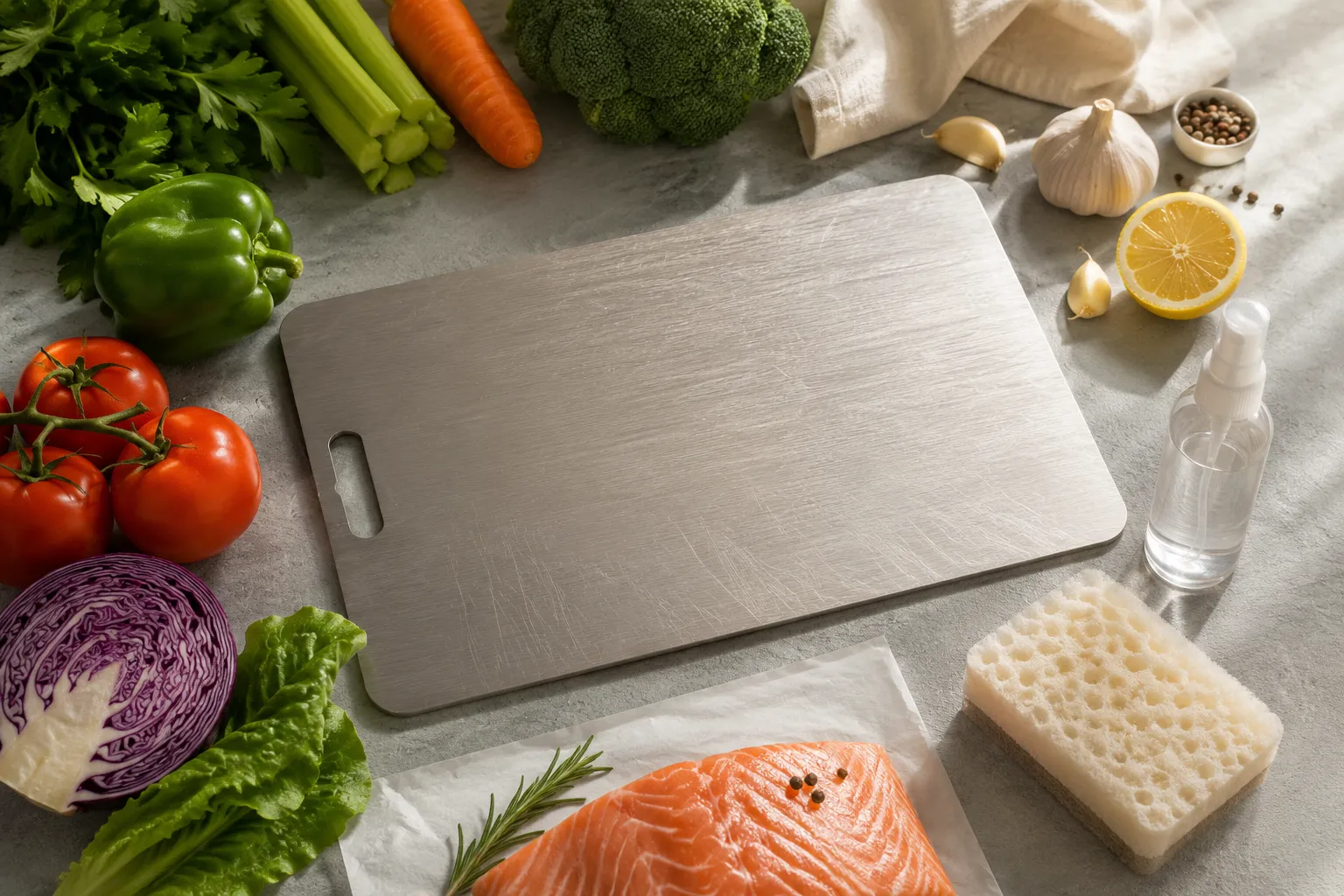
Titanium cutting boards are easier to maintain than wood boards and more reliably sanitized than plastic. The non-porous surface means a simple rinse removes most food residue, and there is no need for oiling or conditioning.
Routine cleaning steps:
- Rinse the board under warm water immediately after use.
- Apply a small amount of dish soap and scrub with a soft sponge or cloth.
- Rinse thoroughly and either air-dry or hand-dry with a clean towel.
- For deep sanitization, run the board through a dishwasher cycle or wipe with a food-safe sanitizing solution.
Maintenance tips for long-term performance:
- Avoid steel wool or abrasive scrubbers, which can scratch the matte finish and dull its appearance over time.
- Use a non-slip silicone mat underneath the board to prevent sliding on smooth countertops.
- Store the board upright rather than flat to allow air circulation and prevent any moisture from sitting beneath it.
- Hand-drying after dishwasher cycles produces a spot-free finish if appearance matters to you.
- There is no need to oil, season, or condition a titanium board, unlike wood.
One thing I appreciate about titanium boards from a practical standpoint is that the cleaning routine is genuinely faster than with wood. There is no anxiety about whether bacteria survived in a groove, and no monthly oiling ritual to keep the surface from cracking.
Titanium Cutting Board Price vs Plastic: Is It Worth the Money?
A quality titanium cutting board costs between $89 and $179, depending on size and brand [1][9]. Plastic boards typically cost $10 to $40. At first glance, the price gap looks enormous. But the cost-per-use calculation changes significantly over time.
Cost comparison over 10 years (estimated):
- Plastic board: Replacing every 1 to 2 years at an average of $25 = $125 to $250 over 10 years, plus the environmental cost of discarded plastic.
- Titanium board: One purchase at $130, with no replacement needed for 10 to 20 years.
Over a decade, the costs are roughly comparable, and titanium may actually be cheaper. The difference is that titanium requires a larger upfront investment.
Is a titanium cutting board worth the money?
Yes, for cooks who use their board daily or near-daily. The hygiene benefits alone justify the cost for anyone who regularly preps raw meat, cooks for immunocompromised family members, or simply wants to stop replacing boards every couple of years.
It is less worth it for occasional cooks, renters who move frequently, or anyone who prefers the feel and aesthetics of a natural wood board.
Pro tip: Several titanium board sellers, including the Katori brand, offer bundle discounts such as “Buy 2 Get 1 Free” promotions. If you need boards for multiple prep stations or want to gift one, these deals improve the value significantly.
Can You Cut Raw Meat on Titanium Cutting Boards?
Yes, and titanium is actually one of the best surfaces for raw meat preparation. The non-porous surface means that meat juices, blood, and fat do not penetrate the board, making it far easier to clean and sanitize after use.
With plastic boards, raw meat prep is a genuine concern because knife grooves trap meat juices at a depth that standard washing cannot fully reach. Research on cutting board bacteriology confirms that used plastic boards show higher microbial contamination than surfaces without groove accumulation [6].
Best practices for raw meat on titanium:
- Designate one side of a double-sided board for meat and the other for produce, if possible.
- Rinse immediately after use to prevent protein residue from drying on the surface.
- Follow up with a hot water rinse or dishwasher cycle for full sanitization.
- No special treatment is needed beyond standard cleaning.
Titanium’s non-reactive surface also means it will not absorb the smell of raw chicken or fish, which is a common complaint with both plastic and wood boards.
Best Cutting Board Material for Different Foods
No single board material is perfect for every task. Here is how titanium compares to alternatives across common food prep scenarios.
Titanium: Best for raw meat, fish, acidic foods (citrus, tomatoes), and any prep where hygiene is the top concern. Also excellent for garlic and onion prep because it does not absorb odors.
End-grain wood: Best for everyday vegetable and fruit prep, bread, and cheese. Gentlest on knife edges. Requires regular oiling and is not ideal for raw meat due to absorption.
Plastic: Acceptable for light duty prep when new. Becomes a hygiene liability after several months of regular use. Convenient for color-coded systems in professional kitchens where boards are replaced frequently.
Bamboo: A middle-ground option. Harder than wood, which means more knife wear. Eco-friendly but can crack with heavy use or improper care.
Glass or ceramic: Not recommended for regular cooking. Extremely hard on knife edges and provides no real hygiene advantage over titanium.
Decision rule: Choose titanium for meat and fish. Choose end-grain wood for daily vegetable prep if you maintain your knives carefully. Avoid glass entirely unless you are using it as a serving board rather than a cutting surface.
Titanium Cutting Board Durability: How Long Does It Last?
A quality titanium cutting board can last 20 years or more with normal use. Titanium has a strength-to-weight ratio roughly twice that of steel at half the weight, which means it handles heavy chopping, hot cookware contact, and daily dishwasher cycles without degrading [2][3].
What to expect over time:
- Surface scratches: Minor surface scratches will appear over years of use, particularly with heavy chopping. These do not affect the board’s hygiene properties because the surface remains non-porous.
- No warping: Unlike wood or plastic, titanium does not warp from heat or moisture exposure.
- No cracking or chipping: The material does not become brittle with age.
- No staining: Foods like beets, turmeric, and berries that permanently stain plastic boards wipe clean from titanium.
The “buy once, use forever” claim made by most titanium board manufacturers is not marketing hyperbole. It is a reasonable expectation given the material’s properties, provided the board is not subjected to extreme physical abuse like being used as a hammer or dropped onto concrete repeatedly.
Titanium Cutting Board Alternatives If Too Expensive
If a titanium board is outside your current budget, there are better alternatives to plastic.
End-grain wood boards ($40 to $120): The best budget-friendly alternative for most home cooks. End-grain wood is self-healing to some degree because knife cuts close along the wood grain rather than leaving open grooves. It requires oiling every few weeks but is gentle on knives and looks beautiful. A good end-grain maple or walnut board will serve you well for years.
Composite boards ($30 to $80): Made from compressed wood fibers or other food-safe materials. More durable than plastic and less maintenance-intensive than wood. A reasonable middle-ground option.
High-density polyethylene (HDPE) boards ($20 to $50): A better plastic option than standard polypropylene boards. HDPE is harder, resists knife grooves better, and is used in commercial kitchens. Still not as hygienic as titanium long-term, but a significant upgrade from standard plastic.
What to avoid: Bamboo boards marketed as eco-friendly are often harder than they appear, which accelerates knife dulling. Glass boards should be avoided entirely for cutting purposes.
If you are interested in how specific titanium board models compare before committing to a purchase, our detailed Katori Titanium Cutting Board reviews and complaints article covers real-world performance data and user feedback.
Where to Buy Titanium Cutting Boards
Titanium cutting boards are available through a small number of channels. Because the category is still relatively new in 2026, not all retailers carry them, and quality varies significantly between sellers.
Reliable sources:
- Official brand websites: The safest option for authenticity. Brands like Katori and Apexiqo sell directly through their own sites and often offer warranty coverage and bundle deals [10].
- Amazon: Several verified titanium boards are available, including double-sided models and boards with non-slip backing [2][3]. Check for “sold by” information to confirm you are buying from the brand directly rather than a third-party reseller.
- Home Depot: Carries select titanium board models, including the Adrinfly 100% Pure Titanium board, which is marketed as medical-grade and scratch-resistant [1].
- Baker’s Secret: Offers a double-sided titanium cutting board with verified food-grade materials [9].
What to look for when buying:
- “100% pure titanium” or “Grade 1 titanium” labeling
- A warranty card included with the product
- Logo engraving on the board itself (a sign of authenticity)
- A care guide included in the packaging
Warning: Avoid unbranded titanium boards from unknown sellers at suspiciously low prices. These are often titanium-coated steel or aluminum products, not solid titanium. The coating wears off over time, defeating the hygiene benefits.
Titanium vs Plastic Cutting Board: A Final Comparison for Different Cooks
The titanium vs plastic cutting board debate ultimately comes down to your cooking habits, budget, and priorities. Here is a clear decision framework.
Choose a titanium cutting board if you:
- Cook five or more times per week
- Regularly prep raw meat, poultry, or fish
- Have household members who are immunocompromised, pregnant, elderly, or young children
- Are frustrated by odor transfer between foods on your current board
- Want to stop replacing boards every one to two years
- Value sustainability and reducing plastic waste
Stick with plastic (for now) if you:
- Cook infrequently and replace your board every year
- Are furnishing a temporary kitchen or rental property
- Need multiple color-coded boards for a commercial kitchen with frequent replacement schedules
- Are working with a budget under $50
Consider wood as an alternative if you:
- Cook daily but prioritize knife longevity over maximum hygiene
- Enjoy the aesthetics of natural materials
- Are willing to oil and maintain a board regularly
The research increasingly supports what premium kitchen brands have been saying: plastic boards are not the hygienic choice they were once marketed as, particularly after months of use. Titanium boards represent a genuine upgrade in food safety for the everyday home cook.
Key Takeaways Before You Decide
- Titanium cutting boards are non-porous, non-reactive, and genuinely safer for raw meat prep than used plastic boards.
- The upfront cost of $89 to $179 is offset by a lifespan of 20 or more years.
- Titanium is harder on knife edges than wood but far gentler than glass or steel.
- Plastic boards develop bacteria-trapping grooves quickly, and recent research confirms their hygiene limitations.
- For budget-constrained buyers, end-grain wood is the best alternative to titanium, not cheap plastic.
- Always verify that you are buying a pure titanium board, not a titanium-coated product.
Conclusion
The titanium vs plastic cutting board comparison is not particularly close when you look at the full picture. Plastic boards win on upfront cost and nothing else. Titanium wins on hygiene, durability, food safety, odor resistance, and long-term value.
If you cook regularly and care about what goes into your food, a titanium cutting board is a worthwhile investment in 2026. The hygiene science is clear, the material is proven in medical applications, and the long-term cost math works in titanium’s favor for frequent cooks.
Actionable next steps:
- Assess how often you cook and whether you regularly prep raw meat. If you cook four or more times per week, titanium is worth the investment.
- Read verified reviews before buying. Our Katori Titanium Cutting Board reviews and complaints article covers real-world performance from actual users.
- If budget is a barrier right now, replace your current plastic board with an end-grain wood board as an interim step.
- When you are ready to buy titanium, purchase from official brand websites or verified Amazon listings to ensure you get a genuine pure titanium product with warranty coverage.
- Add a non-slip silicone mat to your order so the board stays secure on your countertop from day one.
Your cutting board is one of the most-used surfaces in your kitchen. It deserves the same attention you give to your knives, your cookware, and the quality of the food you prepare on it.
Frequently Asked Questions
Is titanium cutting board safe for food prep?
Yes. Titanium is biocompatible and non-reactive, meaning it does not leach metals or chemicals into food. It is the same material used in surgical implants and dental fixtures, making it one of the safest food contact surfaces available.
Does a titanium cutting board dull knives?
Titanium is harder than wood and plastic, so it causes slightly more knife edge wear than a wood board. However, it is significantly gentler on knives than glass, ceramic, or stainless steel boards. Regular honing compensates for any additional wear.
How do I clean a titanium cutting board?
Rinse with warm soapy water and a soft sponge after each use. Titanium boards are dishwasher-safe. For deep sanitization, use a food-safe sanitizing solution or a full dishwasher cycle. No oiling or conditioning is ever needed.
Is a titanium cutting board heavy?
No. Titanium is approximately 40% lighter than stainless steel. Most titanium cutting boards are light enough to handle easily with one hand, despite their solid construction.
Can you cut raw meat on a titanium cutting board?
Yes, and it is one of the best surfaces for raw meat prep. The non-porous surface prevents meat juices from penetrating the board, making it easy to fully sanitize after use.
How long does a titanium cutting board last?
With normal use, a quality titanium board can last 20 years or more. It will not warp, crack, stain, or rust. Minor surface scratches may appear over years of heavy use, but these do not affect hygiene or performance.
What is the difference between a titanium board and a titanium-coated board?
A pure titanium board is made entirely from food-grade titanium. A titanium-coated board uses a thin titanium layer over a steel or aluminum core. Coated boards are cheaper but the coating wears off over time, losing the hygiene benefits. Always look for “100% pure titanium” labeling.
Are plastic cutting boards actually unhygienic?
New plastic boards are reasonably hygienic. The problem develops over months of use as knife grooves accumulate. These grooves trap bacteria that standard washing cannot fully remove. Recent research from Aston University (late 2025) confirmed that used plastic boards carry higher microbial counts than other surfaces.
What is the best cutting board for raw chicken?
Titanium is the top choice for raw chicken prep because its non-porous surface prevents bacterial absorption and is easy to fully sanitize. If using plastic, replace the board frequently and never use a heavily grooved board for raw poultry.
Where can I buy a genuine titanium cutting board?
Purchase from official brand websites, verified Amazon listings, Home Depot, or specialty kitchen retailers like Baker’s Secret. Avoid unbranded products from unknown sellers, which are often titanium-coated rather than pure titanium.
Is titanium cutting board worth it compared to wood?
For hygiene and low maintenance, titanium wins. For knife longevity and aesthetics, end-grain wood wins. The best approach for many cooks is to use titanium for meat and fish prep, and a wood board for everyday vegetable and bread work.
What are the best alternatives to titanium cutting boards if the price is too high?
End-grain wood boards ($40 to $120) are the best alternative for most home cooks. High-density polyethylene (HDPE) boards are a better plastic option than standard boards. Avoid bamboo if you care about knife longevity, and avoid glass entirely for cutting purposes.
References
[2] B0dkdf38m2 – https://www.amazon.com/Titanium-Cutting-Board-Dishwasher-resistance/dp/B0DKDF38M2
[3] B0d7vw9fb3 – https://www.amazon.com/Titanium-Cutting-Stainless-Chopping-vegetable/dp/B0D7VW9FB3
[6] Jvul Schneidbretter Art 10.1007 S00003 015 0949 56 – https://www.boosblocks.de/wp-content/uploads/2021/09/jvul-schneidbretter-art_10.1007_s00003-015-0949-56.pdf
[9] Titanium Double Side Cutting Board – https://www.bakerssecret.com/products/titanium-double-side-cutting-board
[10] Titanium – https://www.apexiqo.com/products/titanium
Tags: titanium cutting board, plastic cutting board, titanium vs plastic cutting board, cutting board hygiene, food safety kitchen, best cutting board material, titanium cutting board review, kitchen prep surface, cutting board bacteria, Katori titanium board, non-porous cutting board, cutting board comparison

With over 13 years of experience in holistic health blogging, I aim to help you navigate your wellness journey with honest insights, expert-backed advice, and a sprinkle of real-world practicality.
Certified Wellness Writer | Herbal Nutrition Advocate | Wellness Research Enthusiast