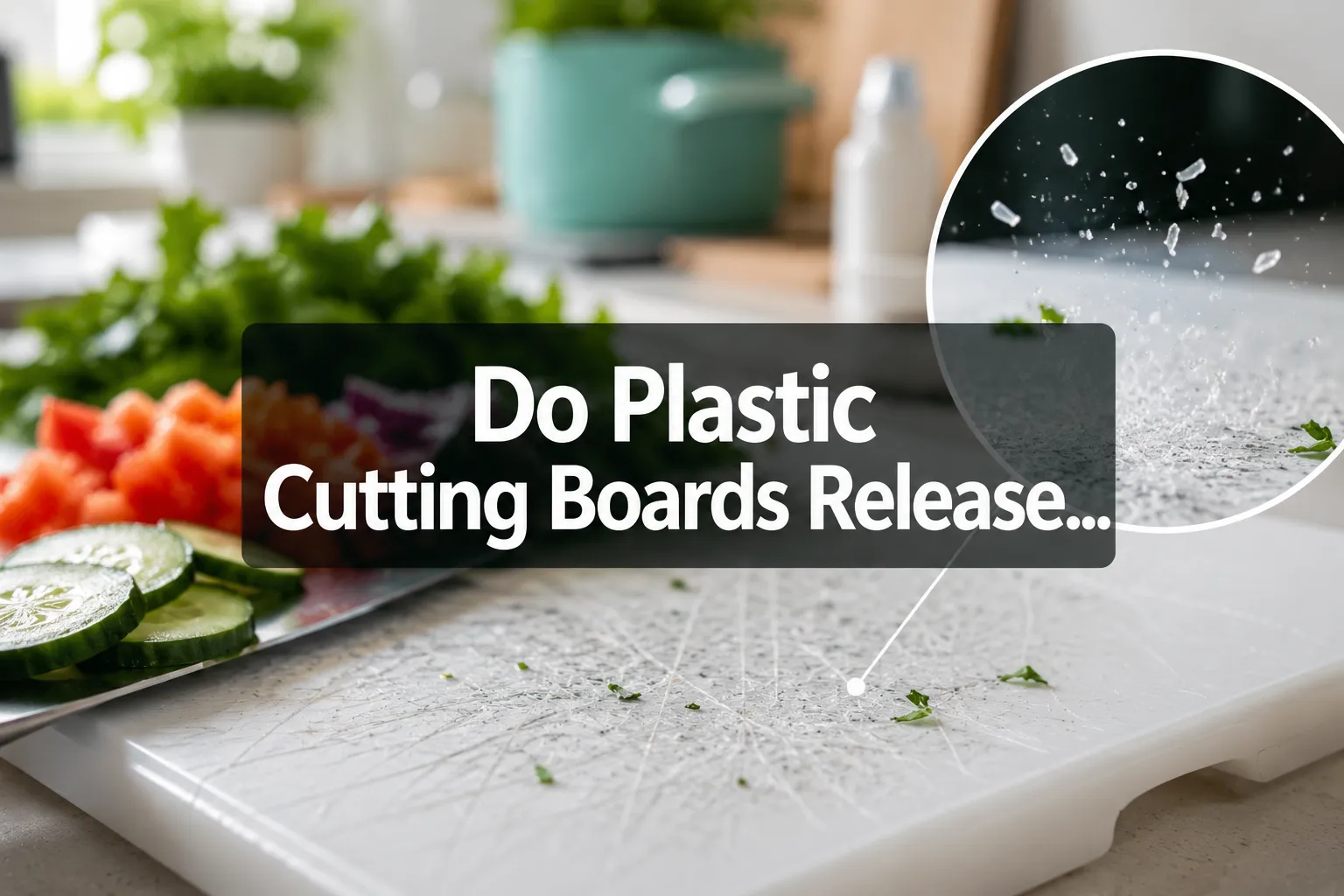
Do Plastic Cutting Boards Release Microplastics? Here’s the Truth
Last updated: July 29, 2026
Quick Answer: Yes, plastic cutting boards do release microplastics into food during normal cutting and chopping. A 2023 study published in ACS Environmental Science & Technology identified plastic cutting boards as a major overlooked source of microplastic contamination in the kitchen. Estimates suggest typical use can introduce between 7 and 50 grams of microplastic particles into food per year, depending on the board material, knife type, and frequency of use [1][3].
Key Takeaways
- Plastic cutting boards shed microplastic particles every time a knife contacts the surface, and those particles end up directly in your food.
- A 2023 ACS study confirmed cutting boards are a significant and underappreciated source of dietary microplastic exposure [1].
- Estimates from a 2026 synthesis by Khorsandi et al. suggest 7 to 50 grams of microplastics per year from typical cutting board use [3].
- Polypropylene (PP) and polyethylene (PE) boards shed different amounts; PP boards tend to release more particles under knife stress [1].
- Deep knife scratches accelerate microplastic release significantly compared to light surface use.
- Dishwasher cycles can weaken plastic board surfaces and increase shedding over time.
- New plastic boards may release more particles initially, but older, heavily scratched boards are the bigger long-term concern.
- Wood, bamboo, and titanium boards are lower-risk alternatives for reducing microplastic ingestion.
- No safe threshold for microplastic ingestion has been established, but current research links chronic exposure to inflammation and endocrine disruption [8][9].
- Replacing scratched plastic boards and switching to non-plastic alternatives are the most effective steps you can take right now.
Do Plastic Cutting Boards Release Microplastics Into Food?
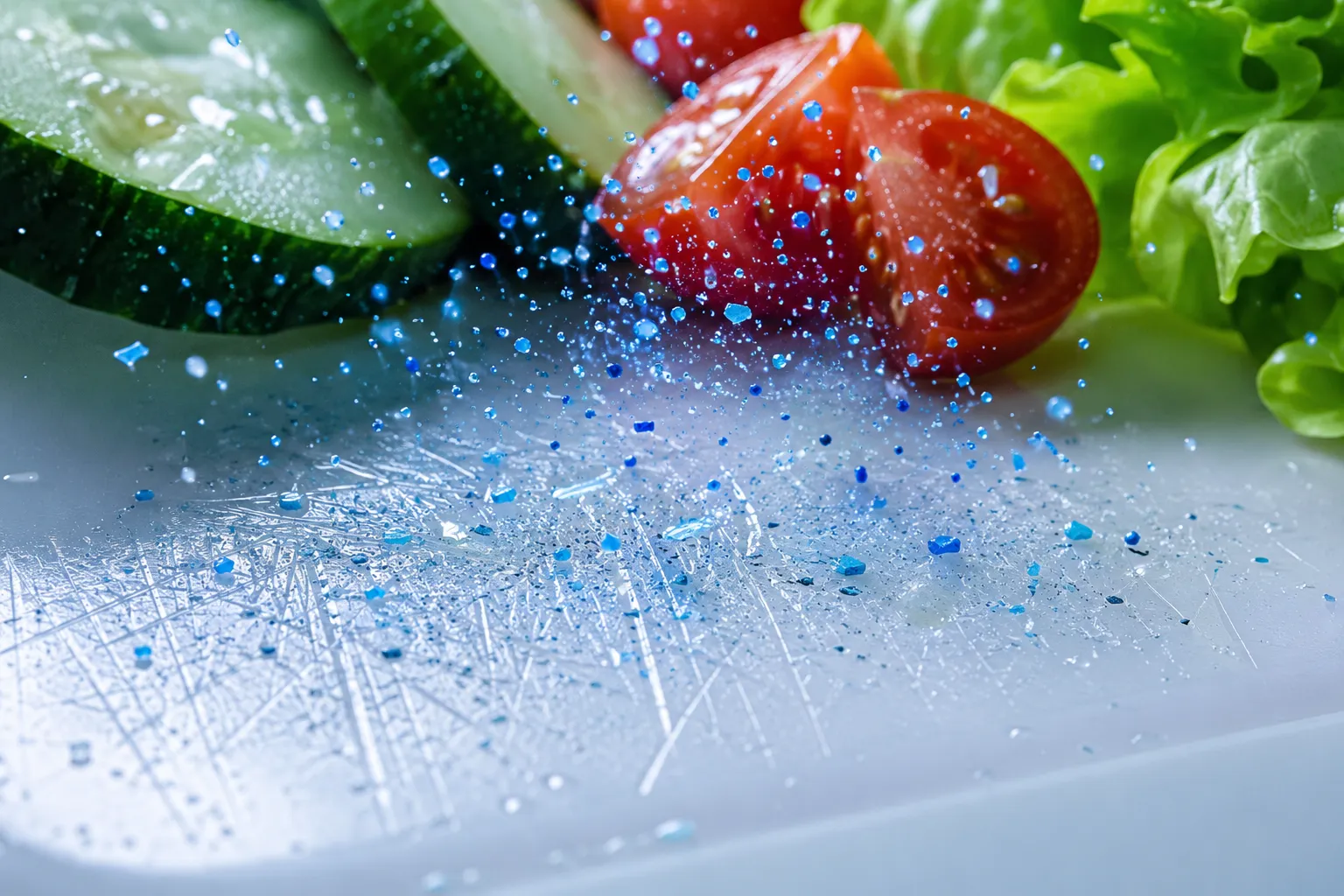
Yes, they do, and the evidence is now strong enough that researchers describe cutting boards as one of the most direct routes for microplastic ingestion in the home kitchen. Every time a knife blade drags across a plastic surface, it shaves off tiny fragments of polymer. Those fragments land on the food you are about to eat.
A landmark 2023 study in ACS Environmental Science & Technology tested polypropylene (PP) and polyethylene (PE) cutting boards under realistic chopping conditions. The researchers found that both materials shed measurable quantities of microplastic particles per cutting session, making the cutting board a more direct source of dietary microplastic exposure than, for example, plastic food packaging [1].
Why this matters:
- Unlike microplastics that enter food during processing or packaging, cutting board particles go straight onto the food surface at the final preparation step.
- There is no filtration, cooking step, or rinsing process that reliably removes all the particles once they land on cut food.
- The particles are small enough to be invisible to the naked eye, so most people have no idea it is happening.
A 2026 synthesis published in PMC by Khorsandi et al. estimated that a person using a plastic cutting board regularly could ingest between 7 and 50 grams of microplastics per year from this single source alone [3]. That range is wide because it depends heavily on board material, knife sharpness, cutting force, and how often the board is replaced.
How Much Microplastic Comes From Cutting Boards?
The quantity of microplastics released from cutting boards is surprisingly large compared to other common sources. Research estimates range from 7 to 50 grams per year for typical household use, making cutting boards one of the highest-yield microplastic sources in a home kitchen [3].
To put that in context:
- A 2023 ACS study found that a single cutting session on a polypropylene board could release millions of microplastic particles [1].
- Polypropylene boards shed more particles than polyethylene boards under the same cutting conditions, likely because PP is harder and more brittle at the surface level [1].
- Particle size ranged from nanometers to several hundred micrometers, meaning many fragments are small enough to be absorbed through the gut lining.
Factors that increase the amount released:
- Using a sharp, heavy knife with a rocking or dragging motion
- Cutting hard foods like carrots, squash, or frozen items
- Using a board that already has deep grooves or discoloration
- Running the board through a dishwasher repeatedly (more on this below)
- Using a thin, low-density plastic board rather than a thick, high-density one
Factors that reduce the amount:
- Using a newer, unscratched board (though new boards still shed)
- Cutting with a pull-through motion rather than a rocking chop
- Replacing boards before deep grooves develop
Do Knife Scratches on Plastic Boards Release More Microplastics?
Yes, knife scratches are the primary mechanism by which microplastics are released from cutting boards. Each scratch creates a groove in the polymer surface, and subsequent cuts shave material from the walls and floors of those grooves [2][10].
A board with visible knife marks is not just cosmetically worn. It is structurally compromised at the surface level. The deeper and more numerous the grooves, the greater the surface area exposed to knife contact, and the more particles released per cut.
What the research shows:
- Heavily scratched boards release significantly more microplastic particles per cutting session than new boards [2].
- Grooves also harbor bacteria because cleaning tools cannot reach the full depth of a cut, which compounds the hygiene concern beyond microplastics alone.
- The color of the board does not affect particle release rates, but darker-colored boards can make it harder to notice when grooves are deep enough to warrant replacement [10].
Decision rule: If you can feel knife grooves with your fingernail or see visible discoloration in the cuts, the board should be replaced. Do not wait until the board is visibly warped or cracked.
Do New Plastic Cutting Boards Release More Microplastics?
New boards release fewer particles than heavily used ones, but they are not microplastic-free. Even a brand-new polypropylene or polyethylene board will shed particles from the first cut because the knife is creating the first grooves in a previously unscratched surface [1][10].
The trajectory over time looks like this:
- New board: Low initial shedding, but every cut creates the foundation for future grooves.
- Lightly used board (a few months): Moderate shedding as surface grooves accumulate.
- Heavily used board (1+ years of daily use): Significantly higher shedding due to deep groove networks and surface degradation.
Some sources suggest that a brief “break-in” period on a new board produces a burst of fine particles as the surface is first cut, similar to how a new non-stick pan releases more material initially. However, the long-term risk is clearly higher with older, more scratched boards [2].
Practical takeaway: A new board is safer than an old one, but neither is truly safe from microplastic release. The goal should be to minimize total exposure by choosing lower-risk materials and replacing plastic boards on a regular schedule.
Are Plastic Cutting Boards Safe to Use?
The honest answer is: they are functional kitchen tools, but they carry a measurable microplastic exposure risk that other materials do not. Whether that risk is acceptable depends on how often you cook, what you cut, and how old your boards are [5][9].
The case for caution:
- Plastic boards have been the default recommendation for food safety for decades because their non-porous surface resists bacterial growth better than wood (in theory). However, research has complicated this picture. Heavily grooved plastic boards actually harbor more bacteria than wood boards because bacteria colonize the grooves and are protected from surface cleaning [2].
- The microplastic exposure from plastic boards is now documented and quantifiable, while the health effects of chronic low-dose microplastic ingestion are an active area of concern in toxicology research [8][9].
The case for continued use (with caveats):
- If your plastic board is relatively new, unscratched, and high-density, the particle release is lower.
- For people who cannot afford alternatives immediately, using a plastic board carefully and replacing it regularly is a reasonable harm-reduction strategy.
- Plastic boards remain effective at preventing cross-contamination when used correctly and kept clean.
Bottom line: Plastic cutting boards are not acutely dangerous, but they are not the safest option available. If food safety and long-term health are priorities, the evidence now supports switching to lower-risk materials.
What Type of Plastic Cutting Board Is Safest?
If you are going to use a plastic board, high-density polyethylene (HDPE) is the better choice over polypropylene (PP). The 2023 ACS study found that PP boards released more microplastic particles under equivalent cutting conditions, making HDPE the lower-risk plastic option [1].
Comparing plastic board types:
| Board Type | Microplastic Release | Durability | Common Use |
|---|---|---|---|
| Polypropylene (PP) | Higher | Moderate | Budget boards, colored sets |
| High-Density Polyethylene (HDPE) | Lower | High | Professional kitchen boards |
| Low-Density Polyethylene (LDPE) | Moderate | Lower | Flexible cutting mats |
Choosing a safer plastic board:
- Look for boards labeled HDPE or food-grade polyethylene.
- Choose thicker boards (at least 1.5 cm) over thin flexible mats, which degrade faster.
- Avoid boards with visible seams, joins, or composite materials.
- Replace any board that shows deep grooves, discoloration in the cuts, or warping.
That said, even the safest plastic board still releases microplastics. Choosing HDPE over PP reduces exposure but does not eliminate it.
Plastic vs. Wood Cutting Board Microplastics
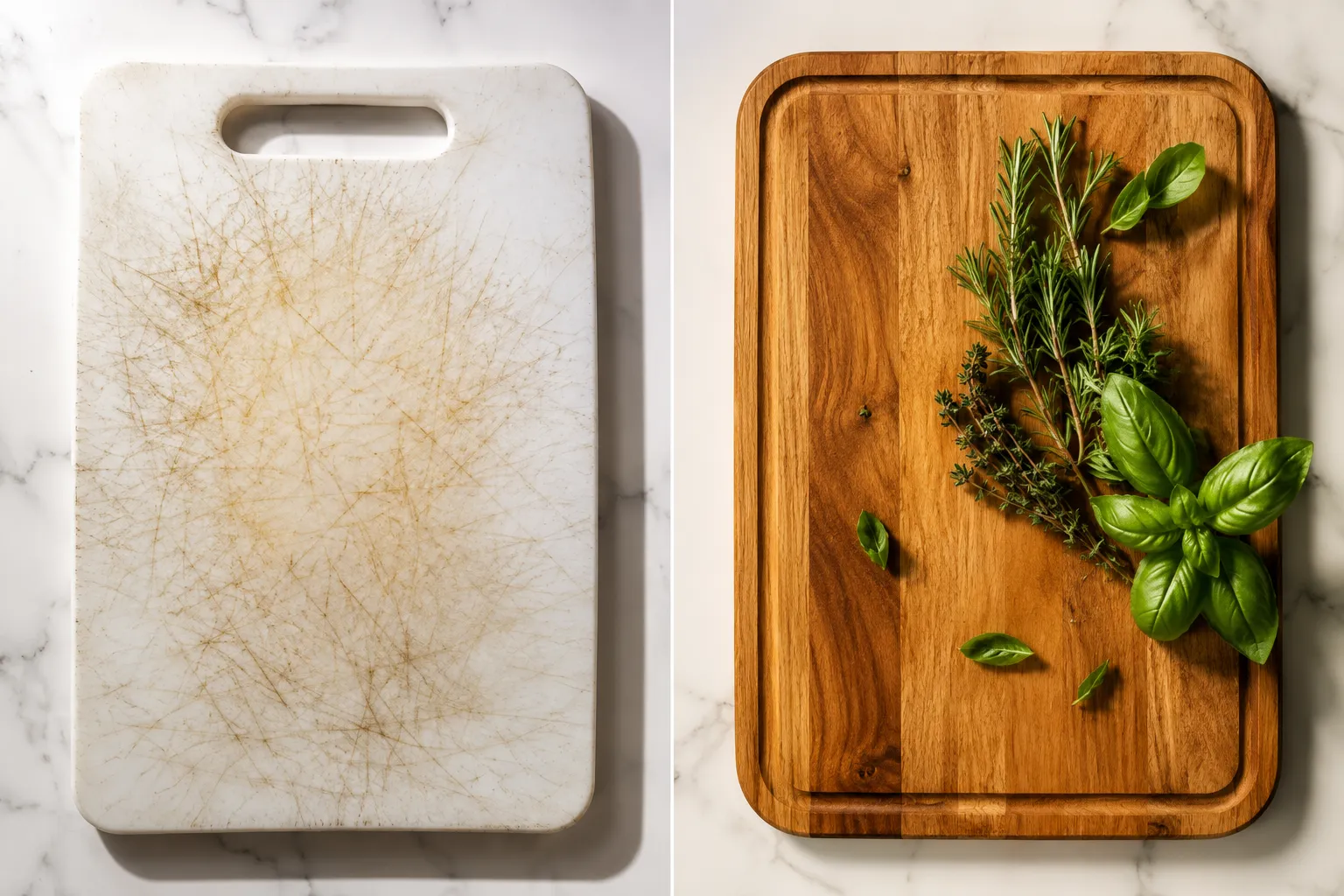
Wood cutting boards release far fewer microplastics than plastic ones because wood is a natural polymer that does not fragment into the same synthetic microplastic particles. When wood fibers are cut, they produce cellulose fragments, not polyethylene or polypropylene particles [2][10].
Key differences:
- Microplastic release: Plastic boards shed synthetic polymer particles; wood boards do not produce synthetic microplastics.
- Bacterial resistance: New plastic boards resist bacteria better, but heavily grooved plastic boards harbor more bacteria than wood. Wood has natural antimicrobial properties (particularly hardwoods like maple and teak) that help reduce bacterial survival in surface grooves [2].
- Maintenance: Wood boards require oiling and should not be soaked or put in the dishwasher. Plastic boards are dishwasher-safe but degrade faster with repeated machine washing.
- Durability: A well-maintained hardwood board can last decades. Plastic boards typically need replacement every 1 to 3 years with regular use.
Common mistake: Many people switched from wood to plastic boards based on older food safety guidance that assumed plastic was more hygienic. Current research suggests that for well-maintained boards, the microplastic risk from plastic outweighs the bacterial risk from wood for most home cooks [2][5].
Choose wood if: You cook frequently, want to minimize synthetic particle ingestion, and are willing to maintain the board with regular oiling.
Choose plastic if: You need a board specifically for raw meat and poultry (where you want a surface you can bleach and sanitize aggressively), and you replace it regularly.
Are Bamboo Cutting Boards Better Than Plastic for Microplastics?
Bamboo boards do not release synthetic microplastics the way plastic boards do. Like wood, bamboo is a natural material, so the particles it sheds are cellulose-based rather than synthetic polymers [10].
However, bamboo boards come with their own considerations:
Advantages over plastic:
- No synthetic microplastic release
- Naturally harder surface than most softwoods
- Sustainable and fast-growing material
- Naturally antimicrobial properties
Disadvantages compared to wood or titanium:
- Bamboo is harder than many knives prefer, which can dull blades faster than softer wood boards
- Many commercial bamboo boards use formaldehyde-based adhesives to bind bamboo strips together; look for boards that specify formaldehyde-free or food-safe adhesives
- Bamboo can crack if not oiled regularly or if exposed to prolonged moisture
Verdict: Bamboo is a better choice than plastic for avoiding microplastic ingestion, but it is not perfect. For the best combination of food safety, knife preservation, and zero microplastic risk, hardwood or titanium boards are the stronger options.
If you are also thinking about overall health habits in the kitchen and beyond, it is worth understanding how everyday exposures accumulate. For instance, how to maintain healthy gums and teeth is another area where small daily choices add up over time.
Best Cutting Board Material to Avoid Microplastics
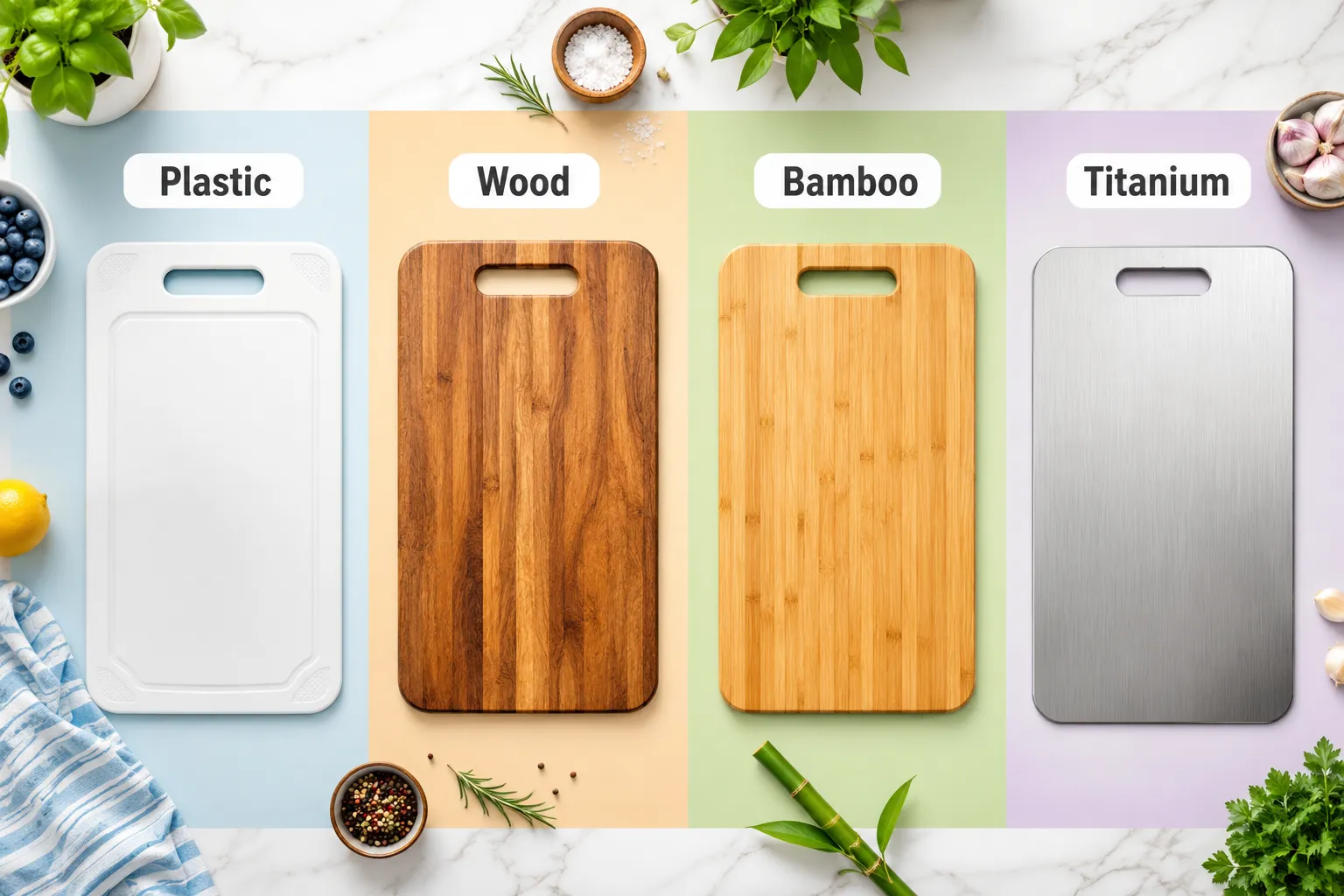
The best cutting board materials for avoiding microplastic ingestion are, in order: titanium, hardwood (maple, teak, walnut), and bamboo. All three avoid synthetic polymer particle release entirely [2][10].
Material comparison for microplastic avoidance:
| Material | Microplastics Released | Knife-Friendly | Maintenance | Durability |
|---|---|---|---|---|
| Titanium | None | Yes | Minimal | Decades |
| Hardwood | None (cellulose only) | Yes | Regular oiling | 10-20+ years |
| Bamboo | None (cellulose only) | Moderate | Regular oiling | 5-10 years |
| HDPE Plastic | Low-Moderate | Yes | Dishwasher-safe | 1-3 years |
| PP Plastic | Moderate-High | Yes | Dishwasher-safe | 1-2 years |
Titanium as a premium option:
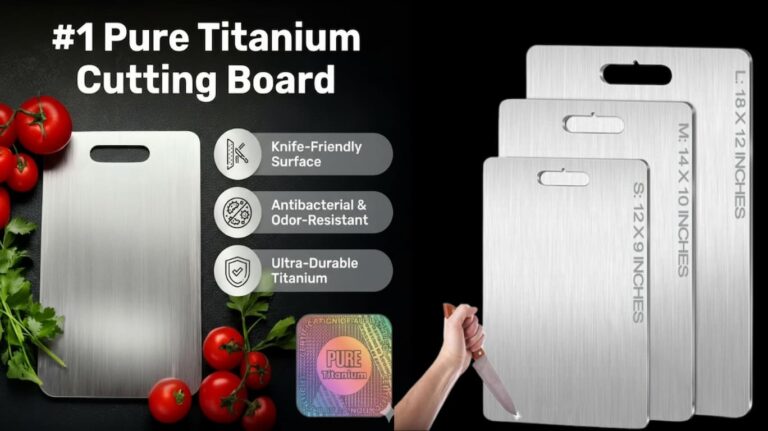
Titanium cutting boards, such as those reviewed in our Katori Titanium Cutting Board analysis, have emerged as a high-end solution that eliminates microplastic risk entirely. Titanium is biocompatible (the same material used in surgical implants), non-reactive with acidic foods, non-porous, and does not shed particles under knife use. The trade-off is cost: quality titanium boards typically run $89 to $179, compared to $10 to $40 for most plastic boards.
For health-conscious cooks who cook daily and want a long-term investment, titanium or high-quality hardwood are the strongest choices available in 2026.
Do Dishwashers Make Plastic Boards Release More Microplastics?
Yes, repeated dishwasher cycles accelerate the surface degradation of plastic cutting boards and increase microplastic release over time. The combination of high heat, strong detergents, and mechanical water pressure breaks down the polymer surface at a microscopic level, making it more susceptible to particle shedding during subsequent cutting [5][10].
What happens in the dishwasher:
- High temperatures (typically 55-75°C in a standard cycle) cause thermal stress in the plastic, particularly in polypropylene boards.
- Alkaline dishwasher detergents chemically attack the surface of the polymer, creating micro-fractures.
- The mechanical action of water jets can dislodge surface particles and further roughen the board’s texture.
- Over many cycles, the surface becomes visibly dull and feels rougher, which correlates with increased particle release during cutting.
Practical guidance:
- If you use a plastic cutting board, hand-washing with mild soap and warm water is gentler than machine washing.
- If you do use a dishwasher, check the board’s surface condition regularly. A board that feels noticeably rougher after washing is already degrading.
- Boards that have been through hundreds of dishwasher cycles should be considered high-risk for elevated microplastic release and replaced promptly.
This is one area where the convenience of dishwasher-safe plastic boards works against food safety. The same feature that makes them easy to clean also accelerates their degradation.
Can You Get Sick From Microplastics in Food? What Happens If You Ingest Them?
The research on health effects is still developing, but the current evidence gives legitimate reason for concern. No regulatory body has established a safe daily intake level for microplastics, which itself reflects how new and uncertain this science is [8][9].
What current research shows:
- Microplastic particles have been detected in human blood, lung tissue, liver, and even placental tissue, confirming that ingested particles can cross biological barriers [9].
- A 2022 study found microplastics in the bloodstream of 77% of participants tested, suggesting widespread systemic exposure [8].
- Animal studies have linked microplastic exposure to inflammation, oxidative stress, gut microbiome disruption, and endocrine disruption [9].
- Some plastic additives (plasticizers, stabilizers, colorants) that leach alongside microplastic particles are known endocrine disruptors, including bisphenol A (BPA) and certain phthalates [5].
What is not yet established:
- The specific dose at which human health effects become clinically significant
- Whether the particles themselves or the chemical additives they carry are the primary driver of harm
- Long-term outcomes from decades of low-level chronic exposure
Honest assessment: You are unlikely to become acutely ill from a single meal prepared on a plastic cutting board. The concern is chronic, cumulative exposure over years and decades. Given that cutting boards are just one of many microplastic sources in daily life, reducing exposure where you can is a reasonable precautionary approach.
For those interested in broader health optimization, understanding how everyday environmental exposures interact with overall wellness is increasingly relevant. Our guide on rebuilding bone strength naturally touches on related themes of long-term health maintenance.
How to Reduce Microplastics From Cutting Boards
Reducing microplastic exposure from cutting boards does not require an expensive overhaul of your kitchen. A few targeted changes make a meaningful difference [2][10].

Step-by-step approach:
Assess your current boards. Check for deep knife grooves, discoloration in the cuts, warping, or surface roughness. Any board showing these signs should be replaced immediately.
Switch to a lower-risk material. If budget allows, replace plastic boards with hardwood (maple or teak), bamboo with food-safe adhesives, or a titanium board. These materials do not release synthetic microplastics.
If keeping plastic boards, choose HDPE. High-density polyethylene releases fewer particles than polypropylene. Look for boards labeled HDPE or food-grade polyethylene.
Hand-wash plastic boards. Avoid the dishwasher for plastic cutting boards to slow surface degradation.
Replace plastic boards on a schedule. Even without visible damage, plastic boards used daily should be replaced every 12 to 18 months. Boards used less frequently can last 2 to 3 years.
Use separate boards by food type. Using a dedicated board for raw meat (where you want aggressive sanitization) and a non-plastic board for produce and ready-to-eat foods reduces overall synthetic particle exposure.
Rinse cut food before serving. While rinsing does not remove all microplastic particles, it can reduce surface contamination from loose particles.
Avoid cutting on plastic plates, plastic-lined containers, or plastic packaging. The cutting board is one source; eliminating others compounds the benefit.
The single highest-impact change is replacing a heavily scratched plastic board with a hardwood or titanium alternative. This alone can substantially reduce your daily microplastic intake from food preparation.
For those focused on overall health and reducing toxic exposures, this connects to broader wellness habits. Our article on how to create a morning routine for better mental health explores how small daily habits compound into significant health outcomes over time.
How Long Before a Plastic Cutting Board Becomes Unsafe?
A plastic cutting board becomes a higher-risk microplastic source as soon as it develops visible knife grooves, which can happen within weeks of regular daily use. For practical replacement timelines, most food safety researchers and kitchen professionals recommend replacing plastic boards every 1 to 2 years for daily users [2][5][10].
Warning signs that a board should be replaced now:
- Knife grooves you can feel with a fingernail
- Discoloration or staining inside grooves that does not wash out
- A rough or dull surface texture (compared to when it was new)
- Visible warping or bowing
- Persistent odors even after washing
Timeline by use frequency:
- Daily use (cooking every day): Replace every 12 to 18 months
- Regular use (4-5 days per week): Replace every 18 to 24 months
- Occasional use (1-2 days per week): Replace every 2 to 3 years, or when visible grooves appear
The cost of a replacement plastic board is low, but the better long-term strategy is to invest in a material that does not require replacement on this schedule. A quality hardwood board maintained with regular oiling can last 10 to 20 years. A titanium board is effectively a one-time purchase.
Key Takeaways Before You Decide
Before making any changes, here is a concise summary of what the evidence supports as of 2026:
- Plastic cutting boards definitively release microplastics into food during normal use [1][3].
- The amount ranges from 7 to 50 grams per year depending on material, use, and board condition [3].
- Knife scratches are the primary delivery mechanism, and older boards shed more than new ones [2][10].
- Dishwasher use accelerates board degradation and increases particle release [5].
- Wood, bamboo, and titanium boards do not release synthetic microplastics.
- Health effects from chronic microplastic ingestion are a legitimate concern, even if a precise harm threshold has not been established [8][9].
- Replacing scratched plastic boards and switching to alternative materials are the most effective harm-reduction steps available.
Conclusion: What to Do With This Information
The science on whether plastic cutting boards release microplastics is no longer ambiguous. They do, and in quantities that are meaningful when you consider cumulative daily exposure over years. The 2023 ACS study and the 2026 Khorsandi synthesis together make a clear case that cutting boards deserve more attention as a microplastic source than they have historically received [1][3].
Actionable next steps:
Today: Inspect every plastic cutting board in your kitchen. If you see deep grooves, discoloration in the cuts, or surface roughness, remove it from use.
This week: Purchase a replacement board made from hardwood (maple, teak, or walnut), food-safe bamboo, or titanium. A quality maple board costs $30 to $60 and will outlast a dozen plastic boards.
Ongoing: If you keep any plastic boards for specific uses (raw meat, for example), hand-wash them, replace them on a 12 to 18 month schedule, and choose HDPE over polypropylene.
Longer term: Consider a titanium board as a permanent kitchen investment. The upfront cost is higher, but the food safety profile, durability, and zero microplastic risk make it the strongest all-around choice for health-conscious cooks.
Reducing microplastic exposure from cutting boards is one of the simpler, more controllable steps you can take toward cleaner food preparation. It does not require a complete kitchen renovation, just a more informed choice about a tool you use every day.
For those thinking about overall body health and how environmental exposures affect long-term wellness, our resources on joint health supplements and silent fatty liver disease symptoms explore related dimensions of how what we put into our bodies accumulates over time.
Frequently Asked Questions
Q: Do all plastic cutting boards release microplastics, or just cheap ones?
All plastic cutting boards release microplastics regardless of price. Higher-quality boards (particularly HDPE) release fewer particles, but no plastic board is microplastic-free. Price does not reliably predict microplastic release rates.
Q: Is it safe to use a plastic cutting board for vegetables if I wash it well?
Washing a plastic board removes bacteria and loose debris but does not remove all microplastic particles embedded in food during cutting. Rinsing cut vegetables can reduce surface particle load, but the safest approach is to use a non-plastic board for produce.
Q: How do I know if my cutting board is polypropylene or polyethylene?
Check the underside of the board for a recycling symbol. The number inside the triangle indicates the plastic type: 5 = polypropylene (PP), 2 = high-density polyethylene (HDPE), 4 = low-density polyethylene (LDPE). If there is no marking, contact the manufacturer.
Q: Do glass cutting boards release microplastics?
Glass boards do not release plastic particles. However, glass is very hard and dulls knife blades quickly, which is a significant practical drawback. Glass boards are a microplastic-free option but are not recommended for frequent knife use.
Q: Are microplastics from cutting boards more dangerous than those from other sources?
Cutting board microplastics are particularly direct because they land on food at the final preparation step with no subsequent filtration. This makes them a higher-priority source to address compared to microplastics that enter the food chain earlier in production or packaging.
Q: Can I sand down a plastic cutting board to make it safe again?
Sanding a plastic board removes the surface layer and creates a fresh surface, but the process itself generates a large quantity of plastic dust and particles. It is not a recommended food-safety practice and does not address the underlying issue. Replace the board instead.
Q: Do silicone cutting mats release microplastics?
Silicone is a different polymer class from polyethylene or polypropylene. Current research has focused primarily on PP and PE boards. Silicone mats may release silicone particles under knife stress, but this has not been as thoroughly studied. Silicone is generally considered lower-risk than PP or PE for food contact.
Q: How do I dispose of old plastic cutting boards responsibly?
Check with your local recycling program. HDPE boards (marked with recycling symbol 2) are accepted by many curbside recycling programs. PP boards (symbol 5) are less widely accepted. If recycling is not available, contact local plastic recycling drop-off facilities.
Q: Is a bamboo cutting board completely free of microplastics?
Bamboo boards do not release synthetic microplastics. However, some bamboo boards use adhesives that may contain formaldehyde or other chemicals. Choose boards labeled formaldehyde-free or with food-safe adhesive certification to minimize chemical exposure.
Q: How often should I replace a plastic cutting board?
For daily users, replace every 12 to 18 months or as soon as visible knife grooves appear. For occasional users, every 2 to 3 years. Do not wait for the board to warp or crack before replacing it.
References
[1] ACS Environmental Science & Technology – https://pubs.acs.org/doi/10.1021/acs.est.3c00924
[2] Microplastics Plastic Cutting Boards – https://nontoxicnook.com/articles/microplastics-plastic-cutting-boards
[3] PMC11980920 – https://pmc.ncbi.nlm.nih.gov/articles/PMC11980920/
[4] PubMed 40042913 – https://pubmed.ncbi.nlm.nih.gov/40042913/
[5] Are Your Plastic Chopping Boards Leaching Toxins And Microplastics Into Your Food – https://www.theweek.in/news/health/2025/09/22/are-your-plastic-chopping-boards-leaching-toxins-and-microplastics-into-your-food.html
[6] PMC12845809 – https://pmc.ncbi.nlm.nih.gov/articles/PMC12845809/
[7] NDSU Microplastics Study Featured Time Magazine – https://www.ndsu.edu/news/2025-12-01-ndsu-microplastics-study-featured-time-magazine
[8] PMC9602623 – https://pmc.ncbi.nlm.nih.gov/articles/PMC9602623/
[9] PMC11336334 – https://pmc.ncbi.nlm.nih.gov/articles/PMC11336334/
[10] Do Plastic Cutting Boards Have Microplastics – https://getplasticproof.com/blog/do-plastic-cutting-boards-have-microplastics
Tags: microplastics cutting boards, plastic cutting board safety, do plastic cutting boards release microplastics, cutting board microplastics food, best cutting board material, wood vs plastic cutting board, bamboo cutting board safety, titanium cutting board, how to reduce microplastics, microplastic ingestion health risks, HDPE cutting board, kitchen food safety 2026

With over 13 years of experience in holistic health blogging, I aim to help you navigate your wellness journey with honest insights, expert-backed advice, and a sprinkle of real-world practicality.
Certified Wellness Writer | Herbal Nutrition Advocate | Wellness Research Enthusiast