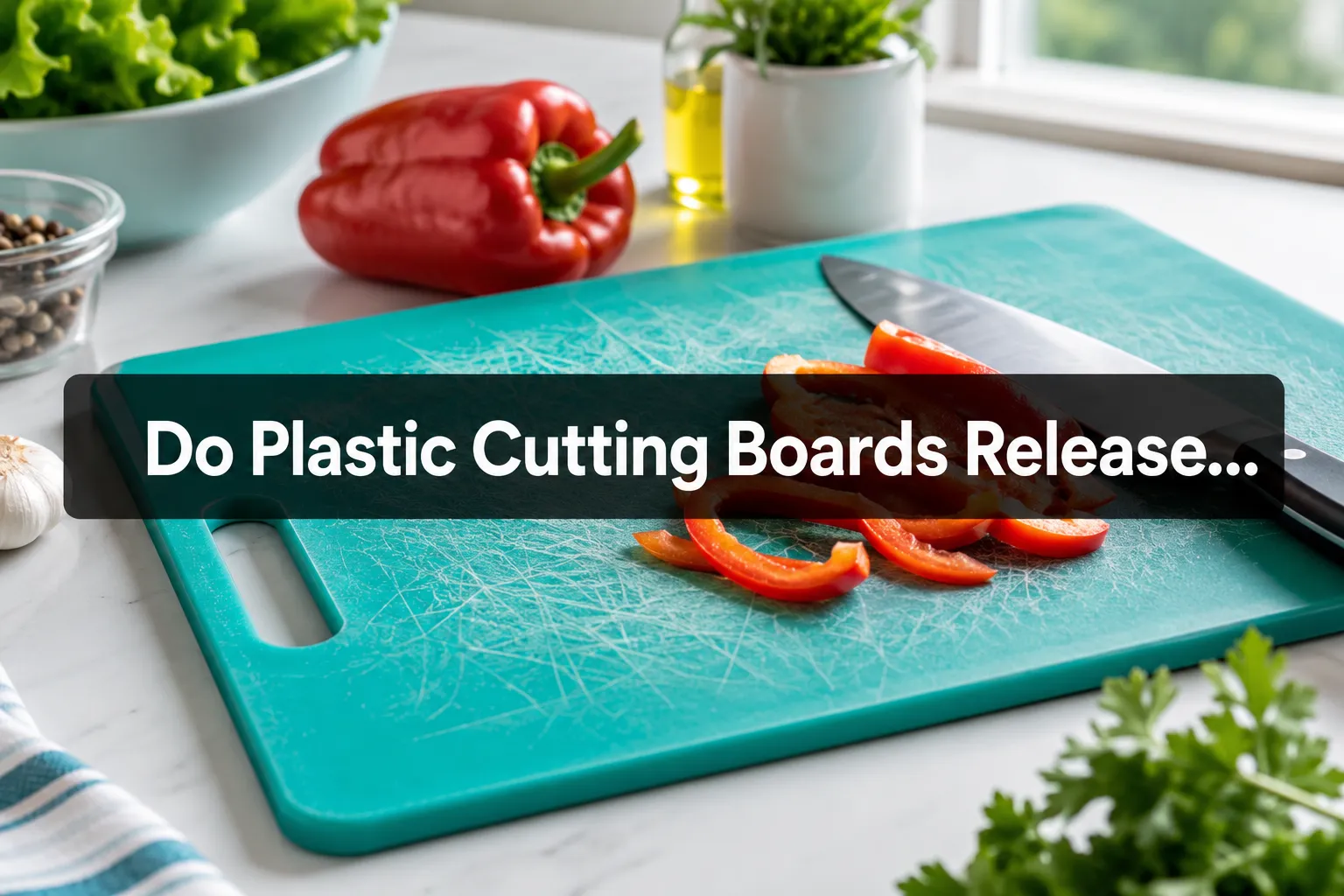
Do Plastic Cutting Boards Release Microplastics? Here’s the Truth
Last updated: July 29, 2026
Quick Answer: Yes, plastic cutting boards do release microplastics during normal use. Every time a knife blade scores the surface, tiny plastic particles break free and can contaminate the food you are preparing. The amount released depends on the type of plastic, how worn the board is, and how aggressively you cut. Switching to non-plastic alternatives is the most reliable way to reduce this exposure.
Key Takeaways
- Plastic cutting boards shed microplastic particles each time a knife cuts across the surface, and those particles can end up in your food.
- A 2023 study published in Environmental Science & Technology estimated that a single plastic cutting board can shed millions of microplastic particles per year under normal kitchen use.
- Softer plastics (such as polypropylene and polyethylene) shed more particles than harder materials.
- Deep knife grooves accelerate microplastic release and also trap bacteria, making worn boards a dual hygiene risk.
- Dishwasher heat and harsh scrubbing further degrade plastic surfaces, increasing particle release.
- Wood, bamboo, glass, and titanium cutting boards are safer alternatives for reducing microplastic ingestion.
- No cutting board material is completely risk-free, but non-porous, non-plastic surfaces come closest.
- Replacing a heavily scored plastic board and choosing food-grade alternatives are the two most actionable steps you can take right now.
What Are Microplastics and Why Are They Bad for You?
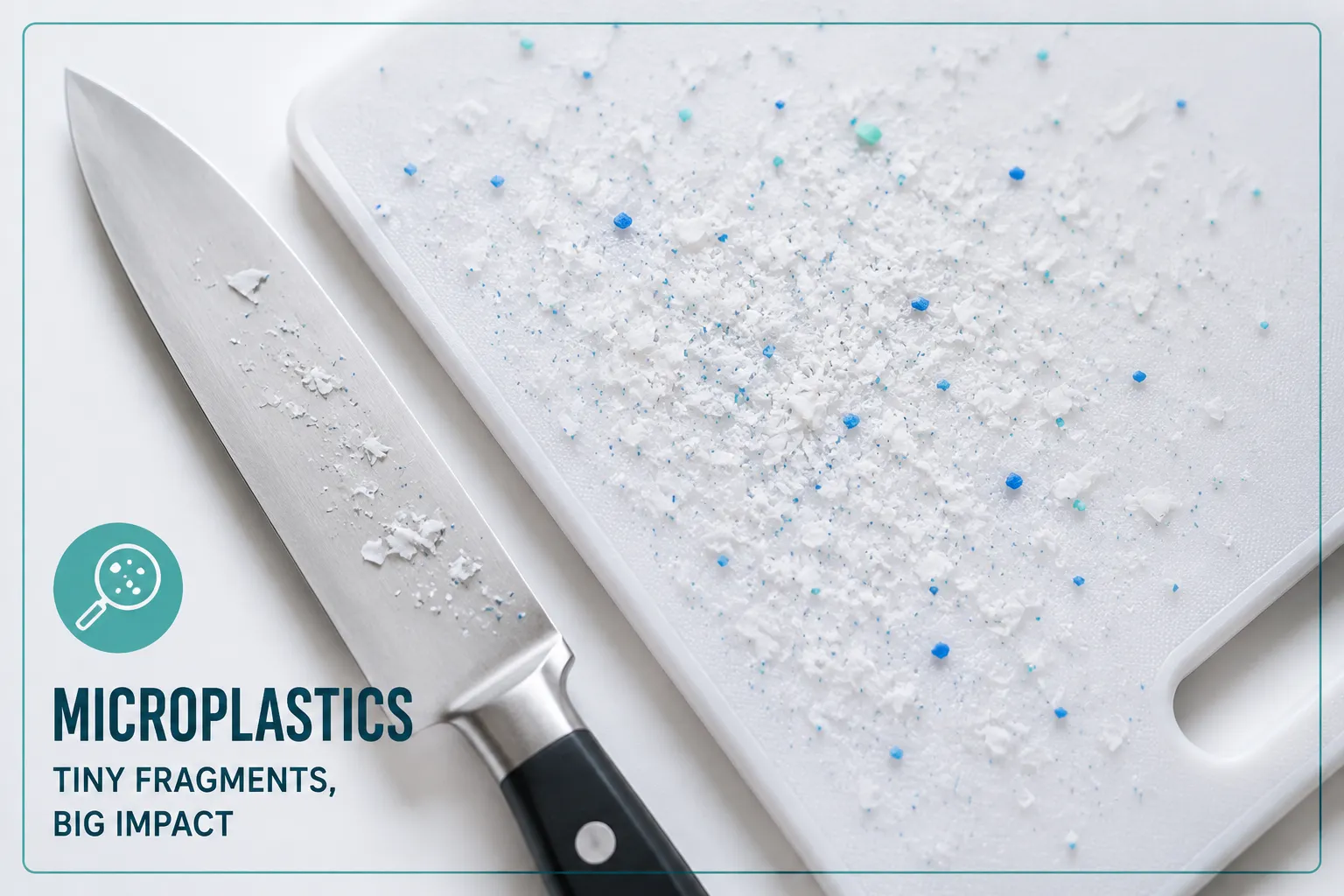
Microplastics are plastic fragments smaller than 5 millimeters, and nanoplastics are even smaller particles invisible to the naked eye. Both categories form when larger plastic objects break down through physical stress, heat, or chemical degradation. They are bad for you because they can enter the body through ingestion, inhalation, or skin contact, and early research suggests they may carry toxic additives, disrupt hormones, and trigger low-grade inflammation.
Why this matters in the kitchen:
- Microplastics have been detected in human blood, lung tissue, and even placental tissue in recent studies.
- Many plastic additives, including plasticizers and stabilizers, are known endocrine disruptors.
- Once microplastics enter the gut, some fraction may cross the intestinal lining and reach other organs.
- Children and pregnant women face higher risk because developing systems are more sensitive to chemical disruption.
The gut connection is worth noting. Research on how the immune system is linked to gut health and intestines suggests that chronic low-level exposure to foreign particles can alter gut microbiome balance, which in turn affects immune function. Reducing dietary microplastic intake is therefore not just a food safety concern but a broader wellness issue.
Common mistake: Many people assume microplastics are only an ocean or water supply problem. In reality, your kitchen cutting board may be one of the most direct and controllable sources of microplastic ingestion in your daily routine.
Do Plastic Cutting Boards Actually Release Microplastics When You Cut?
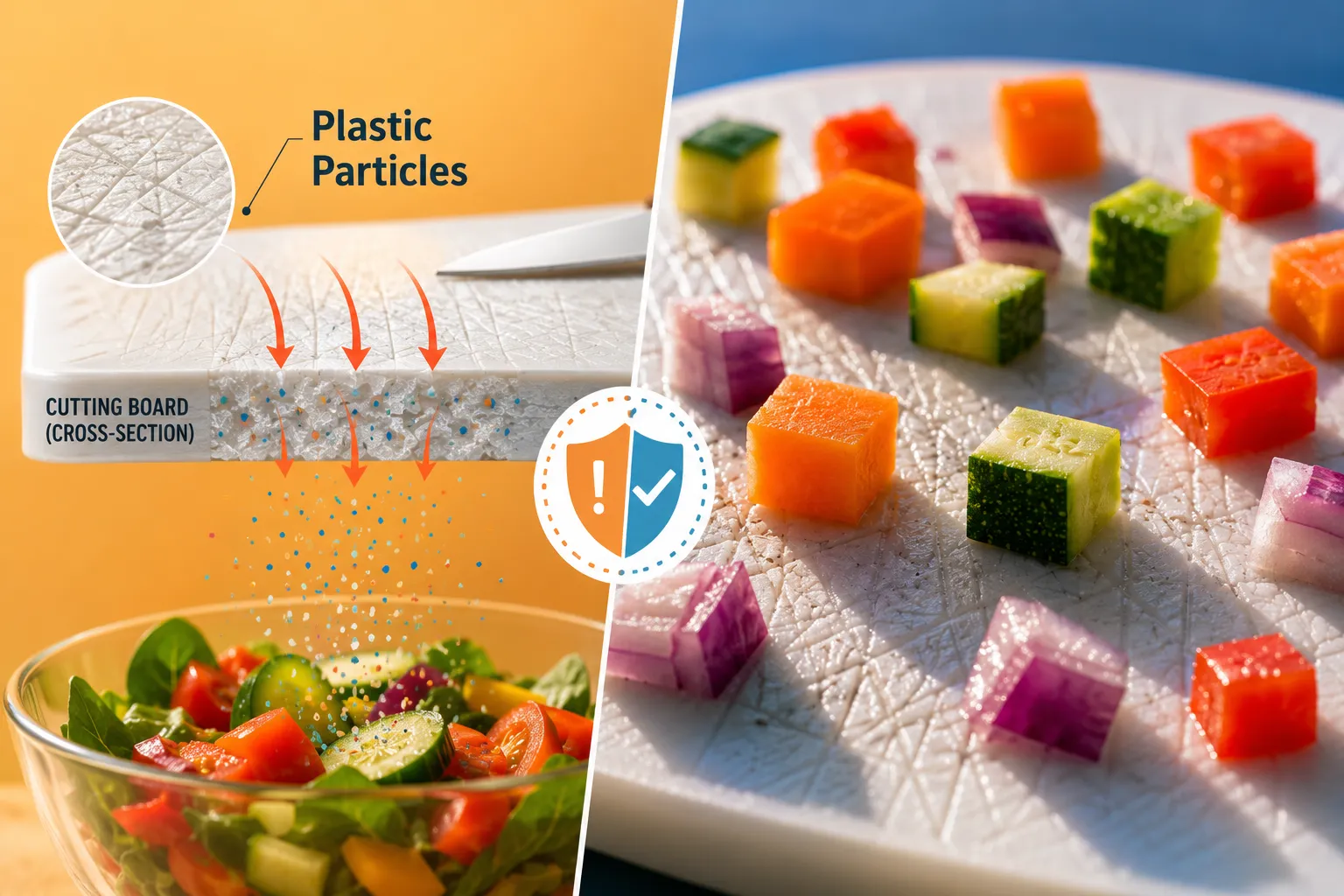
Yes, plastic cutting boards release microplastics every time a knife contacts the surface. This is not a theoretical risk. Researchers at the University of North Dakota published findings in 2023 showing that polypropylene cutting boards shed between 7.4 and 50.7 million microplastic particles per year depending on cutting intensity and board condition.
How it happens:
- A knife blade contacts the plastic surface and physically shears off tiny fragments.
- The fragments range from visible white shavings down to nanoscale particles too small to see.
- Particles land directly on the food being cut or remain on the board surface and transfer during subsequent use.
- Heat from dishwashing or hot food placed on the board causes additional surface degradation.
Factors that increase microplastic release:
- Deep, overlapping knife grooves (common on boards used for years)
- Softer plastic grades such as low-density polyethylene (LDPE)
- High-frequency chopping motions versus slicing
- Acidic foods like tomatoes and citrus, which can chemically soften the plastic surface
- Abrasive cleaning tools that score the surface further
Edge case: A brand-new plastic board releases fewer particles than a heavily grooved one. But even new boards begin shedding from the first cut, and the degradation accelerates quickly with daily use.
How Much Microplastic Do You Ingest from Plastic Cutting Boards?
The exact amount varies, but the numbers from available research are not trivial. Based on the 2023 University of North Dakota study, a household using a polypropylene cutting board daily could theoretically ingest tens of millions of microplastic particles per year from that single source alone.
To put this in context:
| Usage Pattern | Estimated Annual Microplastic Release |
|---|---|
| Light use (a few times per week) | ~7 million particles |
| Moderate daily use | ~20-30 million particles |
| Heavy daily chopping | Up to ~50 million particles |
Note: These are estimates based on published laboratory conditions and may vary with real-world variables such as knife type, board age, and food type.
Not all particles released end up ingested. Some stick to the board, some are rinsed away, and some transfer to food. The ingestion fraction is difficult to measure precisely, but even a small percentage of 50 million particles represents a meaningful exposure over time.
Who is most at risk:
- Households that use the same plastic board for years without replacing it
- Cooks who use hard, heavy knives with a downward chopping motion
- Anyone who cuts acidic or hot foods directly on plastic
Plastic vs. Wood Cutting Boards: Which Is Safer?
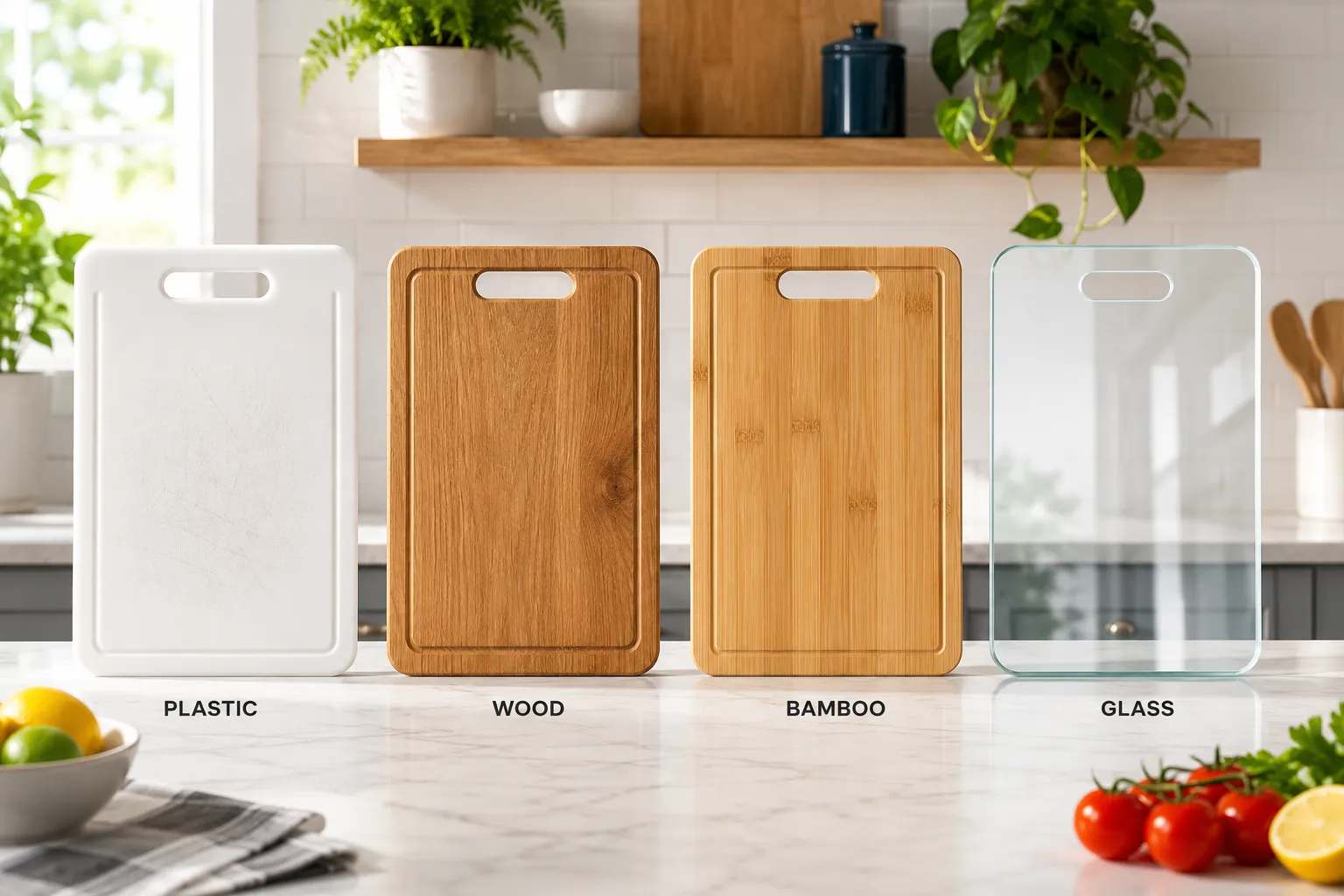
Wood cutting boards are generally safer than plastic when it comes to microplastic exposure, because wood does not shed synthetic polymer particles. However, the comparison is more nuanced than a simple win for wood.
Wood advantages:
- No microplastic release
- Natural antimicrobial properties in some hardwoods (teak, maple, walnut)
- Gentler on knife edges
Wood disadvantages:
- Porous surface can harbor bacteria in deep grooves if not oiled and maintained properly
- Absorbs odors and stains over time
- Not dishwasher-safe; requires hand washing and periodic oiling
- Can crack or warp if dried improperly
Plastic advantages:
- Dishwasher-safe (though this accelerates microplastic release)
- Inexpensive and widely available
- Easy to sanitize with bleach solutions
Plastic disadvantages:
- Releases microplastics with every cut
- Deep grooves trap bacteria and are nearly impossible to sanitize fully
- Degrades faster than wood or titanium
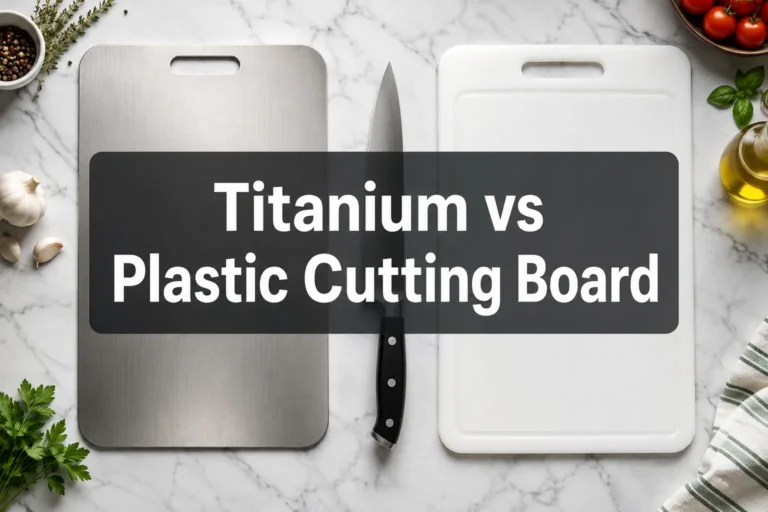
Decision rule: Choose wood if you are willing to maintain it properly with regular oiling and hand washing. Choose plastic only if budget is the primary constraint, and replace it as soon as visible grooves appear. For the safest option overall, consider titanium or glass.
If you are researching titanium as an alternative, the Katori Titanium Cutting Board reviews and complaints page offers a detailed breakdown of how this material compares in real kitchen use.
Best Cutting Board Material to Avoid Microplastics
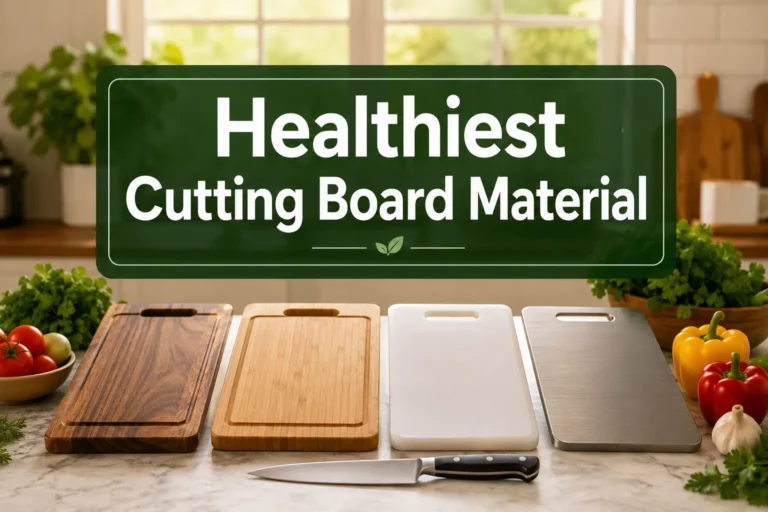
The best cutting board materials for avoiding microplastics are glass, titanium, and well-maintained hardwood. Each eliminates the core problem of synthetic polymer shedding, though each has trade-offs.
Material rankings for microplastic safety:
Titanium – Non-porous, non-reactive, releases zero microplastics, and is biocompatible (the same material used in surgical implants). Titanium is also antibacterial and rustproof. The main drawback is cost and the metallic sound during chopping.
Glass or ceramic – Completely inert, releases no microplastics, and is easy to sanitize. The significant downside is that glass and ceramic are extremely hard and will dull knife edges quickly. They are also heavy and can shatter.
Hardwood (maple, walnut, teak) – No microplastics, naturally antimicrobial when properly maintained. Requires regular oiling and hand washing. Not suitable for raw meat unless sanitized thoroughly.
Bamboo – A strong natural option with no microplastic release. Bamboo is harder than most woods, which means it is slightly tougher on knife edges. Some bamboo boards use formaldehyde-based adhesives, so check for food-safe certifications.
Plastic (polypropylene, polyethylene) – Ranked last for microplastic safety. Convenient and inexpensive, but sheds particles from the first use.
Common mistake: Assuming that “BPA-free” plastic cutting boards are safe from microplastic concerns. BPA-free only addresses one specific chemical additive. The physical shedding of plastic particles still occurs regardless of BPA content.
Do Glass or Ceramic Cutting Boards Release Microplastics?
Glass and ceramic cutting boards do not release microplastics. These materials are inorganic and do not shed synthetic polymer particles when cut. They are among the most chemically inert surfaces available for food preparation.
The trade-off:
- Glass and ceramic are extremely hard (higher on the Mohs hardness scale than most knife steel), which means they dull knife blades significantly faster than any other board material.
- They are heavy, fragile, and can crack or shatter if dropped.
- The hard surface can be loud and uncomfortable for extended chopping sessions.
Best use case for glass or ceramic boards: Light-duty tasks like slicing bread, cheese, or fruit where knife dulling is less of a concern. They are not ideal as a primary cutting surface for a home cook who values knife longevity.
Are Bamboo Cutting Boards Better Than Plastic?
Yes, bamboo cutting boards are better than plastic specifically for microplastic exposure, because bamboo is a natural plant material and does not shed synthetic polymer particles. Bamboo is also harder and more durable than most softwoods, making it a practical everyday choice.
Bamboo advantages over plastic:
- Zero microplastic release
- Naturally antimicrobial surface
- Harder and more resistant to deep grooves than softer woods
- Sustainable and renewable material
- More affordable than titanium or glass
Bamboo watch-outs:
- Some bamboo boards are bonded with formaldehyde-containing glues. Look for boards labeled “food-safe” or “formaldehyde-free.”
- Bamboo is harder than most woods, which can dull knives slightly faster than softer hardwoods like maple.
- Like wood, bamboo requires hand washing and occasional oiling to prevent cracking.
Decision rule: Choose bamboo over plastic if you want a budget-friendly, microplastic-free option. Choose hardwood over bamboo if you prioritize knife longevity and are willing to spend more on maintenance.
Does Washing Plastic Cutting Boards in the Dishwasher Cause More Microplastics?
Yes, dishwasher washing significantly increases microplastic release from plastic cutting boards. The combination of high heat (typically 60-75°C / 140-167°F), strong detergents, and mechanical water pressure accelerates surface degradation and causes more plastic to break down into particles.
What happens in the dishwasher:
- Heat causes plastic polymers to expand and contract, weakening the surface structure.
- Alkaline detergents chemically attack the plastic surface, making it more brittle.
- High-pressure water jets physically dislodge weakened plastic fragments.
- Repeated cycles compound this damage, so a board washed daily in a dishwasher degrades far faster than one hand-washed.
Practical implication: If you insist on using a plastic cutting board, hand washing with mild soap and cool-to-lukewarm water reduces (but does not eliminate) microplastic release compared to dishwasher cycles. However, hand washing also means the board is less thoroughly sanitized, which creates a separate hygiene concern.
The honest answer: There is no way to use a plastic cutting board that is both fully hygienic and microplastic-free. The two goals are in direct tension. This is the strongest argument for switching to a non-plastic material entirely.
What Type of Plastic Cutting Board Is Safest, and Do Expensive Ones Release Fewer Microplastics?
Among plastic cutting boards, high-density polyethylene (HDPE) is generally considered the safest option because it is harder and denser than polypropylene or low-density polyethylene, meaning it sheds fewer particles per cut. However, no plastic board is microplastic-free.
Plastic types ranked by relative safety:
- HDPE (High-Density Polyethylene): Hardest common plastic for cutting boards, fewer particles shed per cut, FDA-approved for food contact.
- Polypropylene (PP): Common in mid-range boards, moderately hard, sheds more than HDPE.
- LDPE (Low-Density Polyethylene): Softest, sheds the most microplastics, least recommended.
Do expensive plastic boards release fewer microplastics?
Not necessarily. Price reflects brand, aesthetics, and sometimes thickness, but not always material hardness. An expensive polypropylene board may shed more than a budget HDPE board. Always check the material specification rather than relying on price as a proxy for safety.
What to look for on the label:
- Material type (HDPE preferred)
- FDA food-contact approval
- NSF certification (common in commercial kitchen boards)
- Thickness (thicker boards last longer before grooves become deep enough to trap bacteria)
Which Foods Absorb the Most Microplastics from Cutting Boards?
Soft, moist foods absorb more microplastics from cutting boards than firm, dry foods. Foods that are sliced with repeated pressure and have a high surface area in contact with the board are at greatest risk.
Higher-risk foods:
- Raw chicken, fish, and meat (soft texture, high moisture, often cut with heavy chopping)
- Tomatoes, strawberries, and other soft fruits (acidic and moist, which softens plastic)
- Bread dough and soft cheeses (pressed against the board surface)
- Leafy greens that are chopped finely (many knife passes over the same area)
Lower-risk foods:
- Hard root vegetables like carrots and beets (firm, less surface contact)
- Hard cheeses sliced with a single pass
- Bread sliced with a serrated knife (less downward pressure)
Practical tip: If you cannot switch away from plastic boards immediately, reserve your plastic board for lower-risk tasks (hard vegetables, bread) and use a wood or bamboo board for soft proteins and acidic produce.
How to Reduce Microplastic Exposure from Kitchen Tools
The most effective way to reduce microplastic exposure from kitchen tools is to replace plastic cutting boards with non-plastic alternatives. Beyond that, several practical steps can meaningfully lower your daily exposure.
Step-by-step reduction plan:
- Replace your most-grooved plastic board first. If the surface has visible deep cuts, it is shedding the most particles. Dispose of it and replace it with wood, bamboo, or titanium.
- Switch to HDPE if you must keep plastic. Harder plastic sheds fewer particles than softer grades.
- Hand wash plastic boards in cool water. Avoid the dishwasher for plastic surfaces.
- Use separate boards by food type. A dedicated wood board for produce and a separate board for raw meat reduces cross-contamination and lets you replace only the high-use board.
- Inspect boards regularly. Replace any board with deep grooves, discoloration, or a rough texture.
- Avoid placing hot food on plastic boards. Heat accelerates degradation.
- Use soft sponges, not abrasive scrubbers. Abrasive cleaning physically scores the surface.
Supporting your body’s natural detox pathways also makes sense if you are concerned about cumulative microplastic exposure. Learning how to improve digestive enzyme function naturally may help your gut process and eliminate foreign particles more efficiently.
Can You Get Sick from Microplastics in Food?
The direct health effects of microplastics in food are still being studied, but early evidence suggests real cause for concern. Microplastics are not acutely toxic in the way that a pathogen or chemical poison is, but chronic low-level exposure may contribute to inflammation, hormonal disruption, and gut microbiome changes.
What current research suggests:
- Microplastics have been found in human blood, lungs, liver, and placental tissue.
- Some plastic additives (phthalates, bisphenols) are confirmed endocrine disruptors linked to hormonal imbalances, reproductive issues, and metabolic disorders.
- Animal studies show that high microplastic doses cause gut inflammation, reduced fertility, and liver stress, though human dose equivalents are unclear.
- The WHO has called for more research and noted that current evidence does not confirm a specific disease threshold.
Who should be most cautious:
- Pregnant women and young children
- People with existing gut inflammation or autoimmune conditions
- Anyone with high daily exposure through multiple plastic food-contact surfaces
The honest caveat: We do not yet have definitive human clinical trials proving that microplastics from cutting boards cause a specific disease. But the precautionary principle applies: given the evidence of accumulation in human tissue and the known toxicity of plastic additives, reducing exposure is a reasonable and low-cost health decision.
How Often Should You Replace a Plastic Cutting Board?
Replace a plastic cutting board as soon as it develops deep grooves or a rough, discolored surface. As a general guideline, most consumer plastic cutting boards used daily should be replaced every 1 to 2 years, though heavily used boards may need replacement sooner.
Signs a plastic board needs immediate replacement:
- Visible deep knife grooves that cannot be cleaned with a brush
- Discoloration or staining that does not wash out
- A rough or pitted surface texture
- Persistent odors even after thorough washing
- Visible plastic shavings or white residue after cutting
Why grooves matter beyond microplastics: Deep grooves are nearly impossible to fully sanitize. A 2017 study published in the Journal of Food Protection found that bacteria in deep cutting board grooves survived standard washing and could re-contaminate food during subsequent use. This means a worn plastic board is a dual risk: both a microplastic source and a bacterial reservoir.
Decision rule: If your plastic board has grooves you can feel with your fingernail, it is time to replace it regardless of how old it is.
Titanium Cutting Boards: A Premium Alternative Worth Considering
Titanium cutting boards represent the highest-end solution to the microplastic problem. Titanium is a biocompatible metal used in surgical implants, meaning it is non-reactive, non-porous, and releases no particles into food under normal cutting conditions.
Why titanium stands out:
- Zero microplastic release: Titanium is a metal, not a polymer. No synthetic particles shed during cutting.
- Non-porous surface: Bacteria and mold cannot colonize the surface the way they do in wood grain or plastic grooves.
- Non-reactive: Titanium does not interact with acidic foods, salt, or moisture. No metallic taste transfers to food.
- Lightweight: Grade 1 titanium is roughly 40% lighter than steel at comparable thickness.
- Dishwasher-safe: Unlike wood or bamboo, titanium can be machine washed without degradation.
Trade-offs:
- Premium price point (typically $89-$179 for quality boards)
- Metallic sound during chopping, which some users find distracting
- Can be slippery on counters without a non-slip mat underneath
- Limited style options compared to wood
For a detailed breakdown of one of the leading titanium boards on the market, see the Katori Titanium Cutting Board reviews and complaints page, which covers build quality, knife compatibility, and real user feedback.
Practical Comparison: Cutting Board Materials at a Glance
| Material | Microplastic Risk | Hygiene | Knife-Friendly | Durability | Maintenance |
|---|---|---|---|---|---|
| Titanium | None | Excellent | Good | Excellent | Very Low |
| Glass/Ceramic | None | Excellent | Poor | Good (fragile) | Very Low |
| Hardwood | None | Good (with care) | Excellent | Good | Moderate |
| Bamboo | None | Good | Good | Good | Moderate |
| Plastic (HDPE) | Low-Moderate | Moderate | Moderate | Moderate | Low |
| Plastic (PP/LDPE) | High | Poor (grooved) | Moderate | Low | Low |

Frequently Asked Questions
Q: Do plastic cutting boards release microplastics even if they look clean?
Yes. A visually clean plastic board still sheds microplastic particles with every knife cut. The particles are too small to see with the naked eye. Surface appearance is not a reliable indicator of microplastic release.
Q: Is a BPA-free plastic cutting board safe from microplastics?
No. BPA-free means the board does not contain bisphenol A, one specific chemical additive. The board still sheds plastic polymer particles when cut. BPA-free labeling does not address the physical shedding of microplastics.
Q: How can I tell what type of plastic my cutting board is made from?
Check the bottom of the board for a recycling symbol with a number inside. Number 2 is HDPE (safest among plastics for cutting boards), number 5 is polypropylene (PP), and number 4 is LDPE (softest, highest shedding risk).
Q: Can I use a plastic cutting board safely if I replace it often?
Replacing it frequently (every 6-12 months for daily use) reduces but does not eliminate microplastic exposure. Even a new plastic board sheds particles from the first cut. Frequent replacement is better than using a grooved board, but switching materials is more effective.
Q: Are silicone cutting mats safer than plastic boards?
Silicone mats also shed particles when cut, though the research on silicone microparticle release is less developed than for polyethylene or polypropylene. Silicone is generally considered more chemically stable than standard plastics, but it is not a zero-risk alternative.
Q: Do microplastics from cutting boards wash off food before eating?
Only partially. Particles that rest loosely on food surfaces may rinse off with water. But particles embedded in soft food tissue (such as raw meat or soft fruits) during cutting are unlikely to wash off completely.
Q: Is titanium the best cutting board material for health-conscious cooks?
Titanium is among the top choices because it releases no microplastics, is non-porous, non-reactive, and biocompatible. It is more expensive than wood or bamboo but requires almost no maintenance and lasts indefinitely.
Q: Do plastic cutting board shavings I can see matter more than invisible particles?
Visible shavings are a clear sign the board is degrading and should be replaced immediately. However, invisible nanoscale particles may be more concerning because they are small enough to potentially cross biological membranes, while larger visible shavings are more likely to pass through the gut without absorption.
Q: Does the color of a plastic cutting board affect microplastic release?
Color itself does not significantly affect the rate of microplastic shedding. However, colored boards use dye additives that add to the chemical load of any particles released. White or natural-colored boards have fewer additive chemicals, though the base plastic still sheds.
Q: Are restaurant-grade plastic cutting boards safer than consumer ones?
Commercial NSF-certified boards are typically made from HDPE and are thicker, which means they last longer before deep grooves form. They shed fewer particles per use than thin consumer boards, but they are not microplastic-free.
Conclusion: Actionable Steps to Protect Your Kitchen
The answer to “do plastic cutting boards release microplastics?” is an unambiguous yes, and the evidence in 2026 is strong enough to warrant action rather than just awareness. Every knife stroke on a plastic surface releases particles, and those particles accumulate in your food, your body, and over time, potentially your health.
Here is what to do right now:
- Inspect your current cutting boards. If any plastic board has visible grooves, discard it today.
- Choose your replacement material deliberately. Titanium or glass for zero microplastic risk; hardwood or bamboo for a practical, affordable middle ground.
- Stop putting plastic boards in the dishwasher. If you keep any plastic board temporarily, hand wash it in cool water.
- Reserve plastic boards for low-risk tasks (hard vegetables, bread) while you transition.
- Invest in one quality non-plastic board rather than cycling through cheap plastic replacements. The long-term cost is lower and the health benefit is clear.
- Support your gut health as a broader strategy, since the gut is the first line of defense against ingested particles.
The kitchen is one of the few environments where you have direct, daily control over what enters your body. Swapping a plastic cutting board for a safer alternative is one of the simplest, most concrete steps you can take to reduce your microplastic exposure starting today.
Tags: microplastics, plastic cutting boards, food safety, cutting board materials, microplastic exposure, kitchen health, titanium cutting board, bamboo cutting board, HDPE cutting board, wood vs plastic cutting board, microplastics in food, kitchen toxins

With over 13 years of experience in holistic health blogging, I aim to help you navigate your wellness journey with honest insights, expert-backed advice, and a sprinkle of real-world practicality.
Certified Wellness Writer | Herbal Nutrition Advocate | Wellness Research Enthusiast