
Types of Testosterone Therapy
Last updated: August 10, 2026
Quick Answer: The main types of testosterone therapy include injections, topical gels, transdermal patches, subcutaneous pellets, and buccal tablets. Each delivery method differs in dosing frequency, convenience, cost, and how consistently it maintains hormone levels. The right choice depends on your health profile, lifestyle, and a physician’s evaluation of your bloodwork.
Key Takeaways
- There are five primary types of testosterone therapy: injections, gels, patches, pellets, and buccal tablets.
- Testosterone replacement therapy (TRT) is a prescription treatment for clinically low testosterone, confirmed by blood tests.
- Injections are the most cost-effective option; gels and patches offer daily convenience without needles.
- Side effects are real and range from acne and mood changes to more serious cardiovascular and fertility concerns.
- Women can use testosterone therapy, but at much lower doses and only under careful medical supervision.
- Most men notice initial changes within 3 to 6 weeks, with full benefits appearing over 3 to 6 months.
- Over-the-counter testosterone boosters are not the same as prescription TRT and have limited clinical evidence.
- Choosing the wrong delivery method is one of the most common reasons therapy underperforms.
What Are the Different Types of Testosterone Therapy?
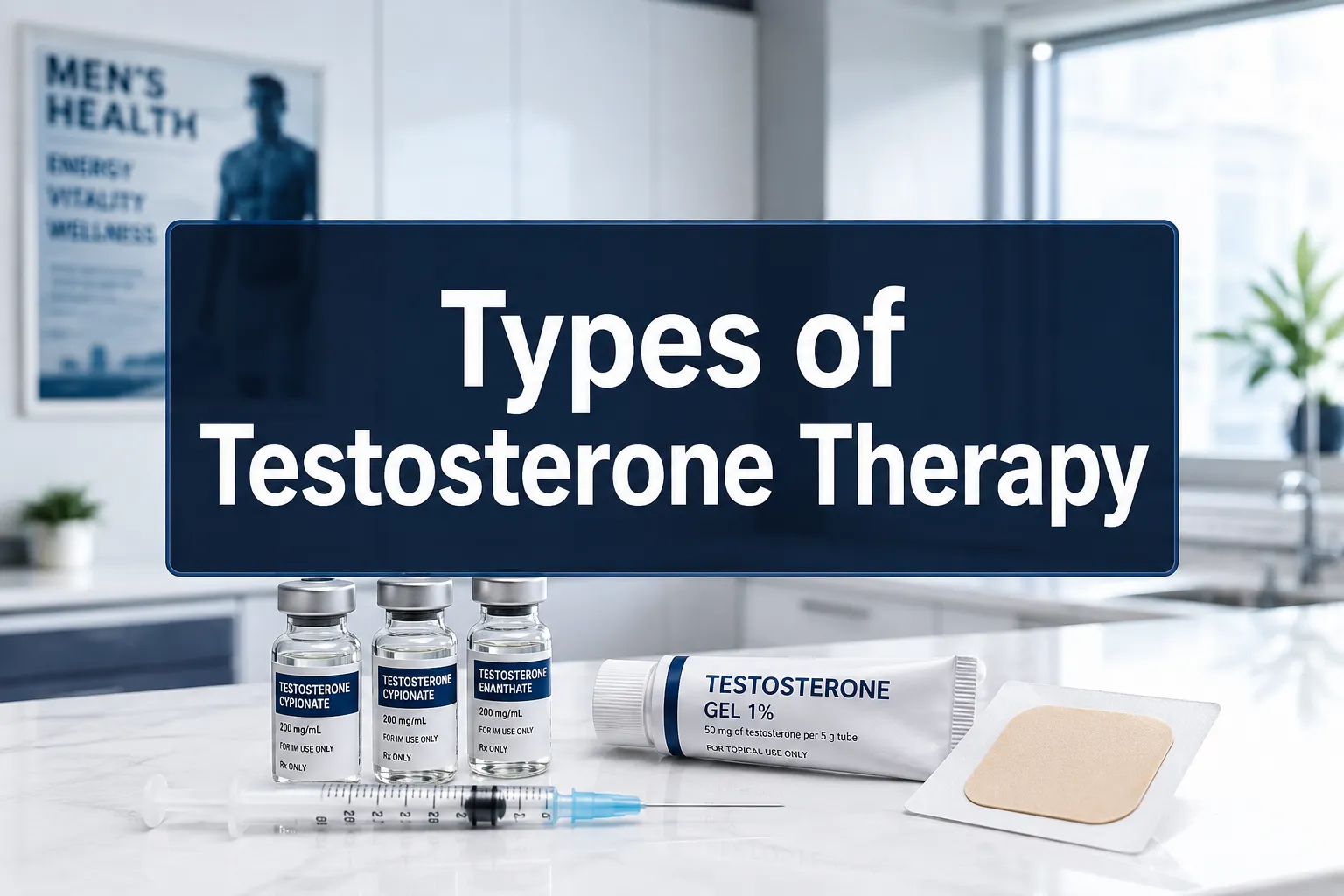
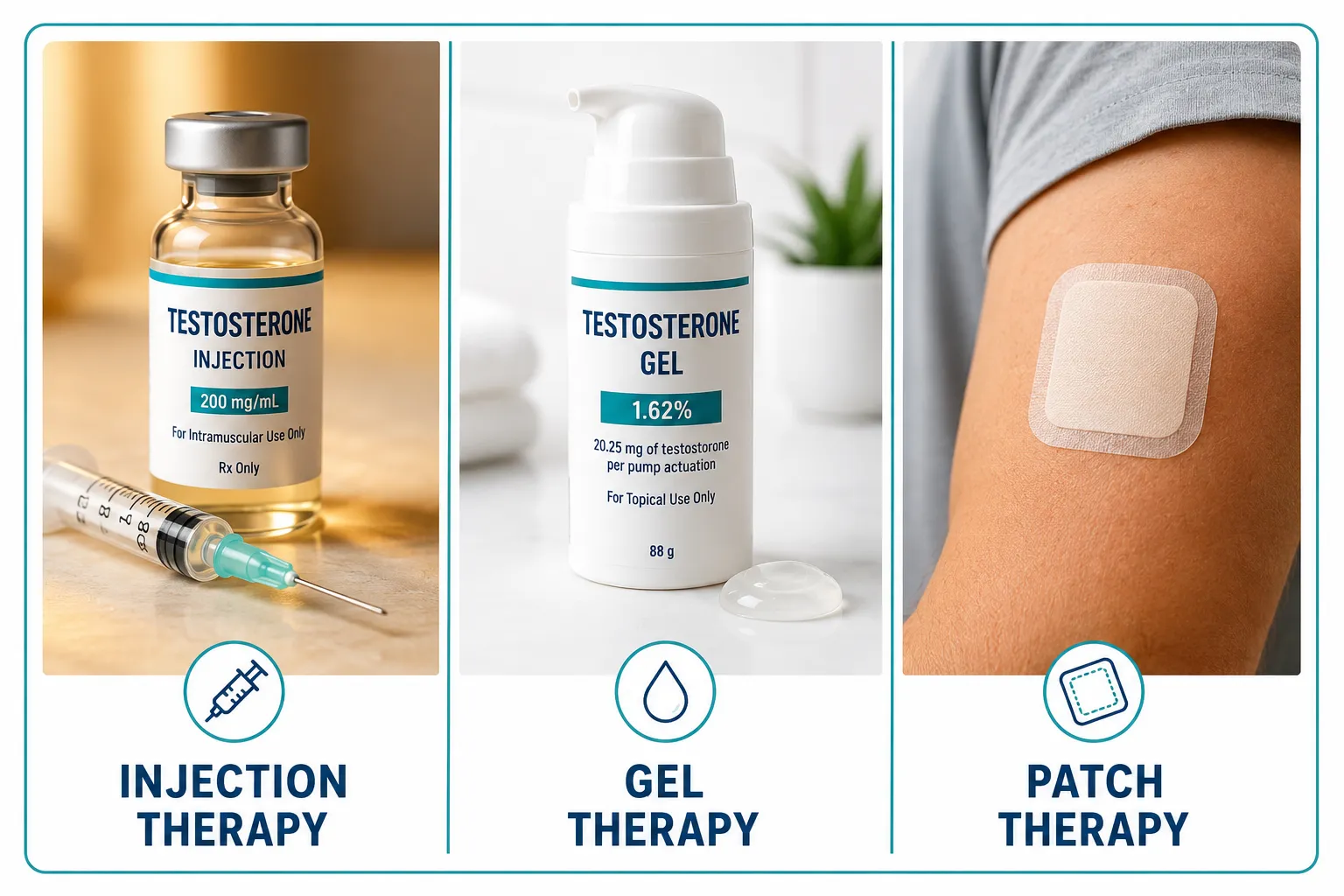
Testosterone therapy comes in several delivery formats, each designed to restore hormone levels in men diagnosed with hypogonadism (clinically low testosterone). The five main types are intramuscular or subcutaneous injections, topical gels, transdermal patches, subcutaneous pellets, and buccal tablets.
Testosterone Injections
Injections are the most widely used and affordable form of TRT. A healthcare provider or the patient self-administers testosterone cypionate or testosterone enanthate into muscle tissue (typically the thigh or glute) every one to two weeks, or testosterone undecanoate every 10 weeks.
Pros: Low cost, predictable dosing, well-studied.
Cons: Hormone levels peak sharply after injection and then dip before the next dose, which some men describe as a “roller coaster” effect.
Testosterone Gels
Gels such as AndroGel and Testim are applied to the shoulders, upper arms, or abdomen once daily. The skin absorbs testosterone steadily throughout the day, producing more stable hormone levels than weekly injections.
Pros: Easy to use, stable daily levels, no needles.
Cons: Risk of transferring testosterone to a partner or child through skin contact; must wait for gel to dry completely before contact.
Transdermal Patches
Patches (brand name Androderm) are applied to the skin once daily, usually at night. They deliver a continuous, low dose of testosterone over 24 hours.
Pros: Steady delivery, discreet.
Cons: Skin irritation at the application site is common; some men find them difficult to keep in place.
Subcutaneous Pellets
Small pellets (brand name Testopel) are implanted under the skin of the buttock or hip by a physician every 3 to 6 months. They dissolve slowly, releasing testosterone at a consistent rate.
Pros: No daily effort, very stable levels.
Cons: Minor surgical procedure required; if a side effect occurs, the pellet cannot be easily removed.
Buccal Tablets
Buccal testosterone (Striant) is a small tablet pressed against the gum twice daily. It dissolves slowly and testosterone is absorbed through the oral mucosa.
Pros: No skin transfer risk, avoids first-pass liver metabolism.
Cons: Can cause gum irritation; twice-daily dosing requires consistency.
Testosterone Replacement Therapy vs. Testosterone Boosters: What’s the Difference?
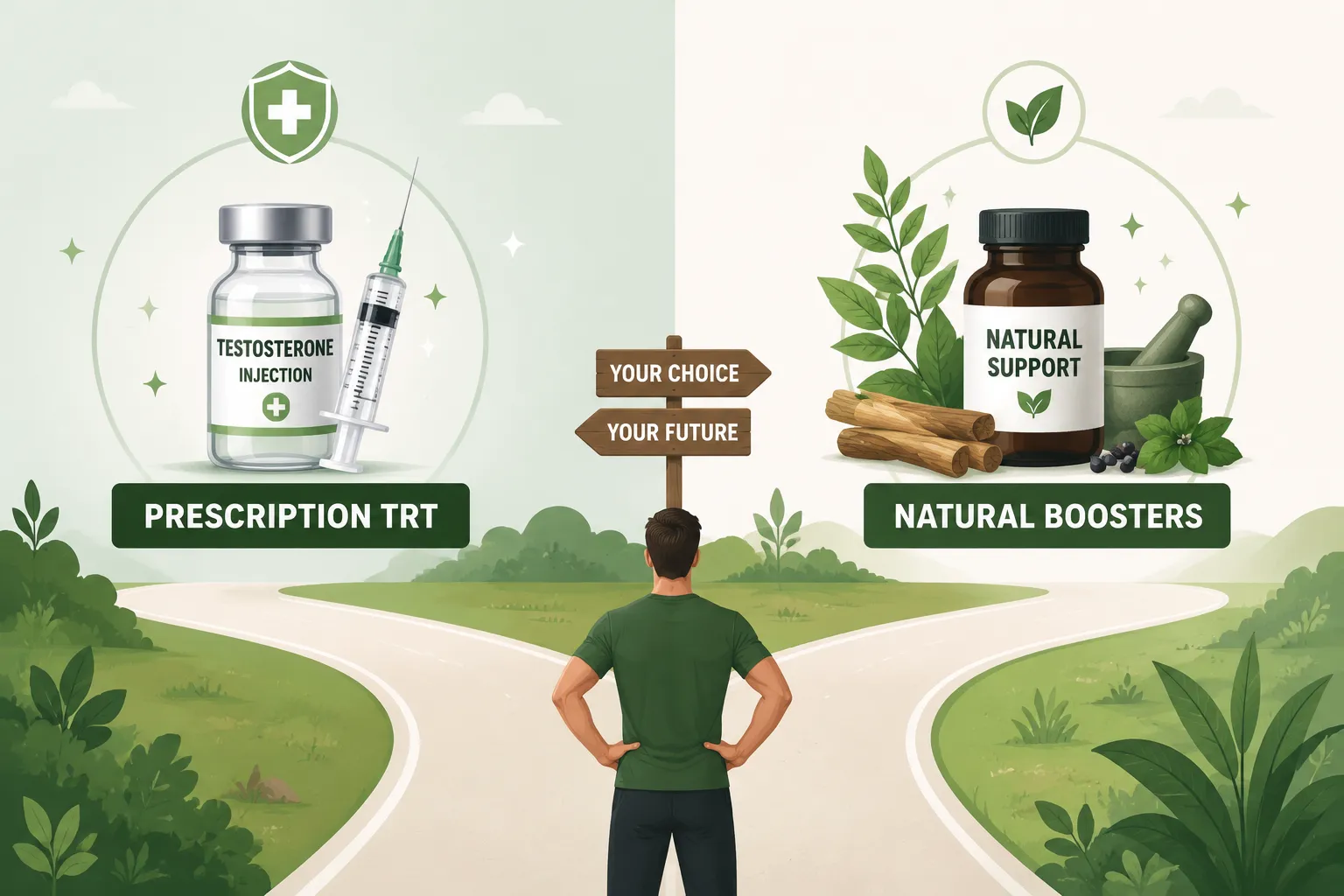
Testosterone replacement therapy (TRT) is a prescription medication that directly supplies testosterone to the body. Testosterone boosters are over-the-counter supplements that claim to support the body’s own hormone production through ingredients like zinc, vitamin D, ashwagandha, or fenugreek.
The difference matters enormously. TRT produces measurable, clinically significant increases in serum testosterone. OTC boosters have limited and inconsistent evidence. A 2019 review published in the World Journal of Men’s Health found that many popular testosterone booster supplements contained ingredients with little to no clinical proof of raising testosterone in men with confirmed hypogonadism.
Choose TRT if: You have a confirmed diagnosis of low testosterone (total T below 300 ng/dL on two separate morning tests) and symptoms such as fatigue, low libido, or loss of muscle mass.
Consider supplements if: Your testosterone is in the low-normal range, you prefer to avoid prescription drugs, and you’re addressing lifestyle factors (sleep, diet, exercise) simultaneously.
Testosterone Injections vs. Gels vs. Patches: Which Is Best?
No single delivery method is best for everyone. The right format depends on your lifestyle, budget, and tolerance for side effects.
| Method | Frequency | Relative Cost | Hormone Stability | Needle Required |
|---|---|---|---|---|
| Injection (cypionate/enanthate) | Every 1-2 weeks | Low | Moderate (peaks and troughs) | Yes |
| Injection (undecanoate) | Every 10 weeks | Moderate | High | Yes |
| Gel | Daily | Moderate, High | High | No |
| Patch | Daily | Moderate, High | High | No |
| Pellet | Every 3-6 months | Moderate | Very High | Minor procedure |
| Buccal tablet | Twice daily | Moderate | Moderate | No |
Choose injections if cost is a concern and you’re comfortable with a needle every one to two weeks.
Choose gels or patches if you want daily convenience and no needles, and you don’t have young children or a partner at risk of accidental skin exposure.
Choose pellets if you want a “set it and forget it” approach and don’t mind a minor in-office procedure every few months.
How Much Does Testosterone Therapy Cost?
Cost varies significantly by delivery method, insurance coverage, and whether you use brand-name or generic formulations.
- Injections (generic testosterone cypionate): Roughly $30 to $100 per month without insurance, making them the most affordable option.
- Gels: Brand-name gels can cost $200 to $500 per month without insurance; generic versions are cheaper.
- Patches: Typically $150 to $400 per month without insurance.
- Pellets: The implantation procedure costs $300 to $700 per session, every 3 to 6 months.
- Buccal tablets: Generally $200 to $400 per month.
Insurance often covers TRT when there is a confirmed medical diagnosis, but coverage varies widely. Telehealth platforms have made access more affordable for some men. If you’re exploring online treatment options, comparing providers is worth the effort, see our guide to Mochi vs Henry Meds for a look at how different telehealth models compare.

Who Should Get Testosterone Therapy?
Testosterone therapy is appropriate for men with clinically confirmed hypogonadism: low serum testosterone combined with symptoms. It is not a general anti-aging treatment or a performance enhancer for men with normal levels.
Candidates typically include:
- Men with total testosterone consistently below 300 ng/dL on two separate morning blood draws
- Men experiencing symptoms: fatigue, reduced libido, erectile dysfunction, loss of muscle mass, depressed mood, or poor sleep
- Men with a diagnosed condition causing low T (such as pituitary disorders or Klinefelter syndrome)
Men who should not start TRT without careful evaluation:
- Men trying to conceive (TRT suppresses sperm production)
- Men with untreated prostate or breast cancer
- Men with severe sleep apnea, uncontrolled heart failure, or a hematocrit above 54%
Low testosterone is also associated with erectile dysfunction. If you’re managing both conditions, it’s worth reviewing options for erectile dysfunction medication with fast results alongside your TRT plan.
Can Women Use Testosterone Therapy?
Yes, women can use testosterone therapy, but at doses far lower than those used for men. In women, testosterone plays a role in libido, energy, bone density, and mood.
Testosterone therapy in women is sometimes prescribed off-label for hypoactive sexual desire disorder (HSDD) or symptoms associated with surgical menopause. Typical doses for women are roughly 5 to 10% of the male dose, usually delivered via low-dose gels or creams.
Important: There are currently no FDA-approved testosterone products specifically for women in the United States. Any use is off-label and requires close monitoring for signs of excess androgen (acne, hair growth, voice changes).
How Long Does It Take to See Results from Testosterone Therapy?
Most men notice early changes within 3 to 6 weeks of starting therapy. Full benefits typically develop over 3 to 6 months, with some effects (like bone density changes) taking up to a year or more.
Timeline of typical changes:
- 2-4 weeks: Improved mood, energy, and libido often appear first.
- 6-12 weeks: Muscle mass and strength begin to improve with consistent exercise.
- 3-6 months: Body composition, sexual function, and cognitive clarity show more significant gains.
- 6-12 months: Bone density improvements become measurable; full metabolic changes stabilize.
Results vary based on the severity of deficiency, the delivery method, dose accuracy, and lifestyle factors like sleep, diet, and resistance training.
Testosterone Therapy Side Effects and Risks
Every form of testosterone therapy carries potential side effects. Being informed helps you catch problems early and discuss adjustments with your doctor.
Common side effects:
- Acne and oily skin
- Increased red blood cell count (polycythemia), which raises clotting risk
- Testicular shrinkage and reduced sperm production
- Fluid retention
- Mood swings or increased irritability
- Sleep apnea worsening
More serious risks:
- Cardiovascular events (the evidence is mixed, but men with existing heart disease need careful monitoring)
- Prostate growth (TRT does not cause prostate cancer, but it can stimulate existing cancer)
- Liver stress (primarily with oral methyltestosterone, which is rarely used today)
Regular blood monitoring (hematocrit, PSA, lipid panel, and testosterone levels) every 3 to 6 months is standard practice during TRT.
Some men on TRT also experience joint discomfort as their body composition shifts. If that’s a concern, our overview of joint support supplements covers evidence-based options worth discussing with your provider.
Natural Testosterone Boosters vs. Prescription Therapy
Natural testosterone boosters are supplements, not medications. They work (when they work at all) by supporting the body’s own hormone production rather than supplying testosterone directly.
What the evidence says:
- Zinc and vitamin D supplementation can help restore testosterone in men who are deficient in those nutrients.
- Ashwagandha has shown modest testosterone-supporting effects in some small studies.
- D-aspartic acid, tribulus terrestris, and fenugreek have inconsistent results in clinical trials.
None of these supplements are a substitute for prescription TRT in men with confirmed hypogonadism. However, they may be appropriate for men in the low-normal range who want to optimize lifestyle factors before committing to a prescription.
If you’re also dealing with bone health concerns alongside low testosterone, the article on how to reverse bone loss naturally covers complementary strategies worth reading.
Testosterone Therapy for Athletes vs. Medical Use
This is a critical distinction. Testosterone therapy for a diagnosed medical condition is legal, ethical, and covered by most insurance plans. Using testosterone to enhance athletic performance in healthy individuals with normal levels is a different matter entirely.
Medical TRT: Prescribed to men with confirmed hypogonadism. The goal is to restore testosterone to a normal physiological range (typically 400 to 700 ng/dL), not to push it above normal.
Performance use: Using testosterone to push levels above the normal range increases muscle mass and recovery speed, but it also carries substantially higher risks of cardiovascular damage, hormonal suppression, and infertility. It is banned by virtually all competitive sports organizations.
Athletes who receive a legitimate TRT prescription from a licensed physician can apply for a Therapeutic Use Exemption (TUE) through their governing body, but approval is not guaranteed.
Common Testosterone Therapy Mistakes to Avoid
Even men who genuinely need TRT often undermine their results through avoidable errors.
- Starting without a confirmed diagnosis. Symptoms alone are not enough. Get two morning blood draws before starting therapy.
- Skipping follow-up labs. Hematocrit and PSA monitoring are not optional. Elevated red blood cells are a real clotting risk.
- Choosing the wrong delivery method for your lifestyle. A gel is useless if you forget to apply it daily or have young children at home.
- Expecting results in two weeks. Impatience leads men to abandon therapy before it has time to work.
- Ignoring lifestyle factors. TRT works best alongside adequate sleep, resistance training, and a reasonable diet. It is not a shortcut.
- Not addressing estrogen. Testosterone converts to estrogen (aromatization). Some men need an aromatase inhibitor to prevent high estrogen side effects like water retention and mood changes.
- Sourcing testosterone outside a licensed provider. Unregulated products carry serious contamination and dosing risks.
For men who are also exploring related men’s health treatments online, our guide to how to get ED medication online safely offers practical advice on vetting telehealth providers.
How to Choose the Right Type of Testosterone Therapy
Choosing among the types of testosterone therapy comes down to four practical factors: cost, convenience, lifestyle constraints, and how your body responds.
Use this decision framework:
- Budget is tight: Start with generic injectable testosterone cypionate. It’s the most studied and least expensive option.
- Needle aversion: Daily gel or patch is the most practical needle-free alternative.
- Busy schedule, poor adherence: Subcutaneous pellets eliminate daily or weekly dosing entirely.
- Young children or pregnant partner at home: Avoid gels due to transfer risk; injections or pellets are safer.
- Fertility is a current goal: Discuss alternatives to TRT entirely (such as clomiphene or hCG), since TRT suppresses sperm production.
Always make this decision with a licensed physician who has reviewed your bloodwork, not based on what worked for someone else.
Testosterone Therapy Alternatives to Injections
For men who want TRT benefits without needles, several effective alternatives exist.
- Topical gels and creams: The most common injection alternative. Applied daily, they provide stable hormone levels.
- Transdermal patches: Convenient once-daily option, though skin irritation is a known drawback.
- Subcutaneous pellets: The longest-lasting option; requires only a minor in-office procedure two to four times per year.
- Buccal tablets: Dissolve against the gum twice daily; no skin transfer risk.
- Nasal gel (Natesto): A newer option applied inside the nostrils three times daily. It has less impact on sperm production than other forms, making it an option for men who want TRT but haven’t ruled out future fertility.
Each of these alternatives is a legitimate medical treatment. The best online men’s health platforms now offer consultations for all of these formats. Our review of the best online ED consultation and treatment programs covers providers that also handle TRT evaluations.
Frequently Asked Questions
What is the most effective type of testosterone therapy?
There is no single most effective type. Injections, gels, patches, and pellets all raise testosterone effectively when dosed correctly. Effectiveness depends more on consistent use and proper dosing than on the delivery method itself.
Can I switch from one type of testosterone therapy to another?
Yes. Men switch delivery methods regularly, often due to side effects, cost changes, or lifestyle shifts. Your physician will adjust dosing and monitor your levels during any transition.
Does testosterone therapy cause prostate cancer?
Current evidence does not support a direct link between TRT and prostate cancer development in men with no prior diagnosis. However, TRT can stimulate existing prostate cancer, which is why PSA monitoring and a prostate evaluation before starting therapy are standard practice.
Will testosterone therapy make me infertile?
TRT suppresses the body’s natural testosterone production and significantly reduces sperm count, often to near zero. This effect is usually reversible after stopping therapy, but recovery can take months to years. Men who want to father children should discuss alternatives with a urologist or reproductive endocrinologist before starting TRT.
How do I know if my testosterone is actually low?
A total testosterone blood test drawn in the morning (when levels are highest) is the standard test. Most guidelines define low testosterone as below 300 ng/dL, but symptoms and free testosterone levels also matter. Two separate tests are recommended before diagnosis.
Is testosterone therapy covered by insurance?
TRT is often covered when there is a confirmed medical diagnosis of hypogonadism. Coverage varies by plan and by the specific product prescribed. Generic injectable testosterone is the most consistently covered option.
Can testosterone therapy help with depression?
Low testosterone is associated with depressive symptoms, and restoring normal levels can improve mood in men with confirmed hypogonadism. However, TRT is not a treatment for clinical depression in men with normal testosterone levels.
What happens if I stop testosterone therapy?
When you stop TRT, your body’s natural testosterone production gradually resumes, though this can take weeks to months. Symptoms of low testosterone will likely return. Men who have been on TRT for years may experience a longer recovery period.
Is nasal testosterone gel as effective as injections?
Nasal testosterone gel (Natesto) raises testosterone levels effectively, though it requires three-times-daily dosing and may not achieve the same peak levels as injections in all men. Its main advantage is a lower impact on sperm production.
How do I find a legitimate testosterone therapy provider?
Look for board-certified physicians (urologists, endocrinologists, or men’s health specialists) who require bloodwork before prescribing. Avoid any provider who prescribes testosterone without lab confirmation of low levels. Telehealth platforms can be legitimate if they follow the same diagnostic standards.
Conclusion
The types of testosterone therapy available in 2026 give men more choices than ever, from weekly injections to long-acting pellets to daily gels. The right option depends on your confirmed diagnosis, lifestyle, budget, and personal preferences, not on trends or what worked for someone else.
Your next steps:
- Get a morning blood draw to check total and free testosterone levels.
- If levels are confirmed low on two tests, consult a licensed physician (in-person or via a reputable telehealth platform).
- Discuss which delivery method fits your lifestyle and health history.
- Schedule follow-up labs at 3 and 6 months after starting therapy.
TRT is a medical treatment, not a shortcut. Used correctly under proper supervision, it can meaningfully improve quality of life for men with genuine hormonal deficiency.