Testosterone Calculator
Last updated: August 10, 2026
Quick Answer: A testosterone calculator is an online tool that estimates your total or free testosterone levels using inputs like age, weight, SHBG, and albumin. It does not replace a blood test, but it can help you interpret existing lab results, spot trends, and decide whether a doctor visit is warranted. Most calculators are free, take under two minutes to use, and are most reliable when paired with actual lab values.
Key Takeaways
- A testosterone calculator estimates free or bioavailable testosterone from existing lab values, it does not measure hormone levels on its own.
- Free testosterone is the clinically meaningful fraction; total testosterone alone can be misleading if SHBG levels are abnormal.
- Online calculators are useful for interpreting lab results but cannot replace a blood draw for diagnosis or treatment decisions.
- Normal testosterone ranges shift with age; what is typical at 25 differs significantly from what is typical at 55.
- Bodybuilders and athletes often use calculators to track changes in free testosterone during training cycles.
- Symptoms of low testosterone (fatigue, low libido, poor recovery) should prompt a doctor visit, not just a calculator check.
- Several free, evidence-based testosterone calculators are available online from academic medical centers.
- Low testosterone is linked to broader health concerns, including erectile dysfunction, an area where ED medication options may also be relevant.
What Is a Testosterone Calculator and How Does It Work
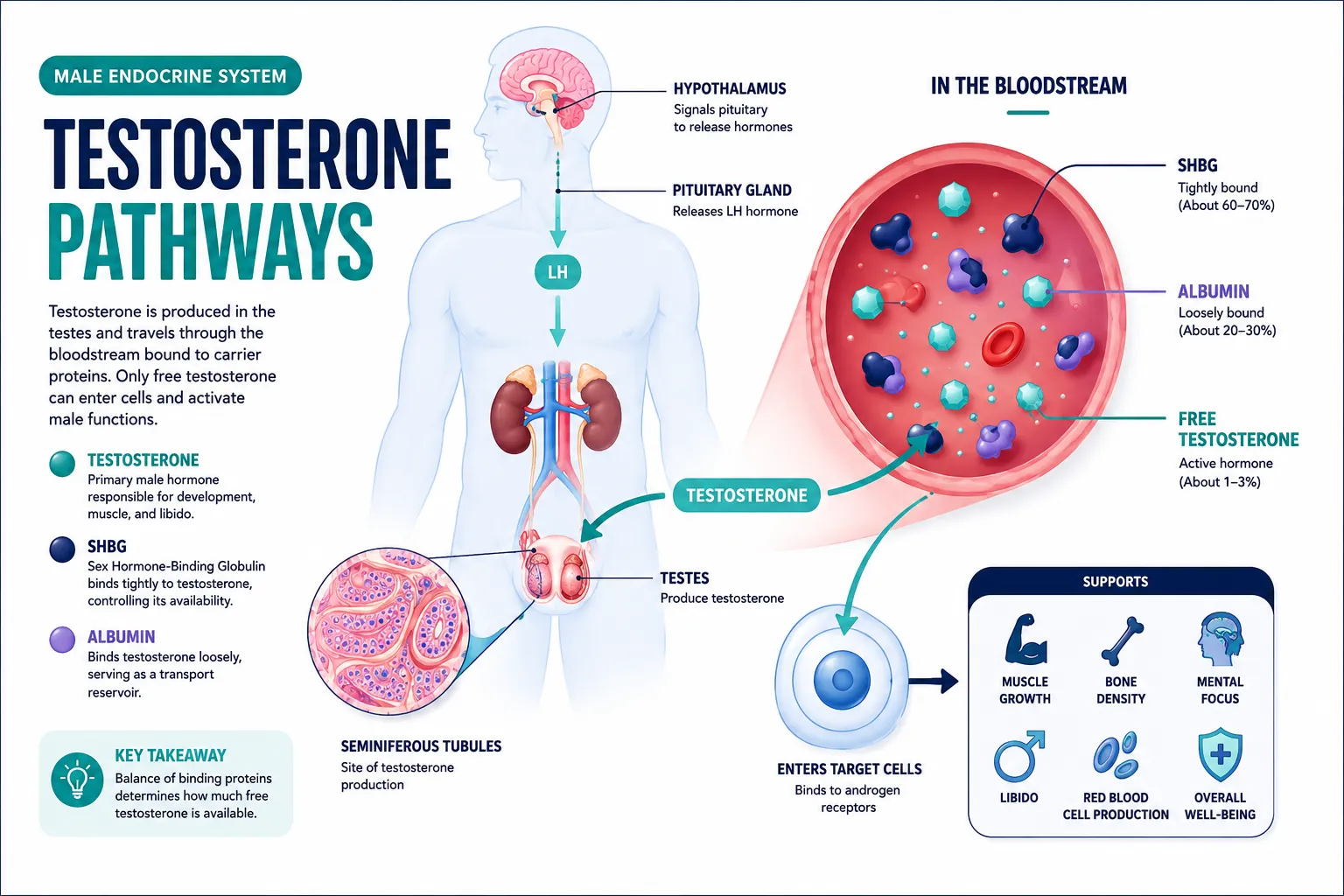
A testosterone calculator is a digital tool that uses a mathematical formula to estimate the concentration of free or bioavailable testosterone in your blood. It takes inputs you already have from a lab report, typically total testosterone, sex hormone-binding globulin (SHBG), and albumin, and applies an established equation to calculate how much testosterone is actually available to your cells.
The most widely cited formula is the Vermeulen equation, published in the Journal of Clinical Endocrinology and Metabolism. It accounts for the binding affinity of testosterone to SHBG and albumin, producing an estimate of free testosterone in nanomoles per liter (nmol/L) or picograms per milliliter (pg/mL).
How the calculation works, step by step:
- You enter your total testosterone level (from a blood test).
- You enter your SHBG level (also from a blood test).
- You enter your albumin level (often assumed at a standard 4.3 g/dL if not measured).
- The calculator applies the Vermeulen or similar formula.
- It returns an estimated free testosterone value and often compares it to age-adjusted reference ranges.
The key point: the calculator does math on data you already have. It does not generate new biological data. Without actual lab values, any result is a rough estimate at best.
What Factors Does a Testosterone Calculator Measure
A testosterone calculator primarily works with three variables: total testosterone, SHBG, and albumin. Together, these determine how much testosterone is “free” versus bound to proteins and therefore unavailable for use by tissues.
The three core inputs:
| Input | What It Represents | Typical Reference Range |
|---|---|---|
| Total Testosterone | All testosterone in blood (free + bound) | 300-1,000 ng/dL (adult men) |
| SHBG | Protein that binds testosterone tightly | 10-57 nmol/L (adult men) |
| Albumin | Protein that binds testosterone loosely | ~4.3 g/dL (standard assumption) |
Some advanced calculators also incorporate:
- Age, to compare results against age-specific norms
- BMI or body weight, because obesity raises SHBG and alters free testosterone
- Luteinizing hormone (LH), to help distinguish primary from secondary hypogonadism
The output is usually expressed as free testosterone (pg/mL or pmol/L) and bioavailable testosterone (the sum of free and albumin-bound testosterone). Bioavailable testosterone is considered the most clinically relevant fraction because albumin-bound testosterone can be released to tissues relatively easily.
Testosterone Calculator for Men by Age
Testosterone levels decline with age, so a testosterone calculator that includes age-adjusted reference ranges is more useful than one that applies a single universal threshold. Most men experience a gradual decline of roughly 1-2% per year after age 30, though the rate varies considerably between individuals.
Age-based reference ranges (approximate, total testosterone):
| Age Group | Typical Total T Range (ng/dL) |
|---|---|
| 20-29 | 400-1,080 |
| 30-39 | 350-950 |
| 40-49 | 300-850 |
| 50-59 | 250-750 |
| 60+ | 200-700 |
These are general estimates drawn from population studies. Individual variation is wide, and symptoms matter as much as numbers. A man at 58 with a total testosterone of 320 ng/dL but no symptoms may not need treatment. A man at 42 with 380 ng/dL and significant fatigue, low libido, and poor sleep might.
Common mistake: Comparing your result only to the broadest “normal” range (often listed as 300-1,000 ng/dL) without considering age. A 28-year-old with 310 ng/dL is likely low for his age group even though the number technically falls within the general range.
How to Use a Testosterone Calculator Step by Step
Using a testosterone calculator correctly takes about two minutes, provided you have your lab results in hand. The most common error is entering values without matching the units the calculator expects.
Step-by-step process:
- Get your blood work done first. You need at minimum a total testosterone and SHBG result. Ask your doctor to include albumin if possible.
- Note the units on your lab report. Total testosterone is often reported in ng/dL in the US and nmol/L in Europe. SHBG is usually in nmol/L. Confirm before entering values.
- Choose a reputable calculator. Academic medical center tools or those based on the Vermeulen equation are most reliable (see the section below on the best tools).
- Enter your values. Input total testosterone, SHBG, and albumin. If albumin is not on your report, most calculators default to 4.3 g/dL, which is acceptable.
- Record your results. Note free testosterone in pg/mL and bioavailable testosterone. Compare against the age-adjusted reference range the calculator provides.
- Interpret in context. A number below the reference range is a flag, not a diagnosis. Bring the result to your doctor alongside your symptoms.
Edge case: If your SHBG is unusually high (above 60 nmol/L) or unusually low (below 10 nmol/L), the calculator’s accuracy decreases. High SHBG is common in older men, men with hyperthyroidism, and those taking certain medications. Low SHBG is associated with obesity, insulin resistance, and hypothyroidism.
How Accurate Are Testosterone Calculators
Testosterone calculators are reasonably accurate for most men when the input values are from a reliable lab, but they are estimates, not measurements. The Vermeulen equation has been validated in research settings and performs well in men with SHBG levels in the normal range.
Where accuracy holds up:
- Men with SHBG between 10 and 57 nmol/L
- Standard albumin levels near 4.3 g/dL
- No acute illness (which can temporarily suppress testosterone)
Where accuracy degrades:
- Very high or very low SHBG (the formula’s assumptions break down at extremes)
- Obesity, liver disease, or thyroid disorders that alter protein binding
- Use of testosterone replacement therapy or anabolic steroids (which change the ratio of free to bound testosterone in ways the standard formula doesn’t fully capture)
A 2019 study in the Journal of Clinical Endocrinology and Metabolism found that calculated free testosterone using the Vermeulen method correlated well with equilibrium dialysis (the gold-standard measurement method) in healthy men but showed wider divergence in men with abnormal SHBG. For most men using a calculator as a screening or monitoring tool, the accuracy is clinically useful, just not definitive.
Testosterone Calculator vs Blood Test: Which Is More Reliable
A blood test is always more reliable than a calculator for diagnostic purposes. The calculator is a mathematical estimate; the blood test is a direct measurement. These tools serve different purposes and work best together.
When a calculator is sufficient:
- You already have lab values and want to understand your free testosterone
- You’re monitoring trends over time using serial lab results
- You want to prepare informed questions before a doctor visit
When you need a blood test:
- You have symptoms suggesting low testosterone (fatigue, low libido, reduced muscle mass, mood changes)
- You are considering testosterone replacement therapy (TRT)
- Your calculated result is borderline and you want confirmation
- A healthcare provider needs data to make a treatment decision
The gold standard for measuring free testosterone is equilibrium dialysis, which is expensive and not widely available. Most labs use immunoassay or calculated methods. For practical purposes, a calculated free testosterone from accurate total T and SHBG values is considered acceptable by many endocrinology guidelines for initial assessment, but not for treatment initiation.
Bottom line: Use the calculator to interpret your existing labs. Use a blood test to get the data the calculator needs, and to confirm any concerning result.

Free Testosterone Calculator Online: Best Tools Available in 2026
Several free, reliable testosterone calculators are available online in 2026. The best ones are based on peer-reviewed formulas and clearly state their methodology.
Top options to consider:
- ISSAM (International Society for the Study of Aging Male) Calculator, Based on the Vermeulen equation, widely cited in clinical literature. Available at issam.ch. Inputs: total T, SHBG, albumin. Outputs: free T and bioavailable T.
- Nebido / Bayer Testosterone Calculator, A clinically oriented tool that includes age-adjusted reference ranges.
- Omni Calculator (Testosterone Calculator), User-friendly interface with unit conversion built in. Good for men unfamiliar with nmol/L vs. ng/dL conversions.
- University hospital-based calculators, Several academic medical centers publish their own tools. These tend to be conservative and well-documented.
What to avoid: Calculators that claim to estimate your testosterone from symptoms alone (no lab values required) are not scientifically valid. They may be useful for self-screening to decide whether to get tested, but they should not be used to interpret hormone levels.
Men dealing with related concerns, such as low energy, reduced libido, or erectile difficulties, may also want to explore ED medication options for performance anxiety or review fast-acting ED medication, since low testosterone and erectile dysfunction often overlap.
Testosterone Calculator Results: What Do the Numbers Mean
Once you have your results, the key values to focus on are free testosterone and bioavailable testosterone. Total testosterone alone can be misleading if your SHBG is outside the normal range.
Reference ranges for free testosterone (adult men):
| Category | Free Testosterone (pg/mL) |
|---|---|
| Optimal | 15-25 pg/mL |
| Normal | 9-30 pg/mL |
| Low-normal | 5-9 pg/mL |
| Low (hypogonadal range) | Below 5 pg/mL |
These ranges are approximate and vary slightly between laboratories and guidelines. The Endocrine Society defines male hypogonadism as a total testosterone consistently below 300 ng/dL combined with symptoms, not a number in isolation.
How to read your result:
- Above the reference range: Uncommon without exogenous testosterone use. Worth discussing with a doctor if you’re not on TRT.
- Within the normal range with symptoms: Symptoms still matter. Some men feel better with testosterone in the upper third of normal. Discuss with an endocrinologist.
- Below the normal range: This is a flag. It does not confirm hypogonadism on its own, but it warrants a follow-up blood test and clinical evaluation.
- Borderline result: Retest in the morning (testosterone peaks between 7-10 AM) after a night of good sleep and without recent intense exercise.
Is a Testosterone Calculator Accurate for Women
Testosterone calculators designed for men are not validated for use in women and should not be used to interpret female hormone levels. Women have significantly lower testosterone concentrations, different SHBG binding dynamics, and different reference ranges entirely.
For women, free testosterone reference ranges are roughly 10-20 times lower than for men. The Vermeulen equation was derived from male population data, so applying it to female lab values produces results that are not clinically meaningful.
Women concerned about testosterone levels, for example, in the context of polycystic ovary syndrome (PCOS), adrenal disorders, or menopause, should work with a gynecologist or endocrinologist who uses female-specific reference ranges and validated measurement methods.
Testosterone Calculator for Bodybuilders and Athletes
Bodybuilders and athletes use testosterone calculators primarily to monitor free testosterone during training cycles, recovery phases, and natural hormone optimization protocols. For this group, the calculator is a practical tool for tracking trends without repeated expensive lab panels.
Common use cases in athletic populations:
- Monitoring free testosterone before and after a training block to assess recovery
- Evaluating the impact of sleep, nutrition, and stress management on hormone levels
- Checking whether natural testosterone support supplements are producing measurable changes
- Tracking post-cycle recovery for those who have used performance-enhancing compounds
Important caveat for athletes on TRT or anabolic steroids: Standard calculators become less reliable in this context. Supraphysiological testosterone levels and altered SHBG dynamics mean the Vermeulen formula’s assumptions no longer hold. Athletes in this situation need direct free testosterone measurement by equilibrium dialysis, not a calculated estimate.
For athletes managing weight alongside hormone optimization, related tools like GLP-1 drug cost guides and semaglutide alternatives may also be relevant, since body composition directly affects testosterone levels.
Testosterone Calculator Limitations and When You Shouldn’t Rely on It
A testosterone calculator is a useful tool with real limitations. Knowing when not to rely on it is as important as knowing how to use it.
Do not rely solely on a calculator if:
- You have symptoms of hypogonadism (fatigue, low libido, depression, reduced muscle mass, hot flashes)
- You are considering starting, adjusting, or stopping testosterone replacement therapy
- You have liver disease, thyroid disorders, or obesity (all of which alter SHBG significantly)
- Your SHBG is outside the 10-57 nmol/L range
- You are a woman or adolescent (different reference ranges apply)
- You have recently had surgery, acute illness, or significant weight change (temporary suppression of testosterone)
The calculator also cannot tell you:
- Why your testosterone is low (primary vs. secondary hypogonadism requires LH and FSH testing)
- Whether your symptoms are caused by low testosterone or another condition
- What treatment, if any, is appropriate
For men experiencing symptoms that could be related to low testosterone, including erectile dysfunction, a doctor visit is the right next step. Resources like best online ED consultation programs and ED medication for older men can help bridge the gap while you arrange formal testing.
Testosterone Calculator vs Doctor Visit: When Should You Get Tested
Use a calculator when you already have lab values and want to understand them better. See a doctor when you have symptoms, when your calculated result is low or borderline, or when you are making any treatment decision.
See a doctor if:
- You have two or more symptoms of low testosterone lasting more than a few weeks
- Your calculated free testosterone falls below 9 pg/mL
- You are over 40 and have not had a testosterone panel in the past two years
- You have risk factors: obesity, type 2 diabetes, sleep apnea, or chronic stress
- You are experiencing sexual dysfunction alongside fatigue or mood changes
A primary care physician can order a morning total testosterone test. If that result is below 300 ng/dL on two separate occasions, a referral to an endocrinologist is standard practice. The calculator can help you walk into that appointment informed, but it cannot replace the clinical conversation.
Men looking for accessible care options may find value in reviewing online ED programs for older men or exploring Hims ED medication alternatives as part of a broader men’s health strategy.

FAQ
What is the most accurate free testosterone calculator available?
The ISSAM calculator based on the Vermeulen equation is the most widely validated tool for estimating free testosterone. It requires total testosterone, SHBG, and albumin values from a blood test and is available free at issam.ch. It performs well in men with SHBG in the normal range.
Can I use a testosterone calculator without blood test results?
No. Calculators that claim to estimate testosterone from symptoms or lifestyle factors alone are not scientifically valid. A meaningful result requires actual lab values, at minimum total testosterone and SHBG.
What is a normal free testosterone level for a 45-year-old man?
For a man in his mid-40s, free testosterone between 9 and 25 pg/mL is generally considered within the normal range. Values below 9 pg/mL may indicate low testosterone, particularly if symptoms are present. Age-adjusted reference ranges vary slightly between labs and guidelines.
Does a testosterone calculator work for men on TRT?
Standard calculators are less reliable for men on testosterone replacement therapy because exogenous testosterone alters SHBG levels and the ratio of free to bound testosterone in ways the Vermeulen formula doesn’t fully account for. Men on TRT should use direct free testosterone measurement by equilibrium dialysis.
How often should I use a testosterone calculator?
If you are monitoring hormone levels for health or athletic performance, checking every 3-6 months alongside regular blood work is reasonable. More frequent checks are unlikely to add useful information unless your health status or medications have changed.
Can low SHBG cause a falsely high free testosterone reading?
Yes. If SHBG is very low (below 10 nmol/L), the calculator may overestimate free testosterone because a greater proportion of total testosterone is unbound. This pattern is common in men with obesity or insulin resistance and is one reason clinical context always matters alongside the number.
Is total testosterone or free testosterone more important?
Free testosterone is generally more clinically meaningful because it represents the hormone available to act on tissues. Total testosterone can look normal while free testosterone is low if SHBG is elevated, a situation that would be missed without calculating or measuring the free fraction.
What symptoms suggest I should check my testosterone levels?
Persistent fatigue, reduced libido, difficulty maintaining muscle mass, increased body fat (especially abdominal), mood changes, poor sleep, and erectile dysfunction are the most common symptoms associated with low testosterone. Any combination of these lasting more than a few weeks warrants a blood test.
Can a testosterone calculator diagnose hypogonadism?
No. Hypogonadism is a clinical diagnosis that requires two morning blood tests showing low testosterone, plus symptoms, plus an evaluation to rule out other causes. A calculator can flag a low result, but diagnosis requires a physician.
Are testosterone calculators free to use?
Yes. The most reputable testosterone calculators, including the ISSAM tool and several university hospital versions, are completely free to use online. No subscription or personal data is required.
Conclusion
A testosterone calculator is a practical, evidence-based tool for any man who wants to understand his hormone health beyond a single lab number. By converting total testosterone and SHBG into a free testosterone estimate, it gives you the clinically relevant figure that total testosterone alone often misses.
Use it to interpret your existing lab results, track trends over time, and prepare for informed conversations with your doctor. Do not use it as a substitute for blood work, and do not make treatment decisions based on a calculated number alone.
Your next steps:
- If you haven’t had a testosterone panel, ask your doctor for a morning blood draw that includes total testosterone, SHBG, and albumin.
- Once you have results, run them through the ISSAM calculator to get your free testosterone estimate.
- If your result is low or you have symptoms, book a follow-up with your physician, bring your numbers and your symptom list.
- If erectile dysfunction is part of your symptom picture, explore ED medication options alongside your hormone evaluation.
Hormone health is not a single data point. It’s a pattern, and a testosterone calculator helps you see it clearly.