Injectable Testosterone
Last updated: August 10, 2026
Quick Answer: Injectable testosterone is a prescription hormone therapy used to treat low testosterone (hypogonadism) in men. It is delivered directly into muscle tissue, typically every one to two weeks, and is considered one of the most effective and cost-efficient forms of testosterone replacement therapy (TRT) available. You need a valid prescription to obtain it legally in most countries, including the United States.
Key Takeaways
- Injectable testosterone is the most widely prescribed form of TRT and is generally more cost-effective than gels or patches
- The two most common types are testosterone enanthate and testosterone cypionate, both injected every 7 to 14 days
- Injections are typically administered into the gluteal muscle, outer thigh, or deltoid
- Most men begin noticing improvements in energy, libido, and mood within 3 to 6 weeks
- Side effects are real and include acne, elevated red blood cell count, testicular shrinkage, and cardiovascular risk
- A prescription from a licensed physician is legally required in the United States and most other countries
- Generic injectable testosterone is affordable, often costing $30 to $80 per month without insurance
- Men with prostate cancer, untreated sleep apnea, or high hematocrit levels should not start TRT without specialist clearance
- Missing a single injection rarely causes serious harm, but consistency matters for stable hormone levels
- Low testosterone is also linked to erectile dysfunction; men dealing with both conditions may benefit from reading about the strongest ED medication options for older men
What Is Injectable Testosterone Used For?
Injectable testosterone is primarily used to treat hypogonadism, a condition where the body produces insufficient testosterone. Beyond that core indication, doctors also prescribe it for delayed puberty in adolescent males and, in some cases, as part of gender-affirming hormone therapy.
Primary medical uses include:
- Primary hypogonadism: Caused by testicular failure due to injury, infection, or genetic conditions (such as Klinefelter syndrome)
- Secondary hypogonadism: Caused by pituitary or hypothalamic dysfunction that fails to signal testosterone production
- Age-related testosterone decline: Testosterone levels drop roughly 1% per year after age 30, according to general endocrinology consensus; TRT may be indicated when levels fall below 300 ng/dL alongside clinical symptoms
- Delayed puberty: Short-term low-dose therapy to initiate puberty in adolescent males
- Muscle wasting conditions: Sometimes prescribed for HIV-related wasting or severe cachexia under specialist supervision
Symptoms that commonly prompt testing and TRT consideration:
- Persistent fatigue and low energy
- Reduced sex drive
- Erectile dysfunction
- Loss of muscle mass and increased body fat
- Mood changes, depression, or poor concentration
- Reduced bone density
Men experiencing erectile dysfunction alongside low testosterone should know these two conditions frequently overlap. Our guide on how to get ED medication online safely covers complementary treatment options worth reviewing alongside TRT.
Injectable Testosterone Brands, Types, and What’s the Difference Between Enanthate and Cypionate
There are several forms of injectable testosterone, each differing in their ester (the chemical chain that controls how slowly testosterone is released into the bloodstream).
The most commonly prescribed types:
| Type | Brand Names | Injection Frequency | Half-Life |
|---|---|---|---|
| Testosterone Cypionate | Depo-Testosterone | Every 7-14 days | ~8 days |
| Testosterone Enanthate | Delatestryl, Xyosted | Every 7-14 days | ~4.5 days |
| Testosterone Undecanoate | Aveed | Every 10 weeks | ~21 days |
| Testosterone Propionate | Generic only | Every 2-3 days | ~2 days |
Testosterone Enanthate vs. Testosterone Cypionate
These two are nearly interchangeable in clinical practice. Both are long-acting esters injected into muscle, both produce similar peak and trough testosterone levels, and both are available as generics at low cost. The main practical difference is that cypionate is slightly more commonly prescribed in the United States, while enanthate is more common in Europe.
Choose cypionate if: You’re in the US and want the most widely available generic option. Choose enanthate if: Your provider prefers it or you’re sourcing through international pharmacy channels.
Testosterone undecanoate (Aveed) is a long-acting injectable given in a clinic every 10 weeks. It’s convenient but more expensive and carries a rare risk of pulmonary oil microembolism, which is why it must be administered in a medical setting with a 30-minute observation period.
Testosterone propionate requires injections every two to three days due to its short half-life. It’s rarely used for standard TRT because of the injection burden, but some advanced users prefer it for tighter hormone control.
How Often Do You Inject Testosterone?

For the two most common forms (enanthate and cypionate), the standard injection frequency is every 7 to 14 days. Many men and their doctors prefer weekly injections because they produce more stable testosterone levels with fewer peaks and troughs.
Typical injection schedules:
- Every 14 days: Traditional protocol, still used, but creates noticeable energy and mood swings as levels peak then drop
- Every 7 days: The current clinical preference for most men; produces more consistent levels
- Every 3.5 days (twice weekly): Used by some men who are sensitive to hormonal fluctuations; maximizes level stability
- Every 10 weeks: Specific to testosterone undecanoate (Aveed), clinic-administered only
Common mistake: Sticking rigidly to a 14-day schedule when you feel energy crashes in week two. Talk to your doctor about switching to weekly injections before assuming TRT isn’t working.
Where Do You Inject Testosterone?
Injectable testosterone is given as an intramuscular (IM) injection, meaning the needle goes into muscle tissue rather than a vein or just under the skin. The three most common injection sites are the gluteus medius (upper outer buttock), the vastus lateralis (outer thigh), and the deltoid (upper arm).
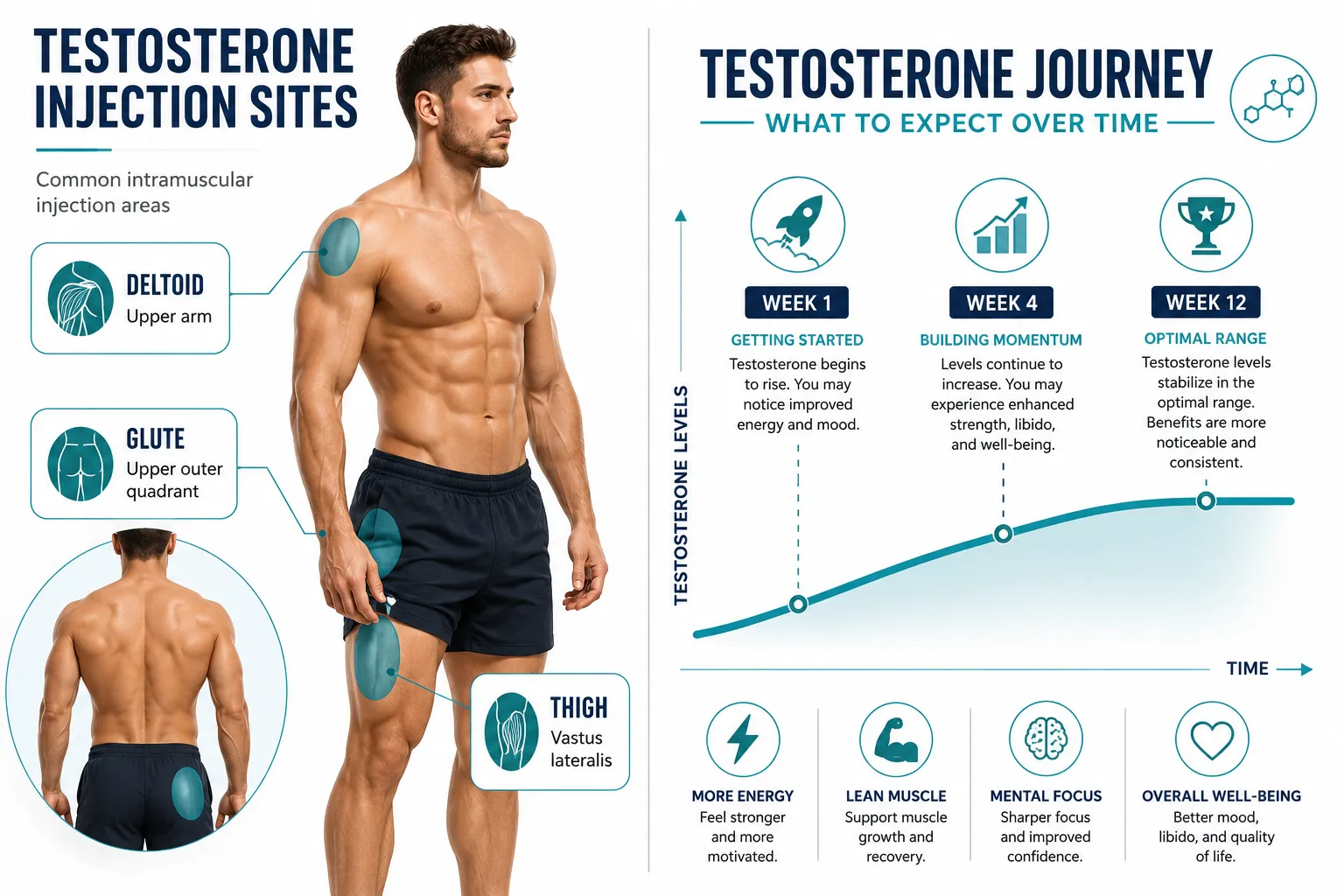
Site-by-site breakdown:
- Gluteus medius (glute): The most commonly used site. Large muscle mass, lower risk of hitting nerves or vessels. Requires some flexibility to self-inject.
- Vastus lateralis (outer thigh): Easiest site for self-injection. Clearly visible, accessible, and well-tolerated. Slight increase in post-injection soreness for some men.
- Deltoid (upper arm): Used for smaller volume injections (0.5 mL or less). Convenient but has less muscle mass, so not ideal for larger volumes.
Subcutaneous (SubQ) injections are an increasingly popular alternative. A shorter, finer needle is used to inject into fatty tissue rather than muscle. SubQ injections tend to cause less soreness and produce slightly lower but more stable testosterone levels. Many men on weekly or twice-weekly protocols prefer this method.
How to Inject Testosterone Safely
Safe self-injection follows a consistent, clean protocol. Skipping steps is the most common cause of infection, bruising, or injection site reactions.
Step-by-step injection checklist:
- Wash hands thoroughly with soap and water for at least 20 seconds
- Gather supplies: vial, syringe (typically 22-25 gauge, 1-1.5 inch needle for IM), alcohol swabs, gauze
- Wipe the top of the vial with an alcohol swab and let it dry
- Draw air into the syringe equal to your dose, inject air into the vial (prevents vacuum)
- Draw the correct dose of testosterone, then tap the syringe and push out air bubbles
- Wipe the injection site with an alcohol swab and let it dry completely (wet alcohol stings and increases infection risk)
- Insert the needle at a 90-degree angle for IM, or 45-degree angle for SubQ
- Inject slowly and steadily (about 10 seconds per mL)
- Remove the needle, apply gentle pressure with gauze (do not rub)
- Dispose of needle in a sharps container immediately
Common mistakes to avoid:
- Injecting into the same site repeatedly without rotating (causes scar tissue buildup)
- Not letting the alcohol dry before injecting
- Injecting cold oil (warm the vial in your hands for 30 seconds to reduce viscosity and pain)
- Reusing needles
What Are the Side Effects of Injectable Testosterone?
Injectable testosterone has a well-documented side effect profile. Most side effects are manageable when testosterone levels are kept within the normal physiological range (typically 400-900 ng/dL for adult men).
Common side effects:
- Acne and oily skin (especially in the first few months)
- Injection site pain, redness, or swelling
- Elevated red blood cell count (erythrocytosis), which increases clotting risk
- Testicular atrophy (the testes shrink because the body stops producing its own testosterone)
- Reduced sperm production and fertility impact
- Mood changes, including irritability in some men
- Fluid retention
Less common but serious side effects:
- Polycythemia (dangerously high red blood cell count requiring dose reduction or blood donation)
- Sleep apnea worsening
- Cardiovascular events (the evidence is mixed; men with existing heart disease need specialist oversight)
- Gynecomastia (breast tissue growth) from testosterone converting to estrogen via aromatization
Monitoring is essential. Men on TRT should have blood work every 3 to 6 months covering total testosterone, hematocrit, PSA (prostate-specific antigen), and a metabolic panel.
Low testosterone and erectile dysfunction often coexist, and some men find that TRT alone doesn’t fully resolve ED. Our comparison of tadalafil and sildenafil combination therapy explains when adding an ED medication alongside TRT makes clinical sense.
How Long Does Injectable Testosterone Take to Work?
Most men notice the first effects of injectable testosterone within 3 to 6 weeks. Full benefits, particularly changes in body composition and bone density, take 3 to 6 months or longer.
Typical timeline:
- Weeks 1-3: Improved energy, better sleep quality, early mood lift
- Weeks 3-6: Increased libido, improved morning erections, reduced fatigue
- Months 2-3: Noticeable strength gains, reduced body fat accumulation, clearer thinking
- Months 3-6: Significant improvements in muscle mass and body composition
- 6-12 months: Bone density improvements begin to register on DEXA scans
Edge case: Men who start with very low testosterone levels (below 150 ng/dL) may notice more dramatic early changes. Men whose levels were only mildly low may notice subtler effects.
Injectable Testosterone vs. Oral Testosterone: Which Is Better?
For most men, injectable testosterone is the more effective and better-studied option. Oral testosterone has historically had poor bioavailability and liver toxicity concerns, though newer formulations have addressed some of these issues.
Comparison overview:
| Factor | Injectable | Oral (e.g., Jatenzo, Kyzatrex) |
|---|---|---|
| Effectiveness | High, well-established | Moderate to good (newer capsules) |
| Liver impact | Minimal | Some concern with older formulations; newer ones use lymphatic absorption |
| Convenience | Requires injections | Daily capsules, easier for needle-averse men |
| Cost | Low (generics $30,$80/month) | Higher ($300,$500+/month for brand-name oral) |
| Level stability | Good with weekly injections | Requires twice-daily dosing for stability |
| Long-term data | Decades of evidence | Limited long-term data for newer oral forms |
Choose injectable if: You want proven efficacy, lower cost, and are comfortable with self-injection. Choose oral if: You have a strong aversion to needles and cost is not a primary concern.
Testosterone gels and patches are a third category worth mentioning. They’re convenient but have lower absorption rates, risk of transfer to partners or children, and higher monthly costs than injectables.
How Much Does Injectable Testosterone Cost?
Generic injectable testosterone (enanthate or cypionate) is one of the most affordable TRT options available. Without insurance, a 10 mL vial of testosterone cypionate (200 mg/mL) typically costs between $30 and $80 at major US pharmacies, based on GoodRx and pharmacy pricing data as of 2026.
Cost breakdown:
- Generic testosterone cypionate (10 mL vial): $30,$80 out of pocket
- Brand-name Depo-Testosterone: $150,$300+ per vial without insurance
- Testosterone undecanoate (Aveed): $1,000,$1,500 per injection (clinic-administered)
- Telehealth TRT programs: $100,$200/month including consultation and medication
- Supplies (syringes, needles, alcohol swabs): $10,$20/month
Ways to reduce cost:
- Use GoodRx or similar discount cards at retail pharmacies
- Ask your doctor to prescribe the generic form explicitly
- Consider telehealth TRT providers, which often bundle consultation and medication
- Use HSA or FSA funds, as TRT prescriptions qualify
Men exploring telehealth options for hormone therapy may also want to compare platforms. Our review of Hims vs. LifeMD for telehealth services covers two popular providers that offer TRT alongside other men’s health services.
Do You Need a Prescription for Injectable Testosterone?
Yes. In the United States, injectable testosterone is a Schedule III controlled substance, which means it requires a valid prescription from a licensed physician. Purchasing or possessing it without a prescription is illegal.
How to get a prescription legally:
- See a primary care physician, urologist, or endocrinologist
- Get a blood test confirming low testosterone (typically two morning tests below 300 ng/dL)
- Discuss symptoms and rule out other causes
- If indicated, receive a prescription for injectable testosterone
Telehealth route: Many men now obtain TRT prescriptions through telehealth platforms. A physician reviews your lab work and symptoms via video or asynchronous consultation, then issues a prescription sent to a pharmacy. This is legal, convenient, and often faster than waiting for a specialist appointment.
Can you buy injectable testosterone online? You can legally purchase it from a licensed online pharmacy with a valid prescription. Buying it from unregulated overseas sources or “research chemical” websites is illegal and carries serious health risks from unverified purity and dosing.
Who Should Not Take Injectable Testosterone?
Injectable testosterone is contraindicated for certain men. Starting TRT without ruling out these conditions can cause serious harm.
Absolute contraindications:
- Prostate cancer or breast cancer: Testosterone can stimulate hormone-sensitive cancers
- Elevated PSA without evaluation: Requires prostate assessment before starting TRT
- Polycythemia (high red blood cell count): TRT worsens this condition significantly
- Untreated severe sleep apnea: TRT can worsen respiratory depression during sleep
- Men actively trying to conceive: TRT suppresses sperm production; fertility-preserving alternatives (like clomiphene or hCG) are preferred
Relative contraindications requiring careful monitoring:
- Severe congestive heart failure
- Recent myocardial infarction or stroke
- Liver disease
- Severe obesity (BMI above 40) without addressing underlying metabolic issues first
Men with prostate concerns should also review our guide on the best prostate supplements as part of a broader prostate health strategy.
What Happens If You Miss a Testosterone Injection?
Missing a single injection is rarely dangerous, but it will cause testosterone levels to drop, which may bring back symptoms temporarily. What you do next depends on how much time has passed.
Practical guidance:
- Missed by 1-2 days: Inject as soon as you remember, then resume your normal schedule
- Missed by 3-5 days: Inject when you remember, but shift your next scheduled injection accordingly rather than doubling up
- Missed by more than a week: Contact your prescribing physician before resuming, especially if you’re on a protocol that includes estrogen management (aromatase inhibitors)
- Never double your dose to make up for a missed injection; this creates a hormone spike followed by a deeper trough
What you may feel: Fatigue, reduced libido, mood dips, and brain fog can return within 5 to 10 days after a missed injection, depending on which ester you use and your baseline levels.
FAQ: Injectable Testosterone
Q: Is injectable testosterone better than testosterone gel? Injectable testosterone is generally more effective, more affordable, and better studied than gels. Gels are convenient but have lower absorption rates and carry a risk of transferring testosterone to partners or children through skin contact.
Q: Can injectable testosterone cause infertility? Yes. TRT suppresses the pituitary signals (LH and FSH) that stimulate sperm production. Men who want to father children should discuss fertility-preserving alternatives with their doctor before starting TRT.
Q: How do I know if my testosterone is too high after injecting? Symptoms of elevated testosterone include acne flares, aggression or irritability, elevated blood pressure, and thick or dark urine. Regular blood work (every 3 to 6 months) is the reliable way to monitor levels and adjust dosing.
Q: Can I self-inject testosterone at home? Yes. Most men on TRT self-inject at home after receiving instruction from their physician or pharmacist. Proper technique, sterile supplies, and consistent site rotation are essential for safety.
Q: Does injectable testosterone cause hair loss? It can accelerate male pattern baldness in men who are genetically predisposed. Testosterone converts to DHT (dihydrotestosterone), which is the primary driver of androgenic alopecia. If hair loss is a concern, discuss it with your doctor before starting TRT.
Q: Will injectable testosterone shrink my testicles? Yes, testicular atrophy is a common and expected side effect. The testes shrink because the body stops producing its own testosterone when exogenous testosterone is present. This is generally reversible after discontinuing TRT, though recovery time varies.
Q: How long do I have to stay on injectable testosterone? TRT is typically a long-term commitment. If you stop, testosterone levels return to baseline (or lower) within weeks. Some men cycle off with medical supervision; others stay on indefinitely. Discuss the long-term plan with your prescribing physician.
Q: Can injectable testosterone improve erectile dysfunction? It can help if low testosterone is the underlying cause of ED. However, many men with low T also have vascular or psychological contributors to ED that TRT alone won’t resolve. Our review of the best ED medication for married men covers combination approaches that address both hormonal and vascular factors.
Q: Is there a difference between testosterone cypionate and enanthate for bodybuilding? In clinical and practical terms, the two are nearly identical. Both are long-acting esters with similar release profiles. Any difference in “feel” between them is largely anecdotal.
Q: What blood tests do I need before starting injectable testosterone? At minimum: total testosterone (two morning tests), free testosterone, LH, FSH, PSA, complete blood count (CBC), comprehensive metabolic panel, and estradiol. Your doctor may also order a DEXA scan and sleep apnea screening.
Conclusion
Injectable testosterone remains the gold standard for testosterone replacement therapy in 2026. It’s affordable, effective, backed by decades of clinical evidence, and manageable for most men with proper medical supervision. The key steps are straightforward: confirm low testosterone with blood work, get a prescription from a licensed physician or telehealth provider, learn proper injection technique, and commit to regular monitoring.
Your next steps:
- Book a lab test to check your total and free testosterone levels
- If levels are low and symptoms match, consult a physician or a reputable telehealth TRT provider
- Ask specifically about testosterone cypionate or enanthate as cost-effective starting options
- Set up a monitoring schedule with blood work every 3 to 6 months
For men dealing with both low testosterone and erectile dysfunction, addressing both conditions simultaneously often produces the best outcomes. Explore our guide on discreet online ED medication for men to understand what complementary options are available alongside TRT.