Testosterone Levels by Age

Last updated: August 10, 2026
Quick Answer: Normal testosterone levels for adult men range from roughly 264 to 916 ng/dL, but what counts as “normal” shifts meaningfully with each decade of life. Testosterone peaks in the late teens to early 20s and declines gradually after age 30. Understanding testosterone levels by age helps you recognize whether a reading is genuinely low or simply part of natural aging.
Key Takeaways
- The harmonized reference range for total testosterone in men aged 19-39 is 264-916 ng/dL [1]
- Testosterone levels peak between ages 18-25 and begin a slow decline around age 30
- After 30, men lose roughly 1-2% of total testosterone per year on average [3]
- Low testosterone (below 300 ng/dL) affects an estimated 2-6% of men overall, but rates rise sharply after age 45 [6]
- Symptoms of low testosterone, fatigue, low libido, muscle loss, can appear at any age and should not be dismissed as “just aging”
- Women also produce testosterone; their normal range is far lower (15-70 ng/dL) and also declines with age [5]
- Blood tests should be taken in the morning when levels are naturally highest
- Lifestyle factors, sleep, exercise, body weight, stress, meaningfully influence testosterone at every age
- Testosterone replacement therapy (TRT) is a legitimate medical option, but it carries risks and requires proper evaluation
- Natural strategies can support healthy levels, especially in men under 50 with borderline readings
What Are Normal Testosterone Levels for Men by Age
Normal testosterone levels for men vary by age group, and no single number applies to everyone. The most widely cited harmonized reference range for total testosterone in men aged 19-39 is 264-916 ng/dL, established through large population studies [1]. Age-stratified ranges narrow as men get older.
Here is a practical reference table based on published clinical data [3][5][8]:
| Age Group | Total Testosterone (ng/dL) | Notes |
|---|---|---|
| 18-25 | 400-1080 | Peak production years |
| 26-35 | 350-900 | Slight early decline begins |
| 36-45 | 300-850 | Noticeable decline in some men |
| 46-55 | 250-800 | Low-T symptoms more common |
| 56-65 | 200-700 | TRT evaluation often appropriate |
| 65+ | 150-600 | Wide variation; symptoms guide treatment |
Important note: These ranges reflect total testosterone. Free testosterone, the biologically active fraction not bound to proteins, is also clinically relevant, particularly in older men whose sex hormone-binding globulin (SHBG) tends to rise [2].
How Does Testosterone Change as You Get Older
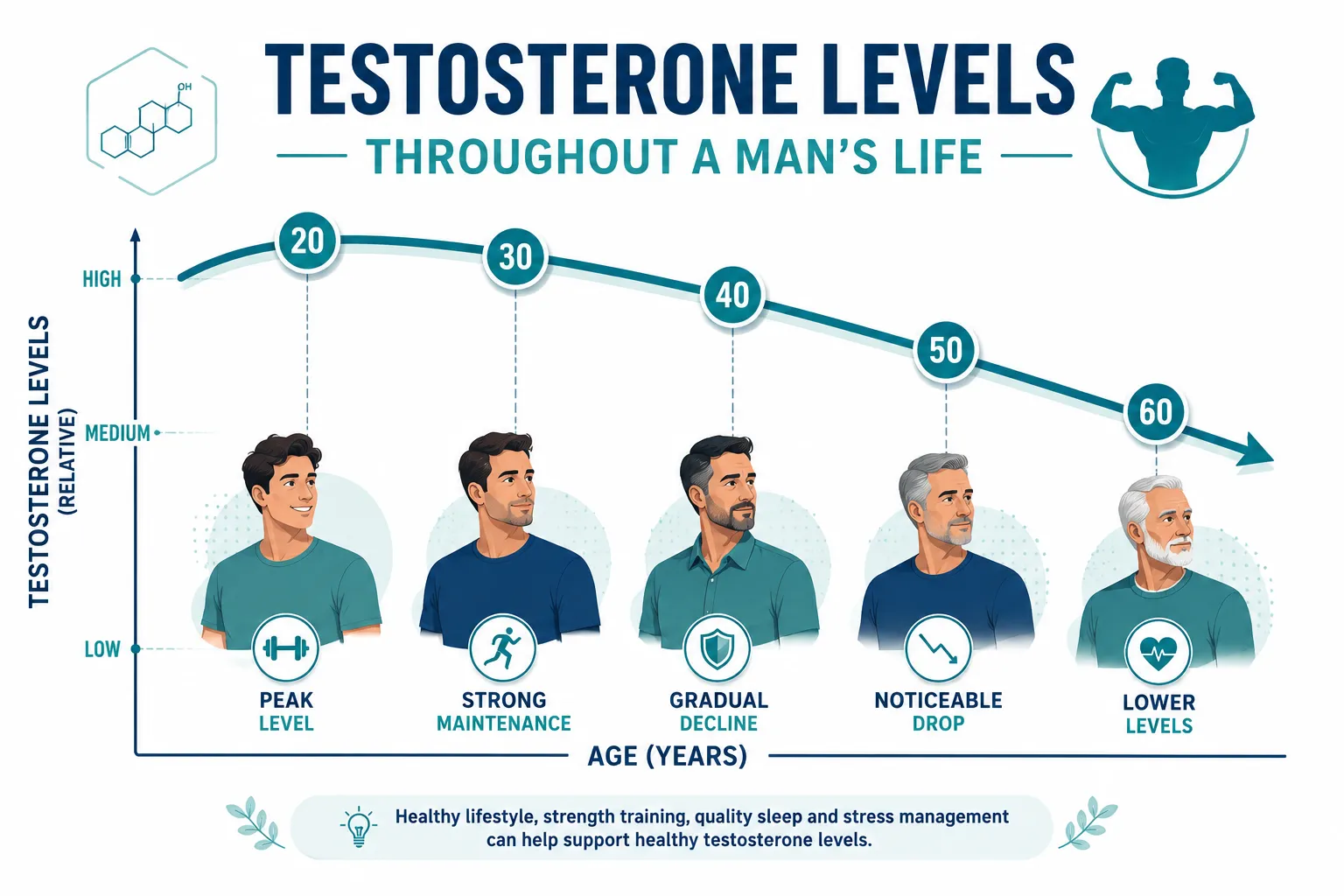
Testosterone does not drop off a cliff at a single age. Instead, it follows a gradual, predictable arc across the lifespan. Levels rise sharply during puberty, plateau in the early 20s, then begin a slow decline that continues for decades [3].
The key phases:
- Puberty to age 25: Rapid rise. Testosterone drives muscle development, bone density, voice changes, and sexual maturation.
- Ages 25-35: Levels stabilize near their peak, though a very gradual decline may begin in the late 20s.
- Ages 35-55: The clearest decline phase. Most men lose 1-2% of total testosterone per year during this window [3]. Free testosterone falls even faster because SHBG rises with age.
- Ages 55 and beyond: Decline continues, but the rate varies widely between individuals. Lifestyle, body composition, and chronic illness all accelerate or slow this process.
“The rate of decline matters as much as the absolute number. A man at 55 with 400 ng/dL who felt fine at 600 ng/dL two years ago may have more symptoms than a man who has been at 400 ng/dL for a decade.”
At What Age Do Testosterone Levels Start to Decline
Testosterone levels begin their measurable decline around age 30 in most men, though the drop is subtle at first. By the mid-30s, many men notice the early downstream effects, slower muscle recovery, slightly reduced libido, or mild fatigue, even when their numbers still fall within the “normal” range [3][8].
The term andropause is sometimes used to describe this gradual male hormonal shift, though it differs from female menopause in that it is slow, partial, and highly variable rather than a defined biological event.
Factors that accelerate early decline:
- Obesity (excess body fat converts testosterone to estrogen)
- Chronic stress and elevated cortisol
- Poor sleep quality or sleep apnea
- Sedentary lifestyle
- Heavy alcohol use
- Certain medications (see below)
Low Testosterone Symptoms in Different Age Groups
Low testosterone symptoms share common features across age groups, but their presentation shifts depending on when they occur. Recognizing the pattern for your decade matters for getting the right diagnosis.
Men in their 20s and 30s:
- Unexplained low libido or erectile dysfunction
- Difficulty building muscle despite consistent training
- Mood changes, depression, or poor concentration
- Low energy that does not improve with adequate sleep
If you are experiencing these symptoms alongside low drive, it may also be worth reviewing options like ED medication for married men or discreet online ED medication, since low testosterone and erectile dysfunction often overlap.
Men in their 40s and 50s:
- Reduced morning erections
- Increased body fat, especially around the abdomen
- Loss of bone density (often silent until a fracture)
- Hot flashes or night sweats (less common but documented)
- Reduced motivation and competitiveness
Men over 60:
- Significant muscle loss (sarcopenia)
- Cognitive fog or memory lapses
- Anemia
- Reduced physical stamina
A symptom alone does not confirm low testosterone. Lab testing is essential for a proper diagnosis [7].
Testosterone Levels by Age: Is Low Testosterone Normal Aging or a Medical Problem
Low testosterone sits in a gray zone between normal aging and a treatable condition. A reading below 300 ng/dL combined with multiple symptoms is generally considered clinically significant by major endocrinology guidelines [6][7]. A low number alone, without symptoms, may not require treatment.
Choose “watchful waiting” if:
- Your level is borderline (280-350 ng/dL) and you have few or no symptoms
- You are managing correctable factors like obesity, poor sleep, or high stress
- You are under 35 and a single test showed a low reading
Consider medical evaluation if:
- You have two separate morning tests below 300 ng/dL
- You have multiple symptoms affecting quality of life
- You are over 45 with levels consistently below 350 ng/dL and symptoms present
The distinction matters because TRT is not risk-free and should not be started casually. It can suppress the body’s own testosterone production and affect fertility [6].

How to Increase Testosterone Naturally at Different Ages
Natural strategies can meaningfully raise testosterone levels, especially in men whose low readings are driven by lifestyle factors rather than primary hypogonadism. The effectiveness of these approaches depends on age and baseline health.
For men under 40 with borderline levels:
- Prioritize sleep. Testosterone is primarily produced during deep sleep. Getting less than 6 hours per night can reduce levels by 10-15% [6].
- Resistance training. Compound lifts (squats, deadlifts, bench press) trigger acute testosterone spikes and support long-term hormonal health.
- Lose excess body fat. Adipose tissue contains aromatase, the enzyme that converts testosterone to estrogen. Reducing body fat directly raises free testosterone.
- Manage stress. Chronic cortisol elevation suppresses the hypothalamic-pituitary-gonadal (HPG) axis, reducing testosterone output.
- Limit alcohol. Even moderate drinking (3-4 drinks per day) can suppress testosterone production over time.
For men over 50:
The same strategies apply, but their impact may be more limited. At this stage, combining lifestyle changes with medical evaluation is often the most practical path. Supporting prostate health alongside testosterone management is also worth considering, see our guide to best prostate supplements that work.
Supplements with some evidence:
- Vitamin D (especially in deficient men)
- Zinc (in zinc-deficient men)
- Ashwagandha (modest effect in stressed men)
Note: No over-the-counter supplement reliably raises testosterone in men with normal micronutrient levels. Claims of dramatic boosts are not supported by clinical evidence.
Testosterone Replacement Therapy: Cost, Options, and What to Expect
TRT is a medically supervised treatment for clinically confirmed low testosterone. It is not a performance enhancement tool, and it requires a proper diagnosis before starting.
Common TRT delivery methods:
| Method | Typical Frequency | Estimated Monthly Cost (2026) |
|---|---|---|
| Testosterone injections (cypionate/enanthate) | Every 1-2 weeks | $30,$80 (generic) |
| Topical gels (AndroGel, generic) | Daily | $100,$300 |
| Transdermal patches | Daily | $150,$400 |
| Pellet implants | Every 3-6 months | $500,$1,000 per insertion |
| Buccal tablets | Twice daily | $200,$500 |
Cost estimates are approximate and vary by provider, insurance coverage, and whether brand-name or compounded formulations are used. Verify current pricing with your prescriber or pharmacy.
How long before you see results from TRT:
- Libido improvements: 3-6 weeks
- Mood and energy: 3-6 weeks
- Muscle mass changes: 3-6 months
- Bone density improvements: 6-12 months [10]
TRT is not a quick fix. Men who expect immediate dramatic changes often discontinue treatment before the full benefit appears.
If you are exploring treatment options, our review of the strongest alternatives to Viagra in 2026 covers related men’s health treatments, and our best ED medication after age 50 guide addresses the overlap between testosterone and sexual function.
Testosterone Levels in Women by Age
Women produce testosterone too, primarily in the ovaries and adrenal glands, though at much lower levels than men. Normal total testosterone in women ranges from approximately 15-70 ng/dL [5][9].
Age-related changes in women:
- Levels peak in the mid-20s
- Decline gradually through the 30s and 40s
- Drop more sharply around menopause, partly because ovarian production falls
- Postmenopausal women may have levels below 15 ng/dL
Low testosterone in women can contribute to reduced libido, fatigue, and decreased muscle tone, though these symptoms overlap significantly with other hormonal changes. Testing and treatment in women require specialist evaluation, as reference ranges and treatment protocols differ substantially from those used in men.
When Should You Get Your Testosterone Tested
Get tested if you have two or more symptoms of low testosterone that have persisted for at least three months and cannot be explained by another condition. A single symptom is rarely sufficient justification for testing.
Testing protocol that matters:
- Test in the morning (7-10 AM), when testosterone is at its daily peak
- Get two separate tests on different days before acting on a low result
- Ask for total testosterone, free testosterone, LH, FSH, and SHBG for a complete picture [2][7]
- Avoid testing when acutely ill, sleep-deprived, or under extreme stress, all of these temporarily suppress levels
A one-time low reading is not a diagnosis. Levels fluctuate by 20-30% within a single day [8].
Can You Have High Testosterone and Still Feel Tired
Yes. High testosterone does not guarantee high energy, and fatigue can coexist with normal or even elevated levels. Several factors explain this:
- Low free testosterone despite normal total testosterone. If SHBG is elevated, most testosterone is bound and inactive [2].
- Other hormonal imbalances. Thyroid dysfunction, cortisol dysregulation, and low DHEA can all cause fatigue independently of testosterone.
- Sleep disorders. Sleep apnea is common in men with high testosterone and obesity, and it causes profound fatigue.
- Iron deficiency or anemia. Often overlooked in men, but a real cause of low energy.
If your testosterone is normal but fatigue persists, a broader hormonal and metabolic panel is warranted before attributing the problem to testosterone.
Testosterone Levels for Athletes vs. Average Men
Athletes, particularly those in strength and power sports, often have testosterone levels at the higher end of the normal range, but they are not dramatically different from non-athletes in well-controlled studies. The difference is smaller than most people assume.
What the evidence shows:
- Resistance-trained men tend to have modestly higher baseline testosterone than sedentary men [6]
- Endurance athletes (especially those training at very high volumes) can have suppressed testosterone due to overtraining and caloric deficit
- Testosterone levels in elite athletes still fall within the standard reference range in most cases
The doping context: Synthetic anabolic steroids and exogenous testosterone push levels far above the physiological range, sometimes 5-10 times normal. This is categorically different from natural variation and carries serious health risks.
What Medications Can Lower Testosterone Levels
Several common medications are known to suppress testosterone production or increase its clearance. If your levels are low and you take any of the following, discuss this with your doctor before starting TRT.
Medications that commonly lower testosterone:
- Opioids (chronic use suppresses the HPG axis)
- Glucocorticoids (prednisone, dexamethasone)
- Antifungals (ketoconazole inhibits testosterone synthesis)
- GnRH agonists (used in prostate cancer treatment)
- Certain antidepressants and antipsychotics (via prolactin elevation)
- Statins (modest effect in some studies; evidence is mixed)
- Spironolactone (blocks androgen receptors)
This is not an exhaustive list. Always review your full medication list with a prescribing physician when evaluating low testosterone.

FAQ: Testosterone Levels by Age
What is a dangerously low testosterone level?
Most clinicians consider total testosterone below 200 ng/dL to be severely low and clinically significant in symptomatic men. Levels this low are associated with increased risk of bone loss, metabolic syndrome, and cardiovascular complications [7].
Can testosterone levels be too high naturally?
Yes, though rare without supplementation. Naturally elevated testosterone (above 1,000 ng/dL in men) may indicate a testicular or adrenal tumor and warrants investigation. In women, levels above 70 ng/dL can signal polycystic ovary syndrome (PCOS) or an adrenal disorder [5].
Does testosterone affect prostate health?
The relationship is complex. TRT does not appear to cause prostate cancer in men with normal prostates, but it is contraindicated in men with active or suspected prostate cancer. Men on TRT should have regular PSA monitoring [6].
Is a home testosterone test accurate?
At-home finger-prick tests can provide a useful screening result, but they are less reliable than a venous blood draw analyzed in a certified lab. Use them as a starting point, not a definitive diagnosis.
How does body weight affect testosterone?
Excess body fat, especially visceral fat, increases aromatase activity, which converts testosterone to estrogen. Losing even 10-15% of body weight can raise testosterone levels meaningfully in overweight men [3].
Can stress permanently lower testosterone?
Chronic stress raises cortisol, which suppresses testosterone production. This effect is largely reversible with stress reduction, but prolonged high cortisol, over years, may contribute to a persistently lower baseline.
What is the difference between total and free testosterone?
Total testosterone includes both bound and unbound hormone. Free testosterone (roughly 2-3% of total) is the biologically active fraction that enters cells and drives effects. In men with high SHBG, total testosterone can look normal while free testosterone is functionally low [2].
At what age should men start monitoring testosterone?
There is no universal guideline for routine screening in asymptomatic men. Most experts recommend testing only when symptoms are present. Men with risk factors (obesity, diabetes, chronic opioid use) may benefit from baseline testing in their 30s.
Does TRT affect fertility?
Yes. Exogenous testosterone suppresses the body’s own LH and FSH production, which reduces sperm production. Men who want to preserve fertility should discuss alternatives like clomiphene citrate with a reproductive endocrinologist [6].
How often should testosterone be retested during TRT?
Most protocols recommend retesting 3-6 months after starting TRT to confirm therapeutic levels, then annually once stable. More frequent testing may be needed if symptoms change or side effects emerge.
Conclusion
Testosterone levels by age follow a predictable pattern, peak in the early 20s, gradual decline from 30 onward, and a wider range of symptoms and health implications after 45. The most important takeaway is that a number alone does not tell the full story. Context matters: your age, symptoms, free testosterone, SHBG, and overall health all shape what a result means for you.
Actionable next steps:
- If you have symptoms of low testosterone, schedule a morning blood test and ask for a full panel (total testosterone, free testosterone, LH, FSH, SHBG).
- Before pursuing TRT, address correctable lifestyle factors, sleep, body weight, alcohol, and stress.
- If TRT is appropriate, work with a licensed provider to choose the right delivery method and monitor your response over at least 3-6 months.
- Do not self-diagnose or self-treat based on a single test result.
For men dealing with related concerns, our guides on men’s health topics and how to reduce prostate swelling naturally offer additional context for managing hormonal health as you age.
References
[1] 13685538.2024 – https://www.tandfonline.com/doi/full/10.1080/13685538.2024.2422379
[2] How To Interpret Free Testosterone – https://healthrx.com/labs-free-testosterone/how-to-interpret
[3] What Is A Normal Testosterone Level For Your Age – https://www.medichecks.com/blogs/testosterone/what-is-a-normal-testosterone-level-for-your-age
[4] Reference Ranges TGRP – https://www.incytediagnostics.com/assets/RefRangeFile/Reference-Ranges-TGRP.pdf
[5] Normal Testosterone Levels By Age Men And Women – https://scienceinsights.org/normal-testosterone-levels-by-age-men-and-women/
[6] PMC5460736 – https://pmc.ncbi.nlm.nih.gov/articles/PMC5460736/
[7] What Is The Normal Reference Range For Total Testosterone – https://www.droracle.ai/articles/1315261/what-is-the-normal-reference-range-for-total-testosterone
[8] Total Testosterone By Age Decade – https://healthrx.com/labs-v2-total-testosterone/by-age-decade
[9] Free Testosterone Levels By Age – https://www.everlywell.com/blog/testosterone/free-testosterone-levels-by-age/
[10] What Are Normal Testosterone Levels – https://balancemyhormones.co.uk/what-are-normal-testosterone-levels/