Enclomiphene

Last updated: August 10, 2026
Quick Answer
Enclomiphene is a selective estrogen receptor modulator (SERM) that stimulates the body’s own testosterone production by blocking estrogen feedback at the hypothalamus and pituitary gland. Unlike traditional testosterone replacement therapy, it raises testosterone levels while preserving sperm production and testicular function. As of 2026, enclomiphene has no FDA approval for any indication and is primarily available through compounding pharmacies or research chemical suppliers. [1][2]
Key Takeaways
- Enclomiphene is the trans-isomer of clomiphene citrate, considered cleaner and better tolerated than its parent compound
- It raises testosterone by stimulating LH and FSH release rather than replacing testosterone directly
- The FDA has not approved enclomiphene for hypogonadism or any other condition as of 2026 [2][5]
- It preserves fertility and sperm production, making it a strong alternative for men who want to maintain reproductive function
- Common dosing ranges from 12.5 mg to 25 mg daily, though protocols vary by prescriber [8]
- Side effects are generally milder than clomiphene, but visual disturbances, mood changes, and estrogen fluctuation are still possible
- It is available through compounding pharmacies with a valid prescription in most U.S. states
- Enclomiphene is not a dietary supplement, it is a pharmaceutical drug [1]
- Men with hormone-sensitive tumors, active liver disease, or certain genetic conditions should not use it
- Results on testosterone levels can appear within 2 to 4 weeks, with full effects seen around 8 to 12 weeks
What Is Enclomiphene and How Does It Work
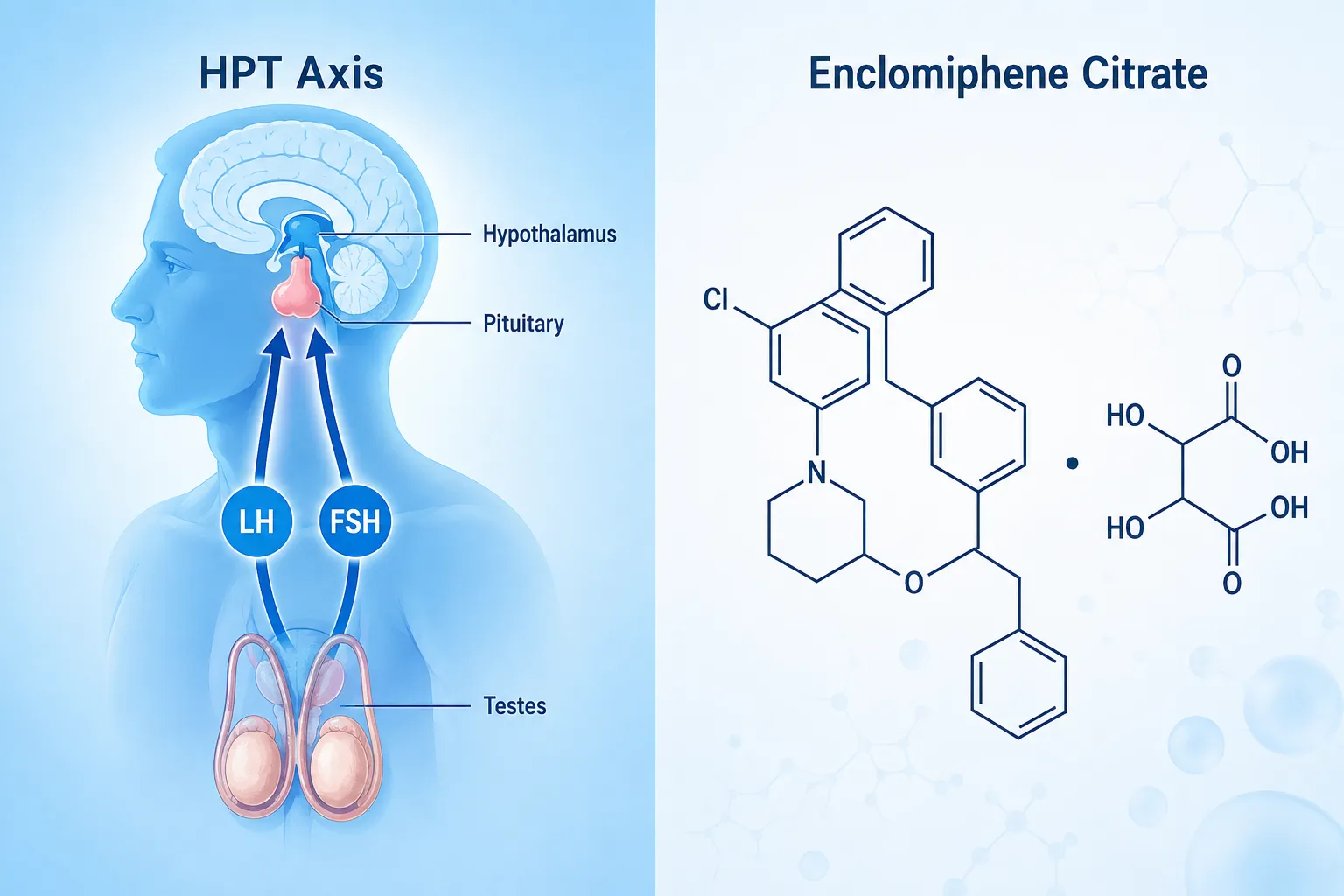
Enclomiphene is the trans-isomer of clomiphene citrate, a SERM that blocks estrogen receptors in the hypothalamus and pituitary gland to increase the release of gonadotropin-releasing hormone (GnRH), luteinizing hormone (LH), and follicle-stimulating hormone (FSH). This hormonal cascade signals the testes to produce more testosterone naturally. Because it works upstream in the hormonal axis rather than delivering testosterone directly, the testes remain active throughout treatment. [3][6]
How the mechanism breaks down:
- The hypothalamus normally detects estrogen and reduces GnRH output (negative feedback)
- Enclomiphene blocks estrogen receptors at that checkpoint, tricking the brain into thinking estrogen is low
- The pituitary responds by releasing more LH and FSH
- LH stimulates Leydig cells in the testes to produce testosterone
- FSH supports Sertoli cell function and sperm production
This is meaningfully different from injecting testosterone, which suppresses the entire hypothalamic-pituitary-testicular (HPT) axis. Men on traditional TRT often see LH and FSH drop to near zero, which shrinks testicular volume and halts sperm production. Enclomiphene avoids that problem entirely. [7]
Common mistake: Some men assume enclomiphene works like a testosterone booster supplement. It does not. It is a pharmaceutical compound that directly modulates hormone receptors, and it requires medical supervision. [1]
Enclomiphene vs Clomiphene Citrate: Key Differences
Enclomiphene is the active isomer of clomiphene citrate, and the two are not interchangeable. Clomiphene citrate is a 50/50 mix of two isomers: enclomiphene (trans) and zuclomiphene (cis). The zuclomiphene component has weak estrogenic activity and a much longer half-life, which is responsible for most of clomiphene’s side effects in men, including mood disturbances and visual symptoms. [3][6]
| Feature | Enclomiphene | Clomiphene Citrate |
|---|---|---|
| Composition | Single trans-isomer | 50/50 isomer mix |
| Half-life | Shorter (days) | Longer (weeks for zuclomiphene) |
| Estrogenic activity | Minimal | Moderate (from zuclomiphene) |
| Mood/visual side effects | Less common | More common |
| FDA approval | None (as of 2026) | Approved for female infertility only |
| Availability | Compounding pharmacies | Compounding + brand (Clomid) |
Choose enclomiphene if you want a cleaner hormonal signal with fewer estrogenic side effects. Choose clomiphene only if cost is the primary concern and your prescriber agrees, since it is cheaper and more widely available.
Enclomiphene for Testosterone Replacement Therapy
Enclomiphene is not a replacement for testosterone, it is an alternative approach to raising testosterone levels in men with secondary hypogonadism (where the problem originates in the brain’s signaling, not the testes themselves). For men whose testes can still produce testosterone when properly stimulated, enclomiphene can raise levels into the normal range without the drawbacks of exogenous testosterone. [7][9]
Clinical research has shown that enclomiphene can raise serum testosterone levels in men with secondary hypogonadism while maintaining or improving sperm parameters, an outcome that standard TRT cannot achieve. [3]
Who benefits most from this approach:
- Men with low testosterone due to secondary hypogonadism
- Men who want to preserve fertility while treating low T
- Men who want to avoid testicular atrophy associated with TRT
- Younger men (under 40) who may want children in the future
Who it will not help: Men with primary hypogonadism (damaged testes that cannot respond to LH stimulation) will not see meaningful testosterone increases from enclomiphene, because the problem is in the testes, not the signaling pathway.
If you are exploring broader men’s health options alongside hormonal support, reviewing a best online ED consultation and treatment program can help you understand what telehealth platforms currently offer for low testosterone and related concerns.
Enclomiphene Side Effects and Safety
Enclomiphene is generally better tolerated than clomiphene citrate, but it is not free of side effects. Because it modulates estrogen receptors, it can affect estrogen balance throughout the body, and individual responses vary. [6][9]
Most commonly reported side effects:
- Headaches (often mild and transient)
- Nausea, especially at higher doses
- Mood changes or irritability
- Visual disturbances (blurred vision, light sensitivity), rare but serious
- Hot flashes
- Elevated estrogen in some men (paradoxical effect)
- Acne or skin changes
Serious but rare concerns:
- Visual disturbances that do not resolve require immediate discontinuation and medical evaluation
- Thromboembolism risk (blood clots), a known class risk for SERMs
- Liver enzyme elevation with prolonged use
Safety edge case: Some men experience a rise in estradiol alongside rising testosterone. If estrogen climbs too high without adequate testosterone balance, symptoms like water retention, mood swings, or gynecomastia can emerge. Monitoring estradiol levels during treatment is standard practice in responsible clinical protocols. [7]
Men managing related conditions like erectile dysfunction alongside hormonal treatment may find it useful to compare options through a best telehealth ED medication program review.
Enclomiphene Dosage and How to Take It
Standard enclomiphene dosing ranges from 12.5 mg to 25 mg taken orally once daily. Most protocols start at 12.5 mg per day and adjust based on lab results at 4 to 6 weeks. Some prescribers use every-other-day dosing at 25 mg to reduce side effect burden. [8]
Typical dosing protocol:
- Start at 12.5 mg daily for 4 to 6 weeks
- Check serum testosterone, LH, FSH, and estradiol
- If testosterone response is insufficient and side effects are tolerable, increase to 25 mg daily
- Recheck labs at 8 to 12 weeks
- Adjust or maintain based on clinical response
How to take it: Enclomiphene is taken orally, typically in the morning with or without food. Consistency matters, taking it at the same time each day helps maintain stable hormone levels.
Common mistake: Taking higher doses assuming faster or better results. Doses above 25 mg daily do not appear to produce proportionally greater testosterone increases and significantly raise the risk of side effects. More is not better with SERMs. [8][9]
Is Enclomiphene Legal in the US
Enclomiphene is legal in the United States when prescribed by a licensed physician and dispensed by a licensed compounding pharmacy. It is not FDA-approved for any indication, which means it cannot be sold as a finished pharmaceutical product, but compounding pharmacies can legally prepare it for individual patients under a valid prescription. [1][2][5]
Key legal points:
- Enclomiphene is classified as a drug, not a dietary supplement [1]
- Selling it as a supplement or over-the-counter product is illegal under federal law
- Purchasing it without a prescription from online research chemical vendors exists in a legal gray area and carries significant risk
- The FDA has taken action against companies marketing enclomiphene as a supplement [1]
For athletes and military personnel: Enclomiphene is banned by the World Anti-Doping Agency (WADA) and the U.S. military’s drug testing programs. Using it without disclosure in competitive sports contexts can result in sanctions. [1]
Where Can I Buy Enclomiphene and What Does It Cost
Enclomiphene is available through compounding pharmacies with a valid prescription from a licensed physician. Telehealth men’s health platforms have made access more straightforward, as a physician can evaluate your labs online and send a prescription directly to a compounding pharmacy. [5][10]
Typical pricing (as of 2026, estimates based on available market data):
- Compounding pharmacy pricing: approximately $50 to $150 per month depending on dose and pharmacy
- Telehealth consultation fees: $50 to $200 for initial evaluation, often reduced for follow-ups
- Total monthly cost with ongoing monitoring: roughly $100 to $300 per month
Prices vary significantly by compounding pharmacy, geographic location, and whether the telehealth platform bundles lab work into the subscription. Always verify current pricing directly with your provider, as costs change.
Where not to buy it: Unregulated online vendors selling enclomiphene as a “research chemical” or supplement offer no quality assurance, no dosing verification, and no medical oversight. Purity and concentration in these products are unreliable. [1]
For men comparing telehealth options for hormonal and sexual health, a Direct Meds erectile dysfunction program review and a look at best Henry Meds alternatives can help identify platforms that also address testosterone concerns.
Enclomiphene for Fertility and Sperm Production
Enclomiphene is one of the few testosterone-raising treatments that actively supports rather than suppresses sperm production. By increasing FSH alongside LH, it stimulates both testosterone synthesis and spermatogenesis simultaneously. This makes it particularly valuable for men with low testosterone who also want to conceive. [3][7]
Research published in peer-reviewed literature has demonstrated that enclomiphene can improve sperm concentration and motility in men with secondary hypogonadism, in contrast to exogenous testosterone, which consistently suppresses sperm production and can cause azoospermia (zero sperm count) in some men. [3]
Practical guidance for men trying to conceive:
- Disclose fertility goals to your prescribing physician before starting any testosterone treatment
- Standard TRT (injections, gels, pellets) should generally be avoided if conception is a near-term goal
- Enclomiphene or clomiphene are the preferred pharmacological options in this scenario
- Allow at least 3 to 6 months of treatment before assessing fertility outcomes, as sperm take roughly 74 days to mature
Enclomiphene vs HCG for PCT
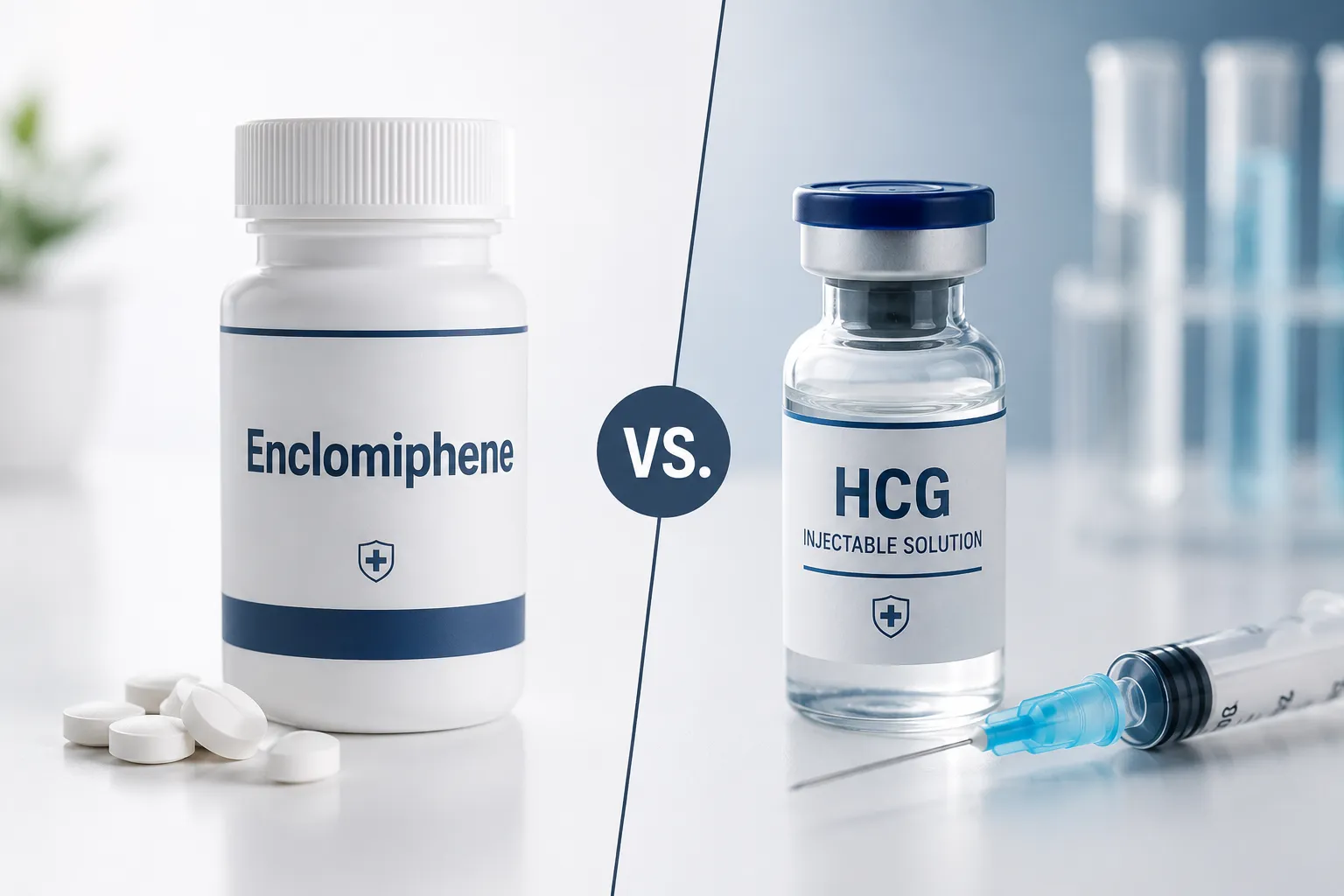
Both enclomiphene and human chorionic gonadotropin (HCG) are used in post-cycle therapy (PCT) after anabolic steroid use, but they work differently and are not equivalent. HCG mimics LH directly at the testes, stimulating testosterone production without engaging the HPT axis. Enclomiphene works higher up the chain, restoring the brain’s signaling to the testes. [9][10]
Side-by-side comparison:
| Factor | Enclomiphene | HCG |
|---|---|---|
| Mechanism | Blocks estrogen receptors at hypothalamus/pituitary | Mimics LH directly at testes |
| Route | Oral | Injectable |
| Restores HPT axis | Yes | No (bypasses it) |
| Raises FSH | Yes | No |
| Supports sperm production | Yes | Partially |
| Estrogen side effects | Possible | Possible (via aromatization) |
| Availability | Compounding pharmacy (Rx) | Compounding pharmacy (Rx) |
Choose enclomiphene for PCT if your goal is to fully restore the HPT axis and preserve long-term endogenous testosterone production. Choose HCG if you need rapid testicular stimulation during a cycle or immediately post-cycle before transitioning to a SERM.
Many experienced PCT protocols combine both: HCG first to restore testicular responsiveness, then enclomiphene to re-establish the HPT axis. Always work with a physician rather than self-directing PCT. [9]
Who Should Not Take Enclomiphene
Enclomiphene is not appropriate for everyone. Men with specific medical conditions or risk factors should avoid it or use it only under close medical supervision. [6][9]
Absolute contraindications:
- Hormone-sensitive tumors (prostate cancer, testicular cancer)
- Active liver disease or significantly elevated liver enzymes
- Known hypersensitivity to clomiphene or enclomiphene
- Primary hypogonadism (non-functional testes), it will not work and may cause side effects without benefit
Use with caution in:
- Men with a history of blood clots or thromboembolism
- Men with untreated thyroid or adrenal disorders (these must be ruled out before treating secondary hypogonadism)
- Men with depression or mood disorders, SERM-related mood changes can worsen pre-existing conditions
- Men with visual disorders, any visual side effect requires immediate discontinuation
Edge case: Men with high baseline estradiol levels may not be good candidates. If estrogen is already elevated, adding a SERM can create unpredictable estrogen receptor dynamics. A full hormone panel before starting is non-negotiable.
How Long Does Enclomiphene Take to Work
Most men see measurable changes in serum testosterone within 2 to 4 weeks of starting enclomiphene. Full effects on testosterone levels, energy, libido, and body composition typically take 8 to 12 weeks to become apparent. [7][10]
Timeline expectations:
- Weeks 1 to 2: LH and FSH begin to rise; testosterone starts increasing
- Weeks 3 to 4: First lab check typically shows testosterone response
- Weeks 6 to 8: Symptom improvements (energy, mood, libido) become noticeable for most men
- Weeks 10 to 12: Testosterone levels stabilize; full clinical assessment appropriate
Sperm improvements, when they occur, take longer, typically 3 to 6 months, reflecting the natural cycle of spermatogenesis.
Common mistake: Stopping treatment after 2 to 3 weeks because results feel slow. Hormonal systems respond gradually, and premature discontinuation prevents accurate assessment of whether the treatment is working.
Enclomiphene and Gynecomastia
Enclomiphene can both help and potentially worsen gynecomastia, depending on the context. As a SERM, it blocks estrogen receptors in breast tissue, which is the same mechanism used to treat gynecomastia pharmacologically. However, if enclomiphene raises testosterone significantly and some of that testosterone aromatizes to estradiol, estrogen levels can climb and potentially stimulate breast tissue growth in susceptible men. [6][9]
Practical guidance:
- Men with pre-existing gynecomastia should disclose this to their prescriber
- Monitoring estradiol during treatment is especially important in this group
- If estradiol rises significantly, dose adjustment or addition of an aromatase inhibitor may be warranted
- Enclomiphene alone is not a first-line treatment for established gynecomastia, it is a hormonal optimization tool

Common Mistakes When Using Enclomiphene
Several avoidable errors reduce the effectiveness of enclomiphene treatment or increase safety risks. Understanding these upfront saves time, money, and potential harm.
The most frequent mistakes:
Skipping baseline labs. Starting without knowing your baseline testosterone, LH, FSH, estradiol, and prolactin makes it impossible to assess response or catch contraindications.
Self-prescribing from unregulated sources. Purity and concentration in research chemical products are unverified. Dosing errors are common and can produce unpredictable hormonal effects. [1]
Using it for primary hypogonadism. If the testes cannot respond to LH stimulation, enclomiphene will not raise testosterone. A proper diagnosis is essential before prescribing.
Ignoring estradiol monitoring. Rising testosterone can increase estrogen through aromatization. Men who skip estradiol checks miss a key safety signal.
Expecting supplement-level results. Enclomiphene produces real, measurable hormonal changes. Treating it casually, inconsistent dosing, no monitoring, no physician oversight, undermines both safety and outcomes.
Combining with TRT without guidance. Adding enclomiphene to an existing TRT protocol without medical supervision creates unpredictable hormonal interactions.
Men interested in broader sexual health support alongside hormonal treatment may benefit from reviewing the strongest ED medication options for older men or exploring a best Cialis alternative online to understand what complementary treatments are available.
Frequently Asked Questions
Is enclomiphene the same as Clomid?
No. Clomid (clomiphene citrate) is a 50/50 mixture of two isomers. Enclomiphene is only the trans-isomer (the active component), without the zuclomiphene isomer that causes most of Clomid’s side effects in men. Enclomiphene is generally considered cleaner and better tolerated.
Can enclomiphene permanently raise testosterone?
Enclomiphene raises testosterone while you take it. If you stop, testosterone levels typically return to baseline within weeks. It does not permanently alter the HPT axis, though some men see sustained improvement if the underlying cause of low T was reversible (such as obesity or sleep apnea addressed during treatment).
Do I need a prescription for enclomiphene in the US?
Yes. Enclomiphene is a pharmaceutical drug, not a supplement. A valid prescription from a licensed physician is required to obtain it legally from a compounding pharmacy in the United States. [1][5]
Can enclomiphene cause infertility?
No, it typically improves fertility markers in men with secondary hypogonadism by raising FSH and supporting sperm production. This is the opposite of what exogenous testosterone does. [3]
Is enclomiphene safe for long-term use?
Long-term safety data beyond 12 to 24 months is limited as of 2026, because no large-scale, long-term clinical trials have been completed. Most clinical experience comes from shorter treatment windows. Regular monitoring is essential for anyone using it beyond 6 months. [9]
What happens if I miss a dose?
Take it as soon as you remember, unless it is nearly time for the next dose. Do not double up. Missing occasional doses will cause minor fluctuations in hormone levels but is unlikely to significantly affect overall outcomes.
Can enclomiphene help with erectile dysfunction?
Low testosterone is one contributor to erectile dysfunction, and raising testosterone through enclomiphene may improve sexual function in men whose ED is primarily hormone-related. However, ED has multiple causes, and enclomiphene is not a direct ED treatment. If ED persists despite improved testosterone, additional evaluation is warranted. For men exploring comprehensive ED care, reviewing a best ED medication for married men guide may offer relevant context.
Will enclomiphene show up on a drug test?
Yes. Enclomiphene is detectable and is banned by WADA and many sports organizations. Military personnel should be aware it may trigger a positive on DoD drug screening. [1]
How is enclomiphene different from testosterone gel or injections?
Testosterone gels and injections deliver testosterone exogenously, suppressing the HPT axis and halting natural production. Enclomiphene stimulates the body’s own production, preserving testicular function and fertility. The trade-off is that it only works when the HPT axis is intact and the testes are functional.
What labs should I get before starting enclomiphene?
At minimum: total testosterone, free testosterone, LH, FSH, estradiol, prolactin, complete metabolic panel (liver function), and a CBC. Thyroid function (TSH) is also worth checking to rule out thyroid-related causes of low T.
Conclusion
Enclomiphene offers a compelling alternative to traditional testosterone replacement for men with secondary hypogonadism, particularly those who want to maintain fertility or avoid the HPT axis suppression that comes with exogenous testosterone. It works by restoring the brain’s natural signaling to the testes rather than bypassing it.
The critical next steps are straightforward: get a full hormone panel, work with a licensed physician who has experience in men’s hormonal health, and obtain enclomiphene only through a legitimate compounding pharmacy with a valid prescription. Avoid unregulated sources entirely.
As of 2026, enclomiphene remains off-label and unapproved by the FDA, which means the quality of your medical oversight matters more, not less. Consistent lab monitoring, honest communication with your prescriber, and realistic timelines (8 to 12 weeks for full effect) are what separate successful outcomes from frustrating ones.
References
[1] Clomiphene And Enclomiphene Drugs Not Dietary Supplements – https://www.opss.org/article/clomiphene-and-enclomiphene-drugs-not-dietary-supplements
[2] Is Enclomiphene FDA Approved – https://www.hims.com/blog/is-enclomiphene-fda-approved
[3] PMC5009465 – https://pmc.ncbi.nlm.nih.gov/articles/PMC5009465/
[5] Is Enclomiphene FDA Approved – https://www.maximustribe.com/resources/is-enclomiphene-fda-approved
[6] What Is Enclomiphene – https://peptidedossier.com/guides/what-is-enclomiphene/
[7] Enclomiphene 2026 Hypogonadism Kisspeptin Practice Use – https://newtropin.com/blog/enclomiphene-2026-hypogonadism-kisspeptin-practice-use
[8] Enclomiphene Dosage Chart – https://glponerx.com/dosage-charts/enclomiphene-dosage-chart
[9] Enclomiphene Comprehensive Research Overview – https://dosingiq.com/research/enclomiphene-comprehensive-research-overview/
[10] Enclomiphene – https://superpower.com/guides/medications/enclomiphene