
Are Titanium Cutting Boards Safe
Last updated: July 29, 2026
Quick Answer: Yes, titanium cutting boards made from food-grade titanium are generally safe for food preparation. Titanium is chemically inert, non-reactive with acidic foods, and does not leach plastics, BPA, or phthalates. The main trade-off is that titanium’s hardness can dull knife edges faster than wood or plastic boards, so they are not the ideal choice for every kitchen.
Key Takeaways
- Food-grade titanium (typically Grade 1, approximately 99.8% pure titanium) is biocompatible and non-reactive, making it safe for direct food contact.
- Titanium cutting boards do not leach plastics, BPA, or chemical additives into food, which is a significant advantage over some plastic boards.
- Scratched titanium surfaces may shed trace metallic particles, but available evidence suggests this occurs at very low rates and poses minimal health risk compared to microplastics from plastic boards.
- Titanium is non-porous, meaning it does not absorb liquids, odors, or bacteria the way wood or grooved plastic boards can.
- The hardness of titanium can dull or chip high-carbon knife blades faster than softer board materials like wood or end-grain bamboo.
- Most titanium cutting boards are dishwasher-safe and resistant to rust, warping, and staining.
- The FDA does not directly approve cutting board materials, but titanium is treated as generally recognized as safe (GRAS) for food-contact applications.
- Titanium boards carry a higher upfront cost ($89 to $179 for quality options) but offer exceptional longevity.
- They are best suited for health-conscious cooks, professional kitchens, camping, and anyone avoiding microplastic contamination.
- Knife-sensitive cooks, budget shoppers, and those who prefer the tactile feel of wood may want to consider alternatives.
What Are Titanium Cutting Boards Made Of?
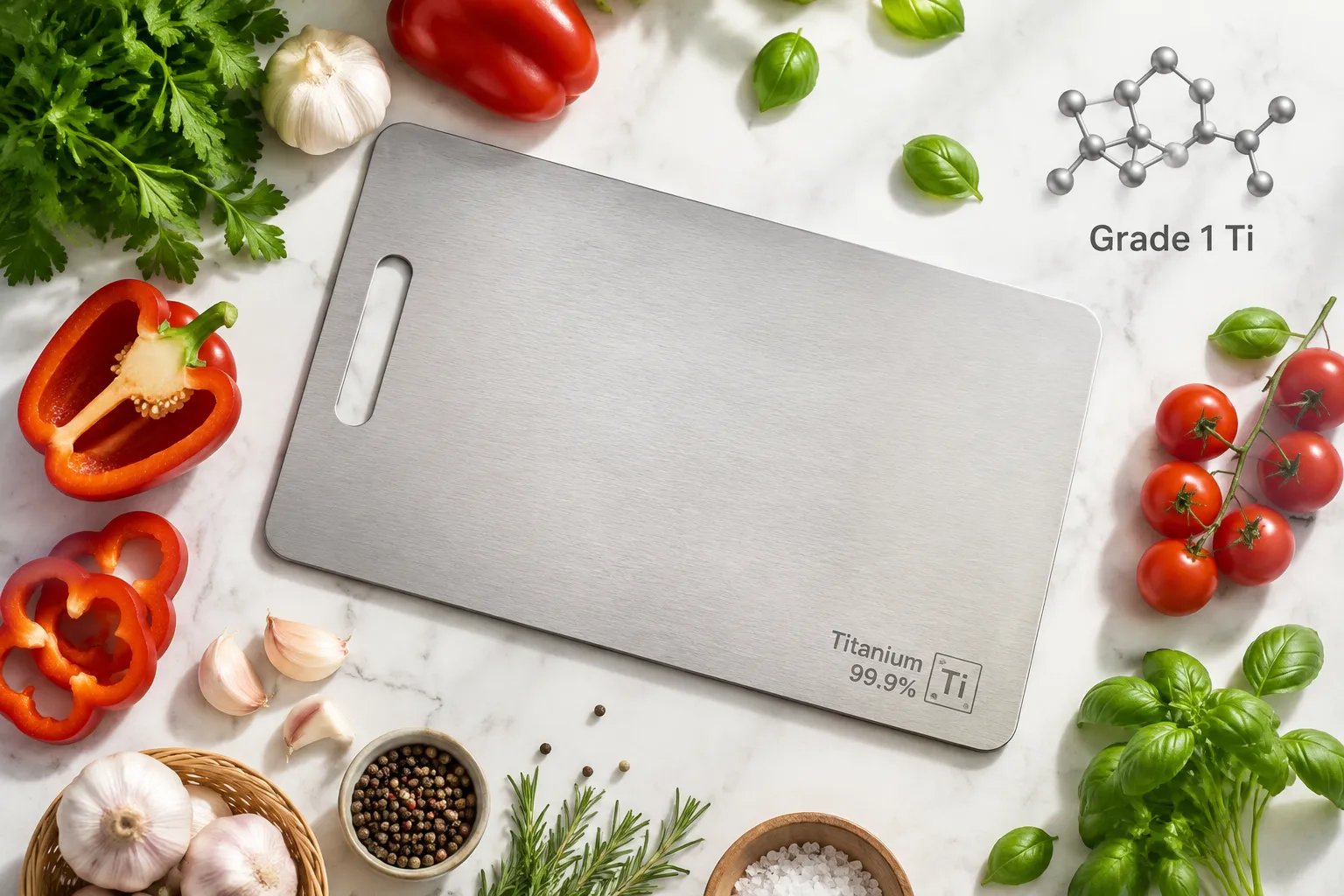
Titanium cutting boards are made from food-grade titanium, most commonly Grade 1 commercially pure titanium, which contains approximately 99.8% titanium with minimal trace elements. This is the same grade used in medical implants, surgical tools, and food-processing equipment, which speaks to its safety profile. [1][2]
Here is what that means in practical terms:
- Grade 1 titanium is the purest commercially available form, prized for its corrosion resistance and biocompatibility.
- The boards are typically 1.5 mm to 2 mm thick, which keeps them lightweight while maintaining structural rigidity.
- Surfaces are usually finished with a matte brushed texture to reduce glare and improve grip during food prep.
- Edges are rounded for safety during handling.
- Some boards include a hanging hole for storage and a non-slip silicone backing (though this varies by brand).
Unlike stainless steel, titanium does not contain nickel or chromium, which are common allergens in metal cookware. This makes titanium an especially good option for people with metal sensitivities. [7]
Are Titanium Cutting Boards Safe for Food?
Titanium cutting boards are safe for food contact. Titanium is biocompatible, meaning it does not react with human tissue or food compounds, and it has a long, well-documented history of safe use in medical and food-industry applications. [2][7]
Several specific safety points stand out:
- Non-reactive surface: Titanium does not react with acidic foods like tomatoes, citrus, or vinegar, which can cause leaching in some metals and degradation in plastics.
- No chemical additives: Unlike plastic boards, titanium boards contain no BPA, phthalates, or plasticizers that could migrate into food.
- FDA status: The FDA does not directly approve cutting board materials, but titanium is treated as GRAS (generally recognized as safe) for food-contact applications when properly manufactured. [2]
- Biocompatibility: The same material is used in bone screws, dental implants, and joint replacements, which reflects its safety at the material level.
One nuance worth noting: when a titanium surface is scratched over time, it can shed very small metallic particles. Available testing suggests these occur at extremely low rates and present minimal health risk, especially when compared to the volume of microplastics that plastic boards shed into food. [1][13]
Decision rule: If you are choosing a board primarily to avoid chemical contamination in food, titanium is a strong option. If you are concerned about any metal particle ingestion, pairing titanium with a sharp knife and proper technique minimizes surface scoring.
Do Titanium Cutting Boards Leach Chemicals?
No, titanium cutting boards do not leach chemicals into food. This is one of their most significant advantages over plastic boards. [1][2][8]
Plastic cutting boards, particularly older or heavily scored ones, are known to shed microplastics and may contain BPA or phthalates depending on their manufacturing. A 2023 study published in the journal Environmental Science & Technology estimated that plastic cutting boards shed billions of microplastic particles per year, though the long-term health implications are still being studied.
Titanium, by contrast:
- Contains no synthetic polymers or chemical additives.
- Does not degrade into microplastics.
- Does not rust or oxidize in ways that introduce harmful compounds into food.
- May release trace titanium particles when scratched, but these are considered biologically inert at the quantities involved. [1]
The key distinction here is between chemical leaching (which titanium does not do) and mechanical particle release (which any hard surface can do to a small degree). For health-conscious cooks, this makes titanium a meaningfully safer choice than many plastic alternatives. [9]
Are Titanium Cutting Boards Good for Raw Meat?
Titanium cutting boards are well-suited for raw meat preparation. Their non-porous surface does not absorb blood, juices, or bacteria, and they can be sanitized thoroughly without warping or cracking. [8]
Key advantages for raw meat use:
- No bacterial harboring: Wood boards develop micro-grooves over time where bacteria like Salmonella and E. coli can survive even after washing. Titanium’s non-porous surface eliminates this risk.
- Odor resistance: Raw meat and fish smells do not cling to titanium the way they do to wood or scored plastic.
- High-temperature sanitization: Titanium boards can withstand boiling water, alcohol wipes, and dishwasher cycles without degrading.
- No warping: Exposure to moisture from raw meat does not cause titanium to warp, unlike wood boards.
Several users who have reviewed titanium boards specifically highlight their performance with raw meat, noting that post-use cleanup is significantly faster and that there is no lingering smell after washing. [6][8]
Edge case: If you are cutting raw poultry and then immediately switching to ready-to-eat foods on the same board, the non-porous surface still requires proper washing between uses. No cutting board material eliminates the need for cross-contamination protocols.
For a detailed look at one popular titanium board’s real-world performance with meat prep, see our Katori Titanium Cutting Board reviews and complaints.
Can Titanium Cutting Boards Scratch Knives?
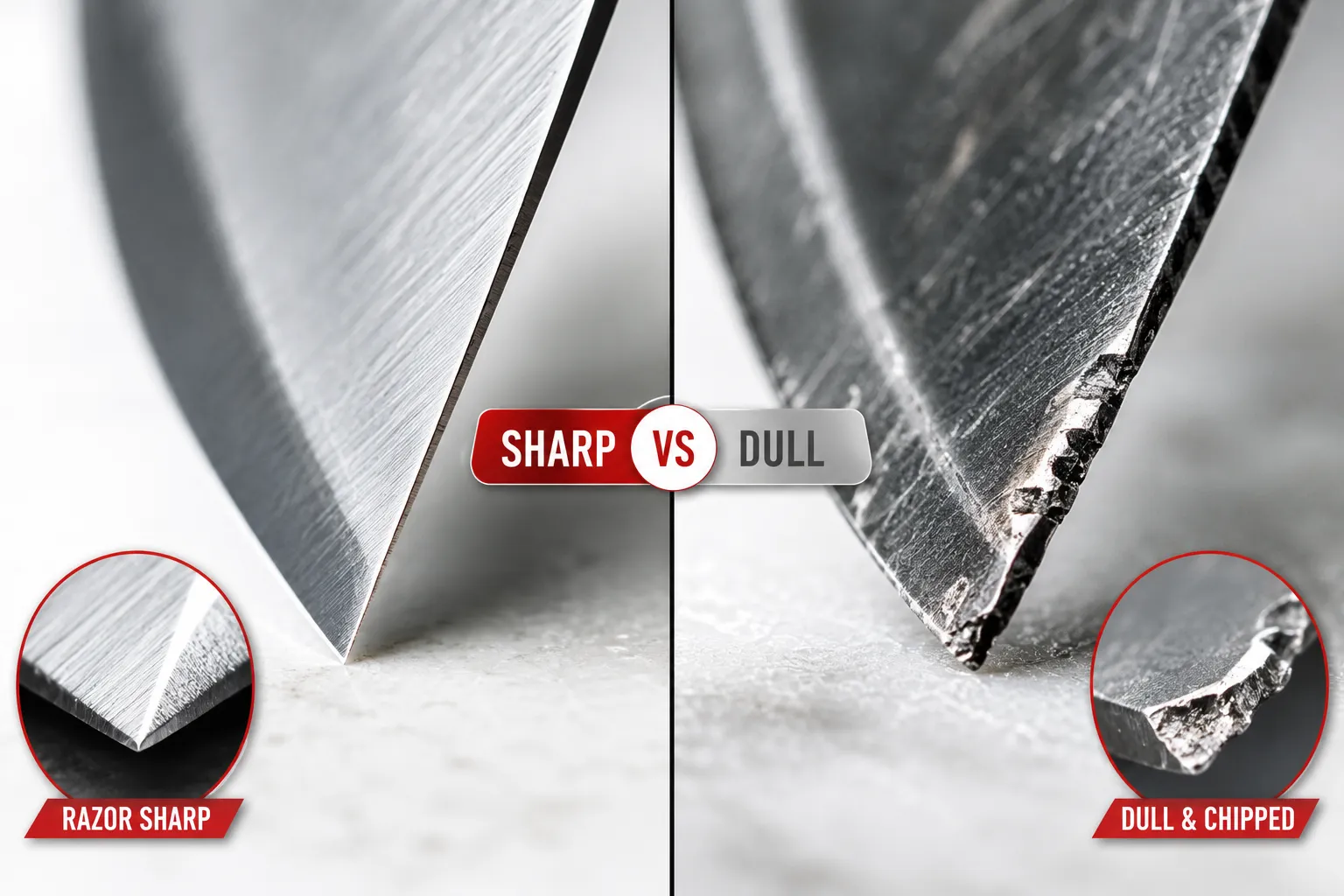
This is where titanium boards receive the most criticism, and the concern is legitimate. Titanium is significantly harder than wood, plastic, and bamboo, and that hardness can dull knife edges faster and even chip high-carbon blades. [5][6][10]
Here is the core issue:
- Hardness mismatch: A quality chef’s knife is typically made from steel with a Rockwell hardness of 56 to 65 HRC. Titanium’s surface hardness is comparable or harder depending on the grade, which means the knife edge bears the brunt of every cut.
- Edge wear: On softer surfaces like wood or end-grain bamboo, the board material gives slightly, preserving the knife edge. On titanium, the knife edge gives instead.
- High-carbon blades: Japanese knives with hardness above 60 HRC are especially vulnerable to chipping on hard surfaces.
Knife experts and experienced home cooks on forums consistently note that titanium (alongside glass, ceramic, and marble) is one of the worst surface choices for knife longevity. [5][6]
Manufacturer claims vs. reality: Some titanium board manufacturers claim their boards are “knife-friendly.” This claim is contested. While titanium may be softer than glass or ceramic, it is still considerably harder than wood and does not offer the same edge preservation. [10][12]
Choose titanium if: You sharpen your knives regularly and prioritize hygiene over knife longevity. Avoid titanium if: You own expensive Japanese knives and rarely sharpen them.
Titanium vs Plastic Cutting Boards: Which Is Safer?
Titanium is safer than plastic in the most meaningful ways for food health, though plastic boards are more knife-friendly and far cheaper. [1][9]
| Factor | Titanium | Plastic |
|---|---|---|
| Microplastic leaching | None | High (especially when scored) |
| BPA / phthalates | None | Possible (varies by type) |
| Bacterial harboring | Very low (non-porous) | High in scored grooves |
| Knife friendliness | Poor to moderate | Moderate |
| Durability | Excellent (decades) | Poor to moderate |
| Dishwasher-safe | Yes | Usually yes |
| Cost | $89 to $179 | $5 to $40 |
The safety advantage for titanium is clearest when it comes to long-term chemical exposure. A plastic board that has been in use for two years, with dozens of knife scores, is actively shedding microplastics into food with every cut. Titanium does not degrade in this way. [1][9]
Common mistake: Many people replace plastic boards only when they look visually worn. By that point, significant microplastic contamination has already occurred. Titanium eliminates this cycle entirely.
Titanium vs Ceramic Cutting Boards for Safety
Both titanium and ceramic cutting boards are non-porous and chemically inert, but they differ significantly in durability and knife impact. For most home cooks, titanium is the safer practical choice between the two.
- Chemical safety: Both materials are non-reactive and do not leach chemicals into food. Neither contains plastics or organic compounds that degrade over time.
- Durability: Titanium is far more durable. Ceramic boards are brittle and can crack or shatter if dropped, creating sharp fragments that pose a physical safety risk. Titanium will not crack or shatter under normal kitchen use.
- Knife impact: Both materials are hard on knife edges. Ceramic is generally considered worse than titanium for knives, as ceramic’s extreme hardness and brittleness can chip knife edges more aggressively. [5][10]
- Bacterial resistance: Both non-porous surfaces resist bacterial harboring effectively.
Choose titanium over ceramic if: You want a non-reactive, non-porous surface without the fragility risk of ceramic. Ceramic boards look attractive but the breakage risk makes them a poor long-term investment for active kitchens.
Titanium Cutting Board Durability: How Long Do They Last?
A quality titanium cutting board can last decades, and some manufacturers market them as a “buy once, use forever” product. This claim has real merit, though it comes with some qualifications. [7][8]
Titanium’s strength-to-weight ratio is exceptional. It is roughly twice as strong as steel at approximately half the weight, which means a 2 mm titanium board can handle heavy chopping, hot pots placed directly on the surface, and outdoor use without degrading. [7]
What to expect over time:
- Surface scratches: Titanium boards will develop light surface scratches with regular use. These are cosmetic and do not compromise food safety or structural integrity. [1]
- No warping: Unlike wood, titanium does not absorb moisture and will not warp, crack, or split.
- No staining: Titanium resists stains from beets, turmeric, and other pigmented foods that permanently mark plastic and wood.
- No rust: Unlike carbon steel or cast iron, titanium does not oxidize or rust even with repeated exposure to water and acidic foods.
Realistic lifespan: With normal care, a food-grade titanium board should last 20 or more years without any meaningful degradation in performance or safety. This makes the higher upfront cost more reasonable when calculated as cost per year of use.
How to Clean and Maintain a Titanium Cutting Board
Titanium cutting boards are among the easiest kitchen surfaces to clean. Their non-porous nature means food residue, bacteria, and odors do not penetrate the surface. [4][8]
Daily cleaning:
- Rinse with warm water immediately after use.
- Apply a small amount of dish soap and wipe with a soft sponge or cloth.
- Rinse thoroughly and either air-dry or hand-dry with a clean towel.
Deep cleaning and sanitization:
- Run through the dishwasher on a standard cycle. Titanium is dishwasher-safe and will not warp or corrode. [4][8]
- For extra sanitization, pour boiling water over the surface or wipe with a food-safe alcohol solution.
- Avoid steel wool or abrasive scrubbers, which can create unnecessary surface scoring.
Storage tips:
- Store upright to prevent scratching other surfaces and to allow air circulation.
- Use a non-slip silicone mat underneath during use to prevent the board from sliding on smooth countertops.
- Pairing with titanium or wooden utensils (rather than metal spatulas) can reduce surface scoring over time.
Common mistake: Some users run titanium boards through the dishwasher and then leave them wet inside the machine. While titanium will not rust, hand-drying immediately after the cycle gives a cleaner, spot-free finish.
Can You Use Titanium Cutting Boards in the Dishwasher?
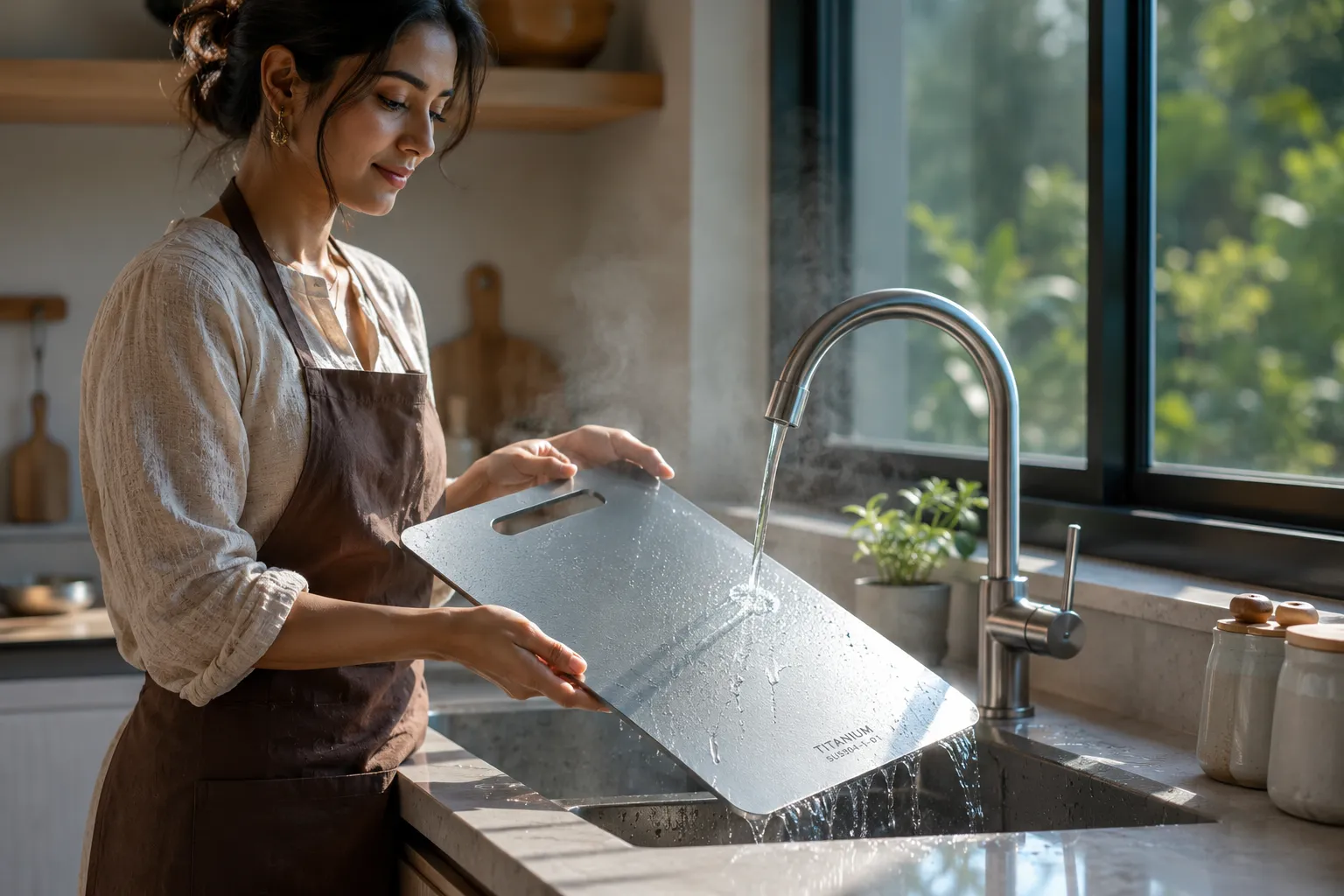
Yes, most titanium cutting boards are fully dishwasher-safe. This is one of their practical advantages over wood boards, which can crack and warp in dishwashers, and over some plastic boards that may degrade with repeated high-heat cycles. [4][8]
Titanium does not absorb water, does not expand or contract with heat, and does not contain adhesives or finishes that could break down in a dishwasher environment. Standard dishwasher detergents are also safe to use.
Best practice: Place the board flat or upright in the dishwasher rack, not wedged at an angle where water cannot circulate freely. After the cycle, remove promptly and hand-dry for a streak-free surface.
Titanium Cutting Board Price vs. Wood: Is It Worth It?
Titanium cutting boards cost significantly more upfront than wood boards, but the long-term value calculation is more favorable than the sticker price suggests.
- Titanium boards: Typically $89 to $179 for quality options like Katori or comparable brands.
- Quality wood boards (end-grain hardwood): Typically $50 to $150 for premium options.
- Budget plastic boards: $5 to $40.
Wood boards require regular oiling (every one to three months) to prevent cracking and warping, and they need replacement every few years with heavy use. A quality titanium board, by contrast, requires no conditioning and can last 20 or more years.
Cost-per-year comparison (rough estimate):
- A $120 titanium board over 20 years = $6 per year.
- A $60 wood board replaced every 3 to 5 years = $12 to $20 per year.
Beyond cost, wood boards carry hygiene trade-offs. They absorb liquids, develop knife grooves that harbor bacteria, and require more careful maintenance to stay food-safe. Titanium eliminates all of these concerns. [7][8]
Choose titanium if: You cook frequently, prioritize hygiene, and want to avoid ongoing maintenance costs. Choose wood if: You prefer a softer surface for your knives and enjoy the tactile and aesthetic qualities of natural materials.
Best Titanium Cutting Board Brands in 2026
Several brands have entered the titanium cutting board market, with varying levels of quality and transparency about their materials.
Katori: One of the most widely discussed titanium cutting boards in 2026, marketed as 100% pure titanium with a non-stick, antibacterial surface. It is available in multiple sizes and is sold through official channels. User reviews are generally positive, with an estimated satisfaction rating around 4.7 out of 5. For a thorough breakdown of real customer experiences, see our Katori Titanium Cutting Board reviews and complaints.
Taima: Positioned as a premium alternative with third-party lab verification of titanium purity. Taima boards include a non-slip backing as standard and carry a lifetime warranty with proof of purchase. They are priced at the higher end of the market.
Generic and camping-focused brands: Several manufacturers produce thinner titanium boards (around 1.5 mm) specifically for outdoor and camping use, where lightweight portability is the priority. These are widely available through home improvement retailers and online marketplaces. [4]
What to look for when buying:
- Confirmation of Grade 1 or food-grade titanium (not titanium-coated steel).
- A warranty covering material defects.
- Third-party lab testing if purity is a primary concern.
- Non-slip backing or the option to use a silicone mat.
Who Should Use Titanium Cutting Boards?
Titanium cutting boards are not the right choice for every kitchen, but they are an excellent fit for specific users and situations. [8][9][10]
Best suited for:
- Health-conscious cooks who want to eliminate microplastic and chemical contamination from food prep.
- Professional or high-volume kitchens that require frequent sanitization and durable, non-warping surfaces.
- Campers and outdoor cooks who need a lightweight, rust-proof, easy-to-clean surface.
- People with allergies to nickel or chromium (common in stainless steel cookware).
- Anyone who replaces plastic boards frequently and wants a long-term alternative.
Not ideal for:
- Collectors of high-end Japanese knives who rarely sharpen and want maximum edge preservation.
- Budget-conscious buyers who cannot justify the upfront cost.
- Cooks who prefer the warmth and aesthetic of natural wood in their kitchen.
- Anyone who finds the metallic chopping sound disruptive (a common complaint from users). [6]
Titanium Cutting Board Common Problems
Even well-designed products have drawbacks. Based on user feedback and material science, here are the most common problems reported with titanium cutting boards. [6][10]
- Knife dulling: The most consistent complaint. Titanium’s hardness accelerates edge wear on most knives.
- Slippery surface: Without a non-slip backing or silicone mat, titanium boards can slide on smooth countertops during use.
- Metallic chopping sound: The hard surface produces a louder, sharper sound than wood or plastic, which some users find unpleasant.
- Limited aesthetic options: Most titanium boards come in a single brushed silver finish. For cooks who want color or design variety, options are limited.
- Availability: Quality titanium boards are primarily sold through official brand websites or select online retailers, making in-store evaluation difficult.
- Surface scratches: While cosmetically minor and food-safe, visible scratches accumulate over time and bother some users aesthetically. [1]
Quick fix for the most common problem: If knife dulling is a concern, use a softer wood board for delicate knife work and reserve the titanium board for tasks where hygiene is the priority, such as raw meat prep.
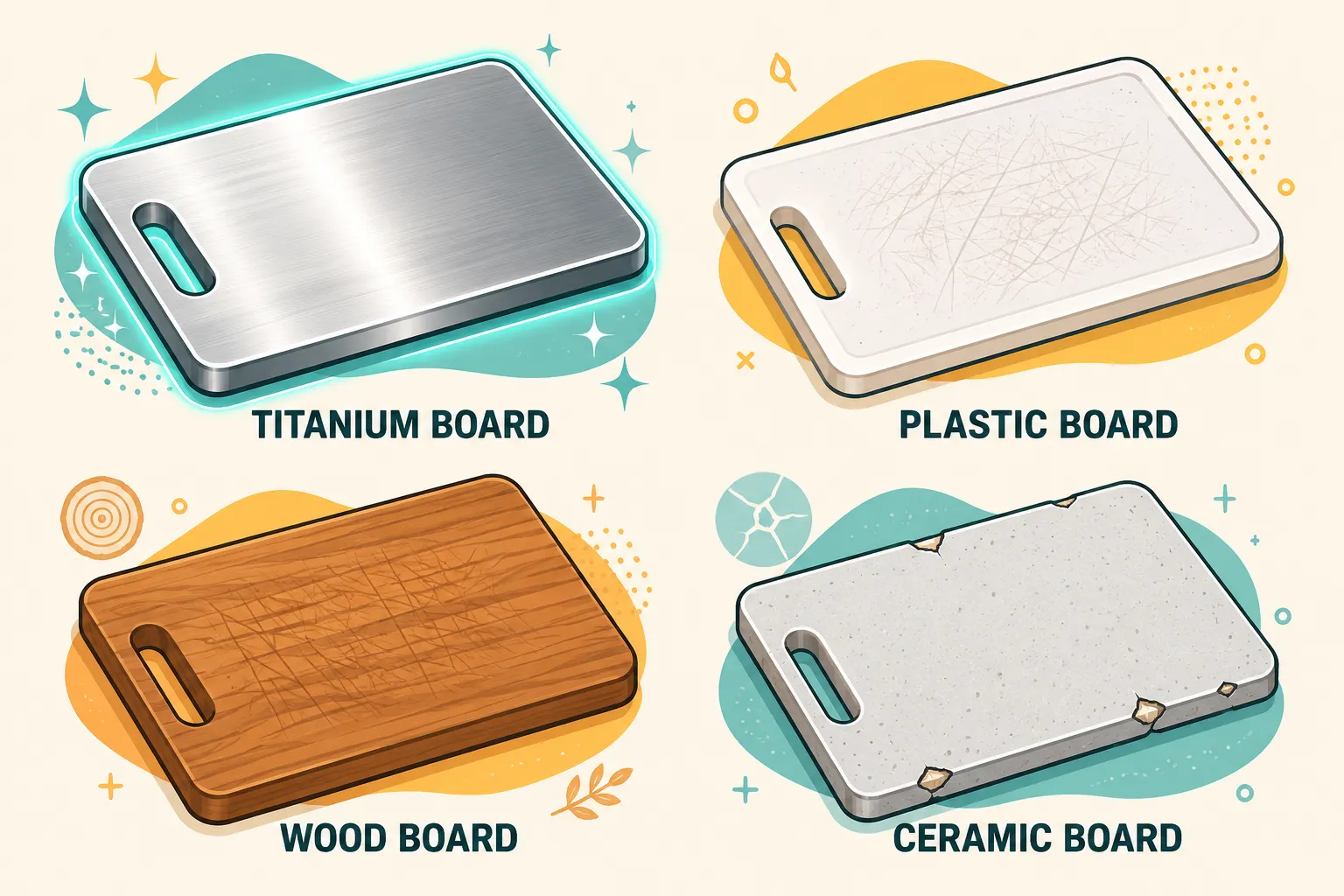
Key Takeaways Before You Decide
- Titanium cutting boards are chemically safe, non-porous, and free from microplastics and BPA.
- They are excellent for raw meat, high-frequency sanitization, and long-term durability.
- The main practical downside is their hardness, which accelerates knife edge wear.
- They cost more upfront but offer a better cost-per-year value than frequently replaced plastic or wood boards.
- Choose titanium if hygiene and longevity are your top priorities. Choose wood or end-grain bamboo if knife preservation is paramount.
Frequently Asked Questions
Is titanium safe for food prep?
Yes. Food-grade titanium is biocompatible, non-reactive, and does not leach chemicals into food. It is the same material used in surgical implants and food-processing equipment. [2][7]
Do titanium cutting boards dull knives?
Yes, more than wood or plastic. Titanium’s hardness causes faster edge wear on most kitchen knives, and can chip high-carbon blades. Regular sharpening mitigates this, but it remains a real trade-off. [5][6]
Can I put a titanium cutting board in the dishwasher?
Yes. Titanium is fully dishwasher-safe. It does not warp, rust, or degrade with repeated dishwasher cycles. Hand-drying after the cycle gives the best finish. [4][8]
How long does a titanium cutting board last?
With normal care, a quality titanium board should last 20 or more years. It will not warp, crack, stain, or rust. Surface scratches may appear over time but do not affect safety or function. [7][8]
Are titanium cutting board scratches dangerous?
Scratches on titanium boards may release trace metallic particles, but available evidence indicates these occur at very low rates and present minimal health risk compared to microplastics shed by plastic boards. [1]
Is titanium better than plastic for cutting boards?
For food safety, yes. Titanium does not shed microplastics, does not harbor bacteria in grooves, and does not contain BPA or phthalates. The trade-offs are higher cost and harder impact on knife edges. [1][9]
Can I use a titanium cutting board for raw chicken?
Yes. Titanium’s non-porous surface does not absorb raw poultry juices, and it can be sanitized with boiling water, alcohol, or a dishwasher cycle. Standard cross-contamination protocols still apply. [8]
Why does my titanium board make a loud noise when I chop?
The hard, non-porous surface amplifies the impact sound of chopping. This is normal and not a sign of a defect. Placing the board on a silicone mat reduces both noise and sliding. [6]
Are titanium cutting boards worth the price?
For frequent cooks who prioritize hygiene and want a board that lasts decades, yes. For occasional cooks on a tight budget, the upfront cost may not be justified compared to a quality wood board. [7][10]
Do titanium boards need oiling or conditioning?
No. Unlike wood boards, titanium requires no oiling, conditioning, or special treatment to maintain its surface or food safety properties. [8]
Is titanium the same as stainless steel in cutting boards?
No. Titanium and stainless steel are different metals. Titanium contains no nickel or chromium, is lighter, and is more corrosion-resistant than stainless steel. Stainless steel cutting boards exist but are a separate product category. [7]
What is the best titanium cutting board brand in 2026?
Katori and Taima are the most discussed brands in 2026. Taima offers third-party purity verification, while Katori offers strong value and availability. See our Katori Titanium Cutting Board reviews and complaints for a detailed comparison.
Conclusion: Are Titanium Cutting Boards Safe and Right for You?
The short answer is yes, titanium cutting boards are safe. The longer answer is that they are safe in the ways that matter most for food health, specifically freedom from microplastics, BPA, and bacterial harboring, while carrying a real trade-off in knife edge wear that every buyer should understand before purchasing.
For health-conscious cooks, families preparing raw meat frequently, or anyone who has been replacing scored plastic boards every year or two, titanium represents a meaningful upgrade. The non-porous, non-reactive surface addresses the most significant food safety concerns associated with conventional boards, and the durability means you are making a one-time investment rather than an ongoing expense.
For knife enthusiasts or those who prefer the natural feel of wood, titanium may not be the best daily driver. A practical middle ground is to use a titanium board specifically for raw meat and high-contamination tasks, while keeping a quality end-grain wood board for delicate knife work.
Actionable next steps:
- If you are currently using a scored plastic board that is more than two years old, consider replacing it. Titanium is one of the safest long-term alternatives.
- If you own expensive Japanese knives, test a titanium board with a beater knife first before committing to it as your primary surface.
- When purchasing, verify that the board is made from Grade 1 or food-grade titanium, not titanium-coated steel.
- Add a non-slip silicone mat to your order, as most boards perform better with one.
- Read real user experiences before buying. Our Katori Titanium Cutting Board reviews and complaints page covers the most common issues and genuine customer feedback to help you make an informed decision.
References
[1] Are Titanium Cutting Board Scratches Safe Safety Facts – https://everti.com.au/blogs/news/are-titanium-cutting-board-scratches-safe-safety-facts
[2] Are Titanium Cutting Boards Healthy – https://www.wisdomtitanium.com/knowledge/are-titanium-cutting-boards-healthy
[3] Are Titanium Cutting Boards Toxic – https://titaniumtrusted.com/are-titanium-cutting-boards-toxic/
[4] Titanium Chopping Board Lightweight Metal Cutting Board – https://www.diy.com/departments/titanium-chopping-board-lightweight-metal-cutting-board-for-kitchen-20cm30cm1-5mm-with-hanging-hole-for-outdoor-camping/5023944951820_BQ.prd
[5] Titanium Cutting Board Video Review – https://www.youtube.com/watch?v=s0zNPgJjImQ
[6] Anyone Here Tried A Titanium Cutting Board – https://www.reddit.com/r/kitchen/comments/1gil21j/anyone_here_tried_a_titanium_cutting_board/
[7] Titanium Cutting Board Pros Cons – https://hontitan.com/titanium-cutting-board-pros-cons/
[8] Is A Titanium Cutting Board Good – https://calmchop.com/is-a-titanium-cutting-board-good/
[9] Are Titanium Cutting Boards Good Full Guide Verdict – https://medium.com/mini-mind-blows/are-titanium-cutting-boards-good-full-guide-verdict-bfbeb41ad4d2
[10] Titanium Cutting Boards Are They Worth It For Everyday Cooking – https://vivront.com/blogs/news/titanium-cutting-boards-are-they-worth-it-for-everyday-cooking
Tags: titanium cutting board, are titanium cutting boards safe, food-grade titanium, cutting board safety, titanium vs plastic cutting board, microplastics in kitchen, best cutting board 2026, titanium cutting board review, non-toxic kitchen tools, cutting board hygiene, Katori cutting board, titanium cookware safety